
Smolnik: Nature Trail and Historic Wooden Church
Accommodation in Smolnik
The “Szkółki leśne w Smolniku” nature trail and the Church of St. Michael the Archangel offer two different themes to consider when planning your trip: forestry and wooden architecture. The history of the historic village adds a geographical perspective, placing it between Otryt and the San River.
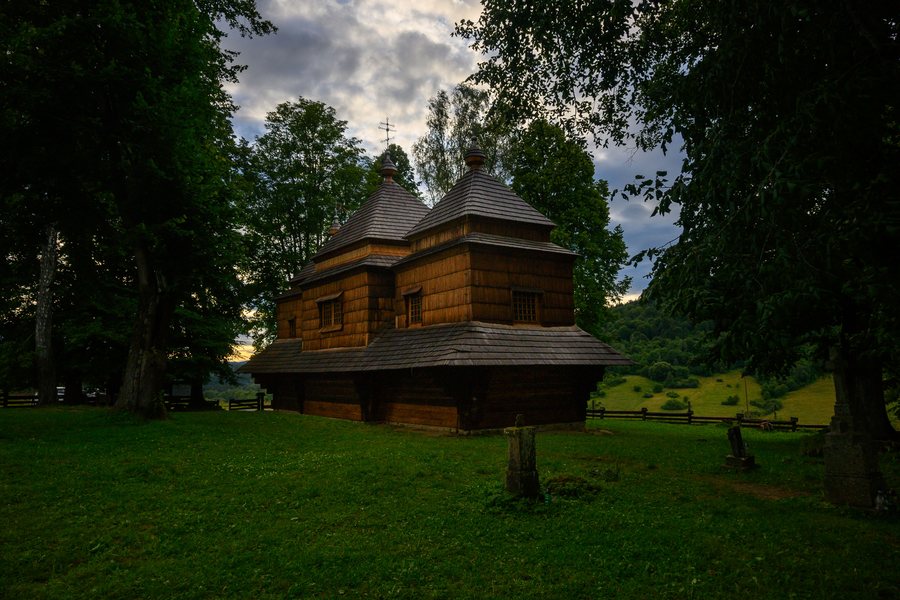 Smolnik, Cerkiew św. Michała Archanioła w Smolniku 01331.jpg
Photo: Daniel.zolopa via Wikimedia Commons, CC BY 4.0
Smolnik at a Glance
- The nature trail is 1.5 km long and has seven stops.
- It illustrates the production cycle for forest seedlings in open-air and understory nurseries.
- The Church of St. Michael the Archangel was built in 1791 and is a three-part log structure.
- A cemetery with several notable gravestones lies north of the church.
What can you learn on the nature trail?
The nature trail passes through the grounds of old forest nurseries. Its subject is the production cycle for forest seedlings, covering both open-air and understory nurseries. Comparing these two types is part of the trail’s content, placing the cultivation of forest plants at its heart. For anyone interested in forests not only as landscapes but also as managed places to live and work, this offers a specific focus.
The 1.5 km length and seven stops describe different aspects of the nature trail: the distance indicates the extent of the route, while the number of stops reflects its thematic structure. The route also passes through forest areas that were reshaped after the 1989 windthrow. Thus, alongside the forest nurseries, the trail also tells the story of a change in the forest. The historical reference to 1989 is part of the description of these areas.
Where was historic Smolnik located?
For several centuries, the historic village of Smolnik stood on a gentle ridge between the eastern end of Otryt and the San River. The ridge is the landscape feature that connects these elements in the description of the village: the two names locate the former settlement and make its setting more tangible than a simple place name would. This adds the history of the village in its landscape to the story of its individual buildings.
What makes the wooden church distinctive?
The Church of St. Michael the Archangel was built in 1791 on the site of an earlier place of worship. This earlier church is first mentioned in 1589 and was burned down by the Tatars. The dates refer to different building phases: 1589 to the mention of the earlier place of worship, and 1791 to the construction of the wooden church.
The building’s design can also be described through two features. The church is a three-part log structure, a type of wooden construction in which the walls are made of logs fitted one above another. Each of the three parts is topped with a ridged tent roof. The building’s sections and the repeated roof design go together: rather than a single roof covering the whole structure, each of its three sections has its own. A cemetery with several notable gravestones lies north of the church. It broadens the view from the church building to another point of interest in its surroundings.
Discover more destinations: Muczne, Krościenko, Ropienka, Polana, Brzegi Dolne, Tworylne, Teleśnica Oszwarowa, Procisne.
FAQ
How long is the nature trail in Smolnik?
The “Szkółki leśne w Smolniku” nature trail is 1.5 km long and has seven stops.
What topics does the nature trail cover?
It illustrates the production cycle for forest seedlings in open-air and understory nurseries, and also passes through forest areas reshaped after the 1989 windthrow.
How is the Church of St. Michael the Archangel built?
It is a three-part log structure. Each of its three parts is topped with a ridged tent roof.
For the broader travel overview: Bieszczady.

