
Brzegi Dolne: Church History and Cycling Route
Accommodation in Brzegi Dolne
Brzegi Dolne offers a clear cultural focus: its church history, a bell tower, and a memorial can be considered alongside a regional circular cycling route. When planning your trip, it is worth distinguishing the village’s history from the route through several places.
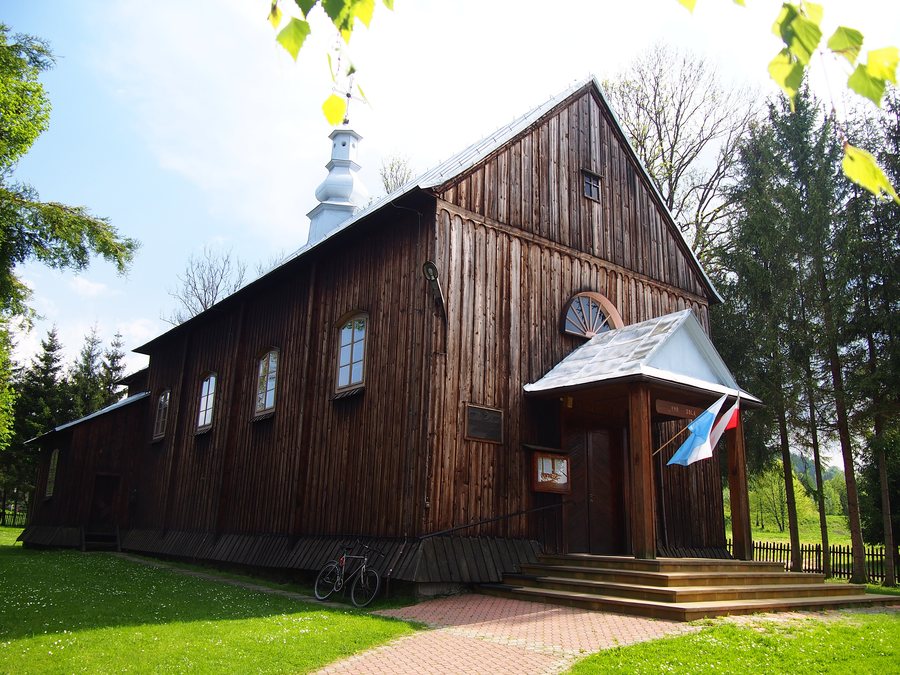 Kościół pw. Matki Bożej Różańcowej, dawniej cerkiew greko-katolicka Michała Archanioła, Brzegi Dolne
Photo: Karak67 via Source, CC BY-SA 4.0
Brzegi Dolne at a glance
The Roman Catholic filial church is dedicated to Our Lady of the Rosary. Beside it stands a brick, umbrella-shaped bell tower. A memorial plaque outside the church commemorates the forced resettlement of the Polish population to Ustrzyki County. The “Szlak Naftowy – Jak to z ropą drzewiej bywało” cycling route also passes through Brzegi Dolne.
What story does the church tell?
After the villagers were expelled in 1951, the church was first used as a fertilizer store and then as a building materials store. In 1973, Roman Catholic worshippers took over the church and converted it into a filial church. This sequence records several distinct chapters: the upheaval caused by the expulsion, the building’s temporary use as a store, and its later designation as a church. The filial church is dedicated to Our Lady of the Rosary.
In 2001, a memorial plaque was installed outside the church in Brzegi Dolne to mark the 50th anniversary of the forced resettlement. It commemorates the Polish population resettled to Ustrzyki County as part of Operation H-T. The memorial thus adds a specific connection to local remembrance culture to the history of the church building.
What details make the church distinctive?
The brick, umbrella-shaped bell tower stands beside the church and was built at the same time as it. Its contemporaneous construction is a distinctive architectural detail. The gravestone of Michał Zubryćki bears the inscription “Father of Ukrainian Ethnography.” Zubryćki was a local priest and a researcher of the Boiko region. The inscription brings his role in the church and his research on the region together in a concise, easily understood way.
How should the cycling route be understood?
The “Szlak Naftowy – Jak to z ropą drzewiej bywało” cycling route is described as a circular route. It runs from Ustrzyki Dolne through Brzegi Dolne, Łodyna, Leszczowate, Brelików, Ropienka, Serednica, and Dźwiniacz Dolny. Brzegi Dolne is therefore one section of a regional route, not the entire route. The cycling route is described as passing working oil pumps or horse-powered extraction equipment.
A 2017 opening report describes the circular route; it does not establish its current condition. If you are planning a ride, check the latest route information. The distinction is clear: the church and memorial plaque relate to the village’s history, while the cycling route covers several places and regional themes.
If you are considering Brzegi Dolne as a place to stay, weigh up whether your trip is mainly focused on the village’s historical sites or also includes the regional circular route.
Discover more destinations: Bukowiec, Lutowiska, Zatwarnica, Stuposiany, Ropienka, Dwernik, Muczne, Tworylne.
FAQ
Who is the filial church dedicated to?
It is dedicated to Our Lady of the Rosary. In 1973, Roman Catholic worshippers took it over and converted it into a filial church.
What does the memorial plaque commemorate?
It commemorates the forced resettlement of the Polish population to Ustrzyki County as part of Operation H-T. It was installed in 2001 to mark the 50th anniversary.
Which places does the circular cycling route cover?
The described route runs from Ustrzyki Dolne through Brzegi Dolne, Łodyna, Leszczowate, Brelików, Ropienka, Serednica, and Dźwiniacz Dolny. Check the latest route information before planning a ride.
Go to the main travel overview: Bieszczady.

