
Węglówka: Nature Trail, Oil History and Old Church
Accommodation in Węglówka
Węglówka combines local history with a nature and educational trail toward Królewska Góra. Those considering a stay here will find points of interest related to cultural history, nature and industrial history.
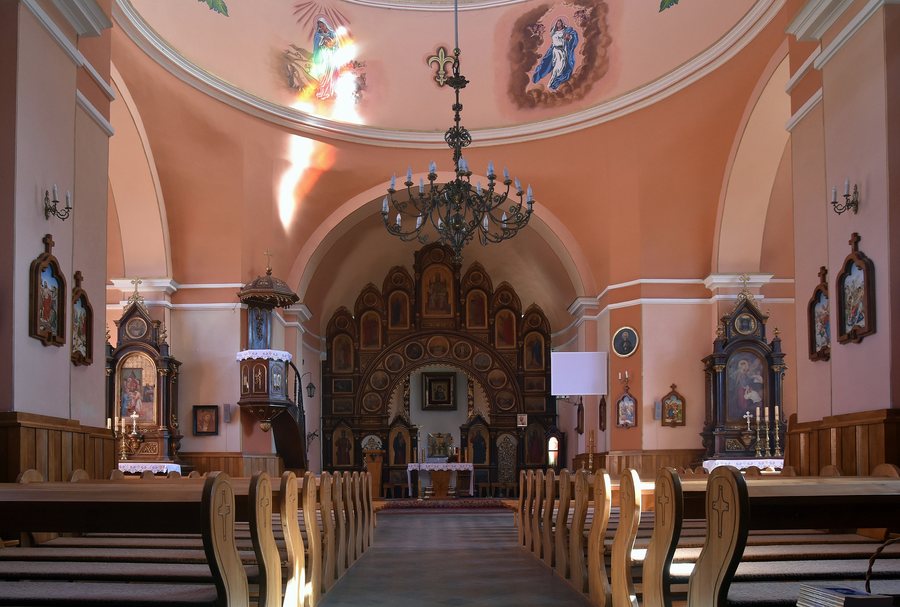 File:Węglówka, cerkiew Narodzenia Najświętszej Maryi Panny (HB8).jpg
Photo: Henryk Bielamowicz via Wikimedia Commons, CC BY-SA 4.0
File:Węglówka, cerkiew Narodzenia Najświętszej Maryi Panny (HB8).jpg
Photo: Henryk Bielamowicz via Wikimedia Commons, CC BY-SA 4.0
Węglówka at a glance
- The village was formerly called Waniwka in Rusyn.
- Węglówka was the seat of a Greek Catholic priest.
- The former Orthodox Church of the Nativity of the Blessed Virgin Mary was built around 1600.
- The “Do Sztolni” nature and educational trail leads from Węglówka toward the summit of Królewska Góra.
- At its four stations, visitors can see, among other things, amphibian habitats and sandstone adits.
What does the village’s history tell us?
Węglówka’s history encompasses several distinct themes. The former name Waniwka reflects the village’s Rusyn-language name. Węglówka was also the seat of a Greek Catholic priest. These details are part of the village’s history and complement one another, but each represents a separate aspect.
The former Orthodox Church of the Nativity of the Blessed Virgin Mary is also part of this historical picture. Its construction is dated to around 1600.
Several old gravestones have been preserved in the cemetery near the church. They are connected with the Rusyn origins of the village’s first residents, known as the Zamieszańcy. Anyone interested in the history of the first inhabitants can consider this connection alongside the traces left by the church as another part of the village’s history.
What traces of the oil industry can be found?
Węglówka has long been known for its oil springs. In the 18th century, the naturalist Balthazar Hacquet reported several springs in a marshy garden. According to his account, farmers used the oil to lubricate wagon axles. The historical account thus describes not only the presence of the resource, but also a specific historical use for it.
1888 is considered the founding year of Kopalnia Węglówka. This year should be distinguished from Hacquet’s account from the 18th century: it is the date regarded as the mine’s founding year, while Hacquet reported on the springs and their use.
What can you see on the nature and educational trail?
The “Do Sztolni” nature and educational trail, created by the Zespół Karpackich Parków Krajobrazowych, leads from Węglówka toward the summit of Królewska Góra.
At its four stations, visitors can see, among other things, amphibian habitats and sandstone adits. The adits date from the turn of the 19th and 20th centuries. The trail brings nature observation together with a historical trace: amphibian habitats and the older adits are distinct points of interest along the same educational trail.
When choosing activities to suit your interests, the distinction is clear: the cemetery, church and oil history offer insights into the village’s past; “Do Sztolni” adds habitats and sandstone adits to these themes. This allows you to decide in advance whether you would like to combine your stay with local history, nature or both.
Discover more destinations: Wrocanka, Korczyna, Rymanów, Krosno, Chyrowa, Królik Polski, Odrzykoń and Dukla.
FAQ
Where does the “Do Sztolni” nature and educational trail lead?
The trail leads from Węglówka toward the summit of Królewska Góra.
What can visitors see at the four stations?
The topics mentioned include amphibian habitats and sandstone adits dating from the turn of the 19th and 20th centuries.
What oil history is associated with Węglówka?
In the 18th century, Balthazar Hacquet reported several oil springs in a marshy garden, whose oil farmers used for wagon axles. 1888 is considered the founding year of Kopalnia Węglówka.
For the broader travel overview: Krośnieński.

.jpg)