
Wrocanka: the Jasiołka, churches and local history
Accommodation in Wrocanka
Wrocanka lies on the right bank of the Jasiołka and combines a distinct riverside setting with a layered history of churches and the village. Three topics offer a useful introduction: the building history of All Saints’ Church, the local veneration of Saint Rozalia, and historic places of remembrance in the surrounding area. This can help you decide whether you are most interested in architecture, religious tradition or commemorative history.
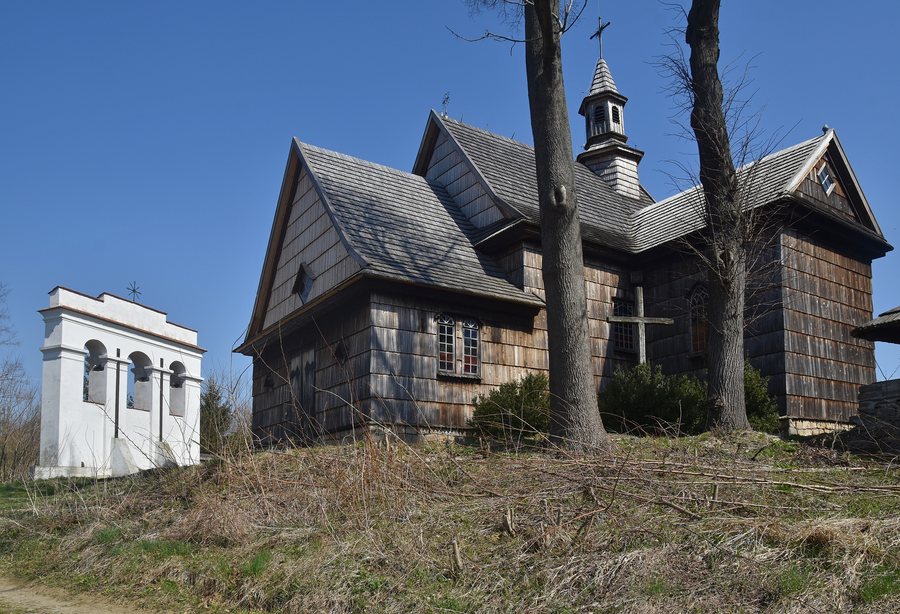 File:Wrocanka, kościół Wszystkich Świętych (HB3).jpg
Photo: Henryk Bielamowicz via Wikimedia Commons, CC BY-SA 4.0
Wrocanka at a glance
- Wrocanka covers 593 hectares and lies on the right bank of the Jasiołka.
- A church on the site of All Saints’ Church was first mentioned in 1487; the wooden church was built in 1770 beside a masonry sacristy dating from the 17th century.
- Saint Rozalia is regarded as the patron saint of Wrocanka. The parish church received relics of the saint in 1861.
- Several old houses and wayside shrines are among the village’s notable features.
What story does All Saints’ Church tell?
To understand the chronology, it is worth distinguishing between the older church site and the later wooden building. A church on the site of All Saints’ Church was first mentioned in 1487. The wooden All Saints’ Church was built in 1770. It adjoins a masonry sacristy dating from the 17th century, which was retained when the church was built. The dates therefore tell of several building phases: the sacristy predates the church, while the 1487 reference points further back to the church site.
The remarkable architecture of the wooden building is a reason in its own right to learn about the church. It also contains a depiction painted on wood of the adoration of the Mother of God by all the saints. The building style, the older sacristy and the artwork offer different ways to explore the village’s religious history. If you plan to visit the interior, it is best to check access in advance.
What role does Saint Rozalia play?
Saint Rozalia features in Wrocanka in several ways. She is regarded as the village’s patron saint, and the parish church received relics of the saint in 1861. Wrocanka is also home to a neo-Gothic chapel dedicated to Saint Rozalia. The “na łąkach” spring belongs to a different kind of tradition: according to local belief, the saint is credited with giving its water healing powers. This is a religious tradition, not a medical claim.
For travellers interested in religious culture, it is helpful to distinguish between these associations: patronage, relics, the chapel’s dedication and the story about the spring are different expressions of local tradition. Their shared connection to Rozalia brings them together without making their individual meanings interchangeable.
What historic places of remembrance are nearby?
Soldiers who fell in the Battle of Klarowiec were buried in a mass grave on a hill between Rogi and Wrocanka. During the interwar period, it was decided to rebury them in the cemetery in Rogi. The original burial and the later decision are two distinct stages in this history.
A wooden memorial cross was erected in 2005 at the former cemetery between Rogi and Wrocanka. PTTK Krosno and the Rogi Village Friends Association took part in the project. The cross came from the war cemetery in Łysa Góra. These details concern places in the surrounding area; they add a distinct historical focus to Wrocanka’s church and local history.
Which focus suits your interests?
If you choose cultural attractions mainly for their architectural history, All Saints’ Church and its different historical phases offer a clear point of entry. The connections to Rozalia, by contrast, shed light on religious traditions, from the local patron saint to the story about the spring. Those interested in the history of war and remembrance can consider the burial site between Rogi and Wrocanka and the former cemetery as separate places in the surrounding area. This allows you to approach Wrocanka from an architectural, religious or historical perspective, without conflating the places or their stories.
Discover more destinations: Chyrowa, Jedlicze, Krosno, Odrzykoń, Rymanów, Królik Polski, Moderówka and Dukla.
FAQ
What does the date 1487 mean for All Saints’ Church?
A church on the site of All Saints’ Church was first mentioned in 1487. The wooden church was built in 1770, so the earlier date refers to the older church site.
What is the water of the “na łąkach” spring believed to do?
According to local tradition, Saint Rozalia is credited with giving the water healing powers. This is a religious belief, not a medical claim.
Which places of remembrance are associated with the area around Wrocanka?
Soldiers who fell in the Battle of Klarowiec were buried on a hill between Rogi and Wrocanka; later, it was decided to rebury them in the cemetery in Rogi. A wooden memorial cross was erected in 2005 at the former cemetery between the villages.
For the broader travel overview: Krośnieński.

