
Discover Jedlicze: Church, History and Chlebianka
Accommodation in Jedlicze
Jedlicze brings together a layered church history, a historic parish cemetery, and the Chlebianka Reservoir. If you are choosing a place to stay based on your cultural and landscape interests, the following sites offer concrete pointers for planning your trip.
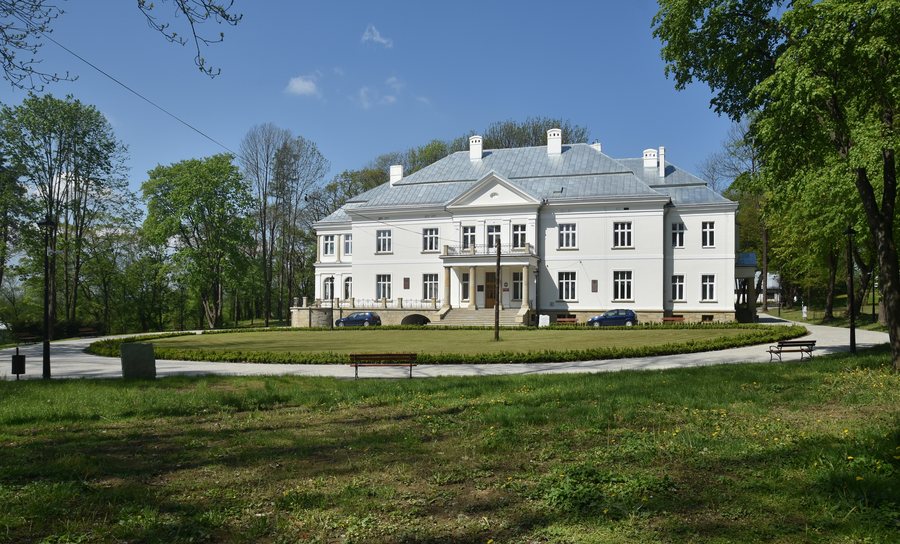 File:Jedlicze, pałac Stawiarskich (HB1).jpg
Photo: Henryk Bielamowicz via Wikimedia Commons, CC BY-SA 4.0
File:Jedlicze, pałac Stawiarskich (HB1).jpg
Photo: Henryk Bielamowicz via Wikimedia Commons, CC BY-SA 4.0
Jedlicze at a glance
The town’s history includes the parish church of St. Anthony of Padua and a cemetery with graves from different historical contexts. Construction of the present-day church began in 1911; its floor plan is shaped like a Latin cross, and its towers are 65 meters high. The parish cemetery contains the graves of two of Maria Konopnicka’s daughters and a mass grave for 22 unnamed patriots. The Chlebianka Reservoir is known for several large fish species.
What does the parish church reveal about Jedlicze’s architectural history?
The present-day parish church of St. Anthony of Padua was begun to a design by architect Jan Sas-Zubrzycki. Construction started in 1911. Built of brick and dressed stone, the church is in the Neo-Romanesque style; its floor plan is shaped like a Latin cross. At 65 meters tall, the towers are a striking feature of the building. Taken together, the design, architectural style, and floor plan offer a concrete sense of how the present-day church can be understood architecturally.
The building’s history stretches further back: from 1598, a wooden church in the Vistula Gothic style stood on the site of the present-day parish church building; it burned down in 1712. After the fire, Remigiusz Wielowiejski had another wooden church built; it was dismantled in 1931. The dates and different architectural forms reveal several historical layers, which should not be confused with the construction start of the present-day church.
What history does the parish cemetery preserve?
Laura Pytlińska and Zofia Mickiewiczowa, the daughters of Maria Konopnicka, are buried in the parish cemetery. Another grave is a mass grave for 22 unnamed patriots. They were shot by Germans in February 1943. The two burial sites represent different aspects of local history: a family connection to a well-known writer and a memorial to the victims of an execution during the Second World War.
If you choose cultural sites based on their historical connections, this information offers a useful guide to what the cemetery preserves. The names Laura Pytlińska and Zofia Mickiewiczowa can be identified specifically, as can the number of people in the mass grave and the historical context.
What is known about the Chlebianka Reservoir?
The Chlebianka Reservoir is known for large catfish, zander, carp, and grass carp. This list of species highlights a different aspect of Jedlicze from its church and cemetery history: here, the focus is on the fish fauna of a local body of water. If you are interested in different facets of a destination, you can consider this nature-related information alongside the historic sites. It provides a concrete point of reference about the reservoir, without making claims about specific activities or the conditions for them.
How do history and the park complement each other?
The Pałac Stawiarskich in Jedlicze has a park. This adds another historic site with associated green space to the townscape, alongside the parish church and cemetery. The combination of building and park can be considered a distinct theme when exploring Jedlicze. This does not imply anything about the palace’s current use.
Discover more destinations: Chyrowa, Korczyna, Bóbrka, Węglówka, Krościenko Wyżne, Królik Polski, Krasna, Krosno.
FAQ
What are the distinctive features of the present-day parish church?
Construction of the Church of St. Anthony of Padua began in 1911, based on a design by Jan Sas-Zubrzycki. It is Neo-Romanesque, built of brick and dressed stone, has a Latin cross-shaped floor plan, and towers that are 65 meters high.
Which historic graves are located in the parish cemetery?
Maria Konopnicka’s daughters, Laura Pytlińska and Zofia Mickiewiczowa, are buried there. There is also a mass grave for 22 unnamed patriots who were shot by Germans in February 1943.
Which fish species is the Chlebianka Reservoir known for?
Large catfish, zander, carp, and grass carp are mentioned.
Go to the main travel overview: Krośnieński.

.jpg)