
Lesko: Art, History and San Panorama
Accommodation in Lesko
Lesko combines its location on the San with sweeping landscape views and places of art and culture. When planning a trip, it is worth distinguishing between cultural and landscape attractions in Lesko and other routes and natural attractions in the wider Leski destination.
Lesko at a glance
- Within the wider Leski destination, Lesko lies on the banks of the San, on the slope of Baszta.
- The Wzgórze Baszta viewpoint is located at an altitude of 421 m on the right bank of the San.
- From the hills around Lesko, the view stretches across the San Valley and the Gór Słonnych Landscape Park as far as Smerek and Połonina Wetlińska.
- Lesko is a tourist centre of the Bieszczady region.
What makes Lesko’s location and views distinctive?
For orientation, there is both a specifically named viewpoint and a far-reaching landscape panorama. Wzgórze Baszta is precisely located at an altitude of 421 m on the right bank of the San. By contrast, the panorama from the surrounding hills opens up views across the San Valley and the Gór Słonnych Landscape Park as far as Smerek and Połonina Wetlińska. Lesko thus combines a clear sense of place with views encompassing several named landscape areas.
What cultural history can you find in Lesko?
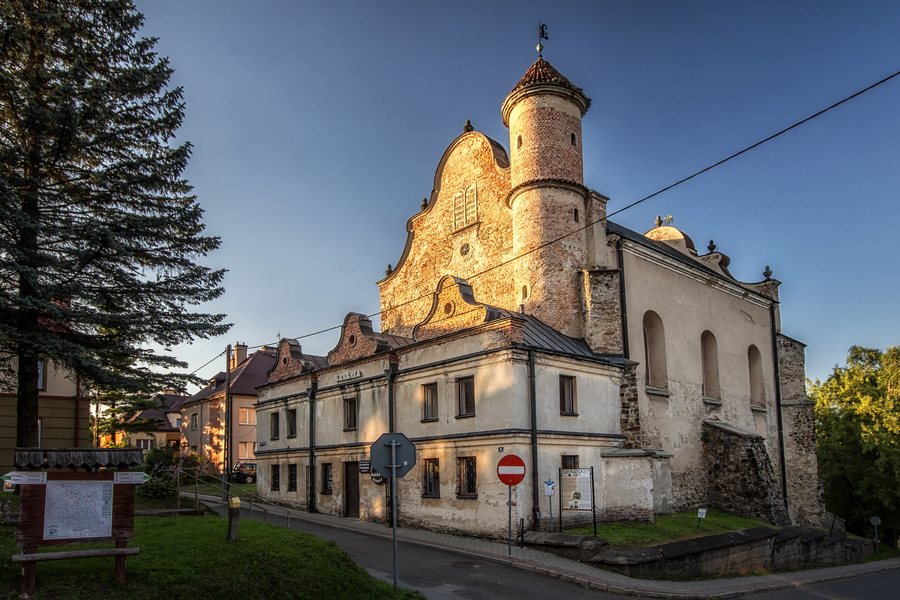
The Bieszczadzka Galeria Sztuki „Synagoga“ (Bieszczady Art Gallery “Synagogue”) presents works by local artists in the historic building of the former synagogue. Local art and the history of the building give this cultural venue distinct facets.
The Jewish cemetery in Lesko is part of the city’s Jewish heritage. It is one of the oldest Jewish cemeteries in Poland, dates from the turn of the 16th and 17th centuries, and has well-preserved matzevot. The gallery and cemetery therefore offer different points of focus: contemporary local art on the one hand, and the history of the Jewish cemetery on the other.
What architectural history does the wider Leski destination offer?
The wider Leski destination also provides a context for Lesko’s architectural history. Kmita Castle was built in the 16th century on a high escarpment above the San. The Church of the Visitation of the Blessed Virgin Mary dates from around 1530. It was built from rubble stone on a ground plan in the shape of a Latin cross. The synagogue was built between 1626 and 1654 in the Mannerist-Baroque style, using river pebbles, dressed stone and bricks.
The dates range from the church, built around 1530, to the 16th-century castle and the 17th-century synagogue. The Muzeum Żydów Galicji (Museum of the Jews of Galicia) and the Galeria Bieszczadzkiej Grupy Twórców (Bieszczady Artists’ Group Gallery) are also located in the former synagogue in Lesko.
What nature and cycling experiences are available in the wider Leski destination?
The garden in Lesko preserves remnants of an earlier woodland in its ravines and on its slopes. These include impressive pedunculate oaks, large-leaved lime trees and elms, some several hundred years old. In the wider Leski destination, Kamień Leski is also one of the region’s notable natural attractions; it is particularly popular with climbers. The woodland and climbing thus offer different nature experiences alongside the sweeping landscape views.
From Lesko, you can set out on a 54 km cycling tour around the Góry Słonne mountain range. The Lesko municipality also has off-road cycling trails in the “Extreme – Bieszczady” series, which run along forest and field tracks. The cycling tour is described by its total distance, while the off-road trails are characterised by their routes along forest and field tracks. Check local route conditions before setting out.
Discover other destinations: Wola Postołowa, Kalnica, Uherce Mineralne, Manasterzec, Rabe, Hoczew, Roztoki Dolne and Bóbrka.
FAQ
Where is the Wzgórze Baszta viewpoint?
It is located at an altitude of 421 m on the right bank of the San in Lesko.
What does the Bieszczadzka Galeria Sztuki „Synagoga“ show?
It presents works by local artists in the historic building of the former synagogue.
Which cycling tour starts in Lesko?
From Lesko, you can set out on a 54 km cycling tour around the Góry Słonne mountain range.
When was the synagogue in Lesko built?
In the wider Leski destination, the synagogue was built between 1626 and 1654 in the Mannerist-Baroque style.
Go to the overview of the wider destination: Leski.

