
Discover Ruda Maleniecka
Accommodation in Ruda Maleniecka
Hiking trails, tree studies and local fishing history give Ruda Maleniecka a distinct character. When planning your trip, you can distinguish nature-related attractions in the village from routes at the municipal level.
Ruda Maleniecka at a glance
- A red hiking trail to the Diabla Góra Nature Reserve passes through Ruda Maleniecka.
- The dendrological nature trail is in the historic manor park and focuses on native and non-native tree species.
- The Royal Carp Monument was erected in 2012 to mark the centenary of the opening of the experimental fishery station.
- The municipality has three Nordic walking routes of varying lengths and difficulty.
Which trails explore nature?
The red hiking trail leads to the Diabla Góra Nature Reserve and passes through Ruda Maleniecka. The dendrological nature trail, meanwhile, is located within the historic manor park. The two trail descriptions have different focuses: one centers on the nature reserve as a destination, while the other focuses on trees in the park.
The dendrological nature trail introduces visitors to native tree-forming species and non-native tree species. The Weymouth pine is given as an example of a non-native species. The trail was created by the Ruda Maleniecka Forest District in cooperation with a local 4H club. This connects tree studies with the story of how the trail came about, without conflating the two subjects.
What do the park, ponds and monument tell us?
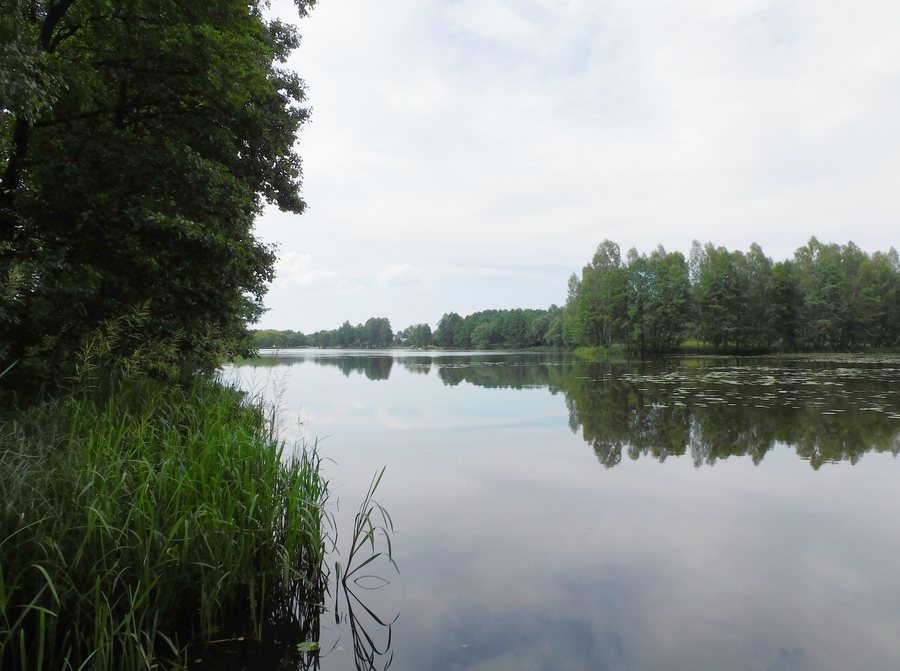
Another nature trail runs through a fish farm, around its breeding ponds. It is part of the Izba Tradycji im. Profesora Franciszka Staffa at Ruda Maleniecka 112. This makes it a second specific location for a themed nature trail in the village, alongside the manor park: one description focuses on tree species, the other on a fish farm and its ponds.
The royal carp is also part of the local fishing history. Research at the experimental fishery station in Ruda Maleniecka led to the breeding of a royal carp variety with few scales. The Royal Carp Monument was erected in 2012 to mark the centenary of the opening of this experimental station. Taken together, the station and monument provide a brief historical connection between research, breeding and commemoration.
What routes are there at the municipal level?
The municipality's three marked Nordic walking routes vary in length and difficulty and are grouped together in the Nordic Walking Park LGD - U Źródeł. The red and black routes share a section with the Piekielny Szlak. This overlap is described within the municipality; it is separate from the red hiking trail through Ruda Maleniecka to the nature reserve.
A route suitable for cycle tourism also passes through the municipality. The places named along it are Machory, Maleniec, Koliszowy, Dęba and Strzęboszów. Together with the Nordic walking routes, it adds a cycling route through several named places to the area's trail options. The differences in the descriptions are useful when comparing the options: length and difficulty distinguish the Nordic walking routes, while the cycling route is described in terms of its suitability for cycle tourism and the places it passes through.
Discover more destinations: Stąporków, Sielpia Wielka, Tama, Fałków, Konskie, Strzeboszow.
FAQ
Which hiking trail leads to the Diabla Góra Nature Reserve?
A red hiking trail leads to the nature reserve and passes through Ruda Maleniecka.
Which tree species does the dendrological nature trail cover?
The trail in the historic manor park covers native tree-forming species and non-native tree species. The Weymouth pine is one example mentioned.
What does the Royal Carp Monument commemorate?
It was erected in 2012 to mark the centenary of the opening of the experimental fishery station. Research at the station led to the breeding of a royal carp variety with few scales.
For the broader travel overview: Końskie.

