
Discover Bartosze
Accommodation in Bartosze
If you are considering Bartosze as a travel destination, you can look at two subjects separately: the protected wetland by Lake Szarek and the war cemeteries and their history. The facts below will help you weigh your interests in nature and culture when planning your trip.
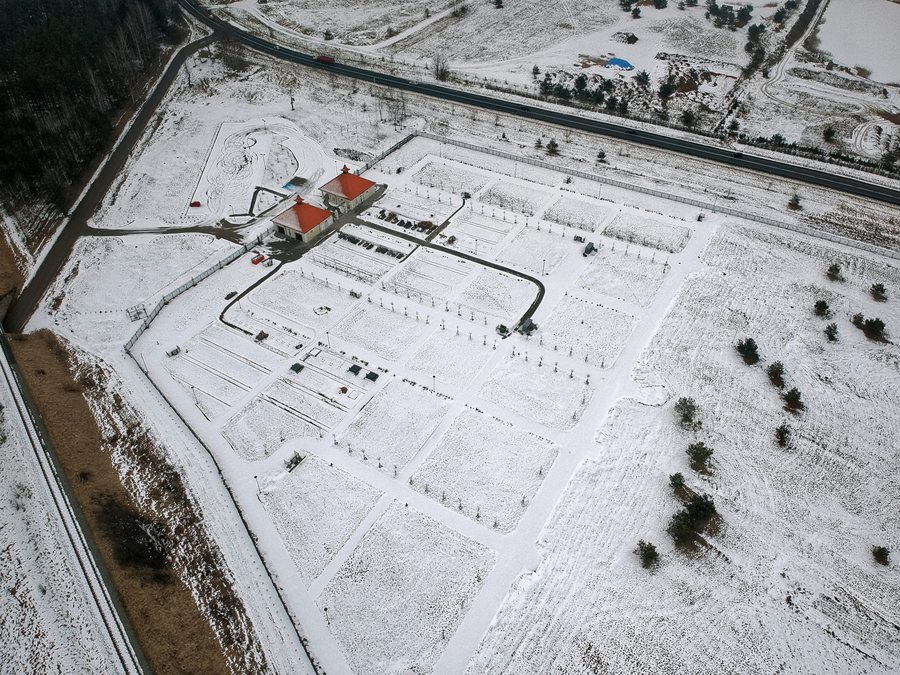 The Municipal Cemetery No. 3, Bartosze near Ełk
Photo: 1957birth via Wikimedia Commons, CC BY-SA 4.0
The Municipal Cemetery No. 3, Bartosze near Ełk
Photo: 1957birth via Wikimedia Commons, CC BY-SA 4.0
Bartosze at a glance
- The „Ostoja bobrów Bartosze“ nature reserve is located in Bartosze; the „Bartosze“ protected area covers 190.46 hectares.
- The European beaver lives in the wetland on the shore of Lake Szarek.
- Around 20,000 Second World War dead are buried at the German military cemetery in Bartossen (Bartosze). It was inaugurated on 9 August 2003.
- The war cemetery is also the resting place of 84 German soldiers from the First World War.
What nature is protected in Bartosze?
„Ostoja bobrów Bartosze“ combines the protection of an animal species with the protection of its habitat: the European beaver lives there in marshy terrain on the shore of Lake Szarek. To understand the nature reserve, it is therefore important to consider not only the beaver but also the wetland where it lives.
The „Bartosze“ nature reserve covers 190.46 hectares. Its conservation objective, established in 2018, is to preserve and protect ecological processes in wetlands. For nature enthusiasts, the focus is therefore on wetland protection.
What characterizes the Second World War military cemetery?
The German military cemetery in Bartossen (Bartosze) was created through cooperation between the Polish Pamięć Foundation and the German War Graves Commission in Kassel. Around 20,000 Second World War dead are buried there. Its inauguration on 9 August 2003 marks another date in its history.
The site lies on a plateau, covers about five hectares, and can be reached via a staircase. Groups of symbolic crosses mark the grave blocks of the Second World War dead. A rest area is located by the access road, offering views of three large wooden crosses visible from afar. The natural-stone enclosure draws on the architecture of East Prussia. Together, these elements offer different clues for understanding the design and historical character of the site.
How should the history of the First World War cemetery be understood?
A small First World War cemetery was the starting point for the establishment of the war cemetery in Bartosze. It bore the name „Golgota Prus Wschodnich“; 84 German soldiers were buried there. The first people buried there had taken part in the so-called Winter Battle of Masuria in February 1915. Three large crosses, visible from afar, define the entire First World War cemetery.
The figures for the two wars refer to different groups: the approximately 20,000 dead are associated with the German military cemetery for the Second World War, while the 84 German soldiers are associated with the First World War war cemetery.
Which perspective suits your travel plans?
If you are especially interested in nature, the wetland, Lake Szarek, and the beaver living there offer a clear thematic focus. By contrast, the cemeteries provide a way to explore the consequences of and remembrance surrounding two world wars, each with its own figures, dates, and architectural features. You can weigh these subjects separately rather than treating them as a single experience. This makes it possible to choose Bartosze based on the interests that matter most for your trip.
Discover more destinations: Mrozy Wielkie, Rękusy, Laśmiady, Sajzy, Zawady Ełckie, Miluki, Straduny, Woszczele.
FAQ
Which animal species is the focus of the nature reserve?
The European beaver is protected in the „Ostoja bobrów Bartosze“ nature reserve. It lives in marshy terrain on the shore of Lake Szarek.
How large is the German military cemetery in Bartossen?
The cemetery site covers about five hectares. It lies on a plateau and can be reached via a staircase.
What does the number 84 refer to?
It refers to the German soldiers from the First World War who are buried at the war cemetery. The „Golgota Prus Wschodnich“ cemetery, where these 84 people are buried, was the starting point for the establishment of the war cemetery in Bartosze.
For the broader travel overview: Lyck.

As.jpg)