
Urziceni – Churches, Archaeology and Riparian Forest
Accommodation in Urziceni
Urziceni can be explored through specific places, dates and names. Local history, archaeological traces, nature and regional events stand alongside one another as different points of access.
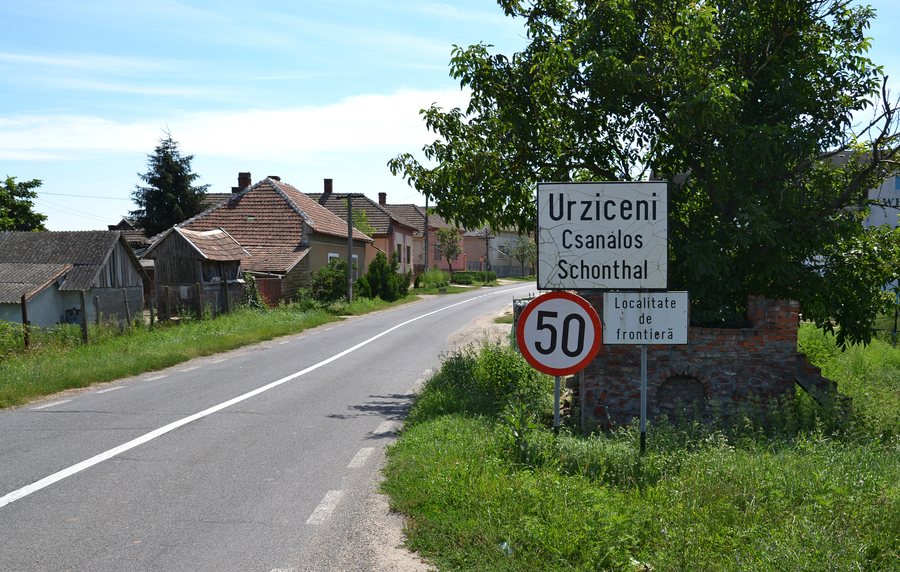 File:Urziceni (Csanálos, Schontal) - trilingual city sign.jpg
Photo: Pudelek via Wikimedia Commons, CC BY-SA 4.0
File:Urziceni (Csanálos, Schontal) - trilingual city sign.jpg
Photo: Pudelek via Wikimedia Commons, CC BY-SA 4.0
Culture
The first Roman Catholic Church of the Holy Cross in Urziceni was consecrated in 1725, expanded in 1751 and burned down together with the parish house in 1832. The altarpiece of the Roman Catholic Church of the Holy Cross in Urziceni depicts the discovery of the Holy Cross. In the Viile Negre area, on the road to Urziceni-Pădure, is Capela Nepomuk, which is also known as Capela Viilor.
The Urziceni–Vade Ret (Vamă) archaeological site comprises a Neolithic settlement of the Pişcolt culture. Forty graves were discovered at Urziceni-Vama; at the time, the necropolis was considered the largest Bodrogkeresztúr necropolis in Romania. The settlement and the necropolis therefore represent two different archaeological findings associated with the same locality.
Geographical Context
Since 2003, there has been a road border crossing between Romania and Hungary near Urziceni, connecting Urziceni with Vállaj. The geographical references of the destinations mentioned differ between the immediate vicinity and the wider surroundings of Urziceni. For spatial orientation, a distinction must be made between Urziceni itself, its immediate surroundings and the wider area. These levels link the border crossing, the aforementioned religious buildings and the destinations in Carei without equating their respective locations.
Nature
Pădurea de frasini Urziceni is a riparian mixed forest with more than 150 plant species assigned to three vegetation communities. The figures for the number of species and their classification into vegetation communities describe the forest both in terms of its extent and its botanical structure.
Notable or rare species found in Pădurea de frasini Urziceni include Hottonia palustris, Trollius europaeus, Leucojum aestivum, Galanthus nivalis, Urtica kiovensis, Lilium martagon, Carex caespitosa and Listera ovata. In addition to this detailed species list, the surrounding area features churches, a monument and parks as distinct types of destinations.
Surroundings
In the immediate vicinity of Urziceni are Biserica Urziceni and Biserica Romano-Catolică Foieni. In the surroundings of Urziceni are the Monumentul Ostaşului Român Carei monument, the Sinagoga Mozaică Carei synagogue, Parcul Romei and the Parcul Dendrologic Carei dendrological park. The Dealul Ardudului and Dealul Bobald hills are also located in the surrounding area. Thus, the surroundings include religious buildings, a monument, a synagogue, parks and hills.
Regional Event
The Festivalul Ștrudelului takes place annually in Urziceni and attracts visitors from other parts of Satu Mare County. The event complements the historical and natural-history themes with a regional occasion held at a recurring time.
Those wishing to get to know Urziceni through its churches, archaeological traces, riparian forest or regional events can compare hotel offers separately based on travel dates, room category and cancellation conditions. This information stands alongside the different geographical references and can be weighted differently depending on the planned stay.
More local pages: Vama, Lazuri, Apa, Mădăras, Satu Mare, Botiz, Bixad, Dorolţ
To the higher-level travel overview: Satu Mare.

_-_trilingual_city_sign.jpg)