
Boița at the Entrance to the Turnu-Roșu Pass
Accommodation in Boiţa
Boița lies at the foot of the Lotru Mountains, where the Olt River enters the Turnu-Roșu Pass.
Culture
The present-day Biserica Adormirea Maicii Domnului was built between 1812 and 1822 on the site of, or near, an older wooden church. A church is already documented in Boița for the mid-17th century.
The Biserica Adormirea Maicii Domnului is an Orthodox church with a pronaos, naos, and main apse; a dome on a drum rises above the nave. In the courtyard of the present-day church, a stone cross-troiță was erected near the southern wall, with inscriptions on two sides. This stone cross-troiță is a unique example in this area and cannot be architecturally assigned to any of the typologies of the crosses of Mărginimea Sibiului.
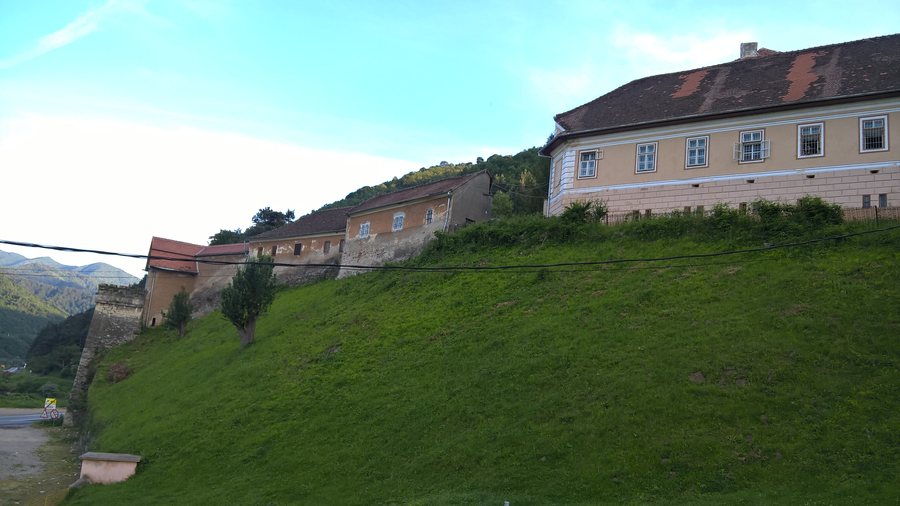
The rural ensemble “Centrul localității” in Boița dates from the 18th to the 19th century. The surviving fragments of Turnul Spart date from the 14th century. The Turnu Roșu Tower has walls 1.20 to 1.50 metres thick, constructed mostly from river stone. Castelul Turnu Roșu in Boița is dated to the period 1533–1930 and is now used as Centrul de plasament nr. 18.
History
The Roman fort of Ruda is presumed to be identified with Caput Stenarum and was part of the northeastern frontier of the Roman Empire in Dacia. In the area of the Roman archaeological site of Ruda, Roman roads branched off towards the provincial capital, Apulum, and as far as the eastern border of Dacia.
From the Roman archaeological site of Ruda, the entrance to the Olt mountain gorge, the ridge of the Făgăraș Mountains, the Parâng Mountains, the hilly landscape of Transylvania, and the course of the Olt can be seen. The Turnul Spart archaeological site lies on a narrow strip of bank between the Olt and the DN 7 national road.
Remains of the route known by the inhabitants as “Drumul lui Traian” can be seen today about 2 km south of Boița. In the Turnu-Roșu Pass, about 3 km south of Boița, lies the cold, fresh mountain spring Fântâna Împăratului; it was enclosed in 1852 in honour of Emperor Franz Joseph’s visit to this area.
Nature
The municipality of Boița features a hilly landscape at elevations between 350 and 425 metres. Sessile oak forests (Quercus petraea) and beech stands (Deschampsio–Fagion) alternate on the piedmont hills and some of the municipality of Boița’s higher terraces.
In the south of the municipality of Boița, in the Turnu-Roșu Depression and the first section of the Olt Gorge, there are rocky grasslands.
When choosing a hotel in Boița, travel dates, room category, and cancellation conditions provide an objective basis for comparison. Depending on the travel itinerary, the cultural heritage, Roman traces, and the pass landscape may provide different thematic focuses. This makes it possible to consider accommodation and sightseeing separately and assign them individual importance.
Other destination pages
Bazna, Sibiu, Gunzendorf, Biertan, Porumbacu De Jos, Şelimbăr, Rusciori, Gura Raului
To the overarching travel overview: Hermannstadt.

.jpg)