
Poiana Negrii: Nature, Trails and Culture
Accommodation in Poiana Negrii
Character
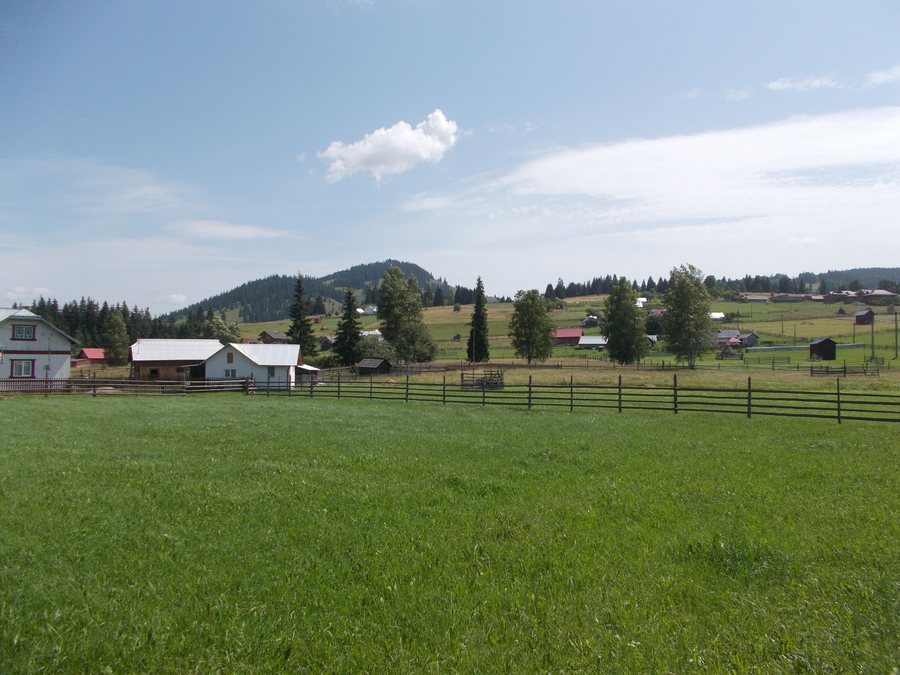
Poiana Negrii is a village district of the municipality of Dorna Candrenilor and is considered one of the most distinctive settlements in Țara Dornelor. A section of the Via Transilvanica long-distance trail runs through the village. This long-distance route complements the trails leading from Poiana Negrii to the surrounding natural and cultural destinations.
Nature and Trails
The 12 Apostoli Nature Reserve can be reached from Poiana Negrii via a blue-marked trail to Schitul 12 Apostoli. From there, a red-marked trail continues to the summit of Vârful 12 Apostoli. The color markings identify the two consecutive sections leading to the summit.
A monastery is located at the foot of the 1,770 m-high Vârful Lucaciu. From Poiana Negrii, this monastery can be reached by motor vehicle via a forest road. Another hiking trail leads along the access road to Schitul Apa Rece. The hiking connections therefore include both the route to a monastery on Vârful Lucaciu and access to a schitul and a summit.
An additional route runs from Poiana Negrii via Schitul 12 Apostoli, Vârful 12 Apostoli and the village of Gura Haitii to Vârful Călimanul Cerbului. The route thus includes several named stops, including two summits, a schitul and a village. Its sequence extends from the starting point via religious sites and mountain summits to another village.
A cycling loop is also connected with Poiana Negrii: the C11 cycling loop runs via Coșna, Tătaru and Poiana Stampei back to Poiana Negrii. Both the start and finish are in Poiana Negrii, while the loop includes three other places. For hiking and cycling routes, it is advisable to check current trail and route conditions before setting out. For planning purposes, the marked section, the destination and, in the case of a loop, the return to the starting point can be considered separately.
Mineral Water
Poiana Negrii is considered a spa resort with balneological factors and mineral springs. The mineral waters of Poiana Negrii are considered carbonated, ferruginous, bicarbonate-rich, calcium-rich and hypotonic. The village also has a mineral water bottling plant.
A special tap was installed at a mineral spring in Poiana Negrii, where anyone interested could draw water. The spring supplements the existing mineral water facilities with a publicly accessible collection point.
Culture and Tradition
The wooden Church of Sfântul Dimitrie cel Nou stands on a hill in the village of Poiana Negrii. It was built in 1797. The ecclesiastical classification also includes the parish of Sf. Cuvios Dimitrie Basarabov, Poiana Negrii II; it belongs to the municipality of Dorna Candrenilor. The church and the parish thus represent two separately named ecclesiastical affiliations within the municipality.
According to a local tradition, someone was buried in the center of the meadow; since then, the place has been called Poiana Negrii. The story links the place name to a tradition from the village. The church on the hill and the center of the meadow mark different locations in the village within this tradition.
Other places on the same level are Cârlibaba, Fălticeni, Crucea, Gura Humorului, Căsoi, Pojorâta, Sadova and Dealu Floreni.
For the higher-level travel overview: Suceava.

