
Hotels in Dobrna – Thermal Spa, Gorges and Culture
Accommodation in Dobrna
Dobrna combines an exceptionally long thermal tradition with the Hudičev Graben Gorge, waterfalls, historic buildings and paths through the hilly landscape. The town is home to Slovenia’s oldest continuously operating thermal spa, whose tradition dates back more than 610 years. The warm springs have been used for health purposes in Dobrna since 1403. A magnificent chestnut avenue runs between the spa and the town centre; the spa park is also home to a 200-year-old chestnut avenue. A Populus alba can also be found there, considered the third-largest known specimen of its species in Slovenia.
Nature
The Hudičev Graben Gorge is about one kilometre long and can be reached from the centre of Dobrna via a roughly 30-minute, 2-kilometre walk. The path through the gorge passes numerous rapids and waterfalls. At Ledenica Cave, the Drenovec stream plunges over rock overhangs and the Drenovec Waterfall into the Dobrnica torrent. The Šumečnik Waterfall also has several stages: one cascade is 4 metres high and forms a pool, while the cascades have a total height of 7 metres.
There is also a Kneipp spring with clear spring water near Ledenica Cave, used for Kneipp treatments. The pond in Lokovina can be reached from the centre of Dobrna on foot or by bicycle. Visitors can fish at the pond.
Culture
The history of the town includes Ledenica Cave, which was enlarged from a natural limestone cave into an ice storehouse. Beer from the brewery at Dobrnica Castle was cooled there. Dobrnica–Gutenek Castle was built in the 17th century and can be reached from Dobrna in about 30 minutes on foot. Kačji grad Castle stands on the hill above Lokovina; signposted paths lead there from Dobrna.
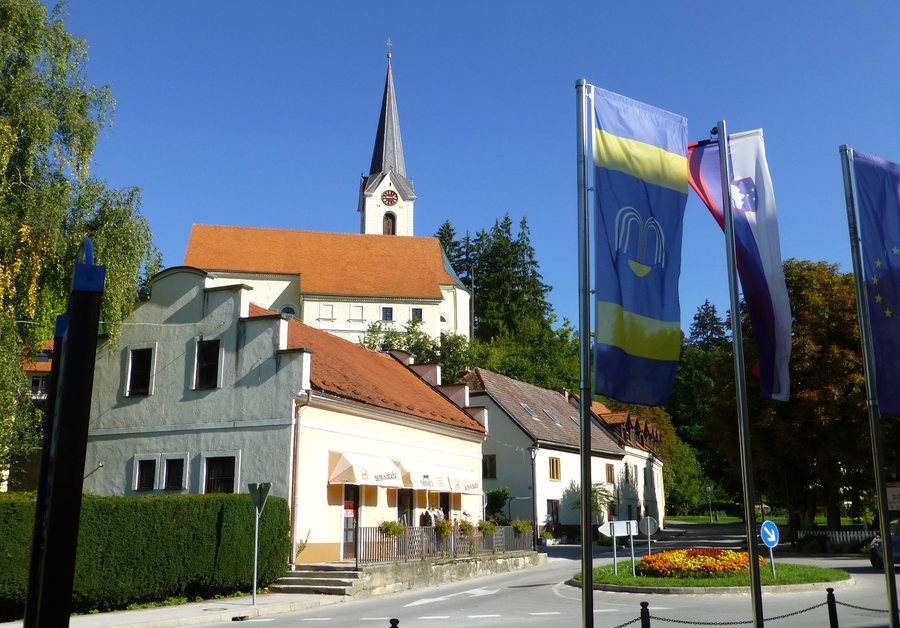
The parish church of the Assumption of Mary, the town’s central religious building, stands in the centre of Dobrna. The present church was built in 1844 in the Baroque style on the ruins of an older church. The Polenek Cultural Heritage House offers another way to explore the past. It houses a collection of approximately 10,000 old objects collected by the collector Jože Polenek.
The Vovk Mill stands in the Valley of the Mills; it is a preserved 450-year-old mill that is still in operation. Above Dobrna, the Šumej Farm is located in Brdce. A black kitchen has been preserved there, offering an insight into the way of life 300 years ago.
Paths and Activities
There are about five marked cycling routes around Dobrna, with different lengths and levels of difficulty. The Ana Trail runs through hilly terrain between the Dobrnica torrent and the Hudinja River, which flows in from the direction of Vitanje. Its final ascent leads to a panoramic view of Dobrna and the surrounding area. Along the way, the Ana Trail passes the Šumej Farm and continues to the Blažič Farm, where honey is also offered to visitors.
The Loška Trail passes the ruins of Snake Castle and the Valley of the Mills. There is an equipped climbing route at Žeblarjeva Peč; the summit offers a view of the valley.
Cuisine
At Minka Farm, homemade cured meat products and a wide selection of aperitifs are served. Walnut bread is considered a culinary speciality in the Dobrna destination; visitors can also prepare it themselves. Honey is also offered at Blažič Farm along the Ana Trail.
More destinations
More destinations on poezdka.de: Vojnik, Celje, Nova Cerkev, Štore.
Back to the main travel overview: Celje.

