
Malá Štáhle: Hotels and Accommodation
Accommodation in Malá Štáhle
Malá Štáhle can be viewed from three perspectives: through its cultural history, the natural landscape along the Moravice, and routes through the hilly countryside.
Culture and History
The chapel of Malá Štáhle is dedicated to Saint John the Baptist. It contains a rare stained-glass depiction of the Stations of the Cross; it was built in 1759.
Malá Štáhle was founded around 1540 by Josef Pňovský of Sovinec. The local history also includes Wallhübel: it was located about half a kilometre from present-day Malá Štáhle on the left bank of the Moravice. Wallhübel is not signposted and is difficult to identify in the terrain. The site may have served as a defensive structure guarding a ford across the Moravice, which lay on a presumed historical route between Silesia and Moravia.
Landscape
In the village landscape, spoil heaps made of shale fragments bear witness to the numerous former slate quarries. The floodplain of the meandering Moravice also encompasses the cadastral area of Malá Štáhle and is a breeding and refuge area for birds along an important Central European migration route.
On the Way
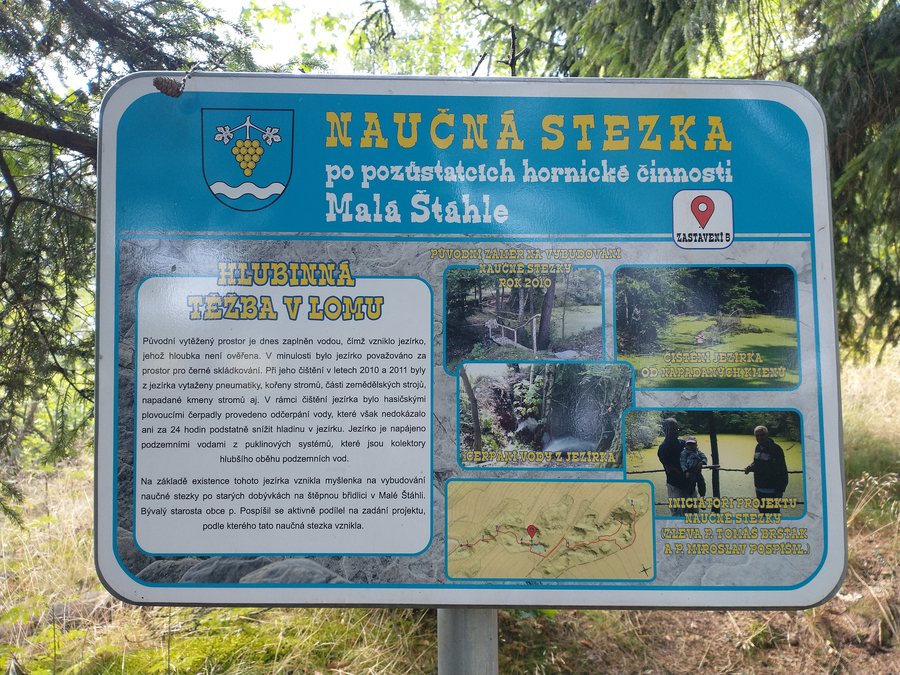
The educational trail following the traces of slate mining near Malá Štáhle presents the history and remains of local slate extraction. A separate route leads through hilly terrain and offers beautiful views as far as the area above Dolní Moravice. In the vicinity of Velká Stáhle, there is a newly built inline skating track with a shared path for cyclists and pedestrians.
Other Destinations
Other destinations: Třemešná, Brantice, Slezská Harta, Bohušov, Široká Niva, Rýmařov-Harrachov, Karlovice and Mala Moravka.
To the overview of the wider travel region: Bruntál District.

