
Trojanovice: Hotels and Accommodation
Accommodation in Trojanovice
Trojanovice is closely associated with Radhošť. At 1,129 m, Radhošť is the highest and also the best-known peak in the territory of Trojanovice.
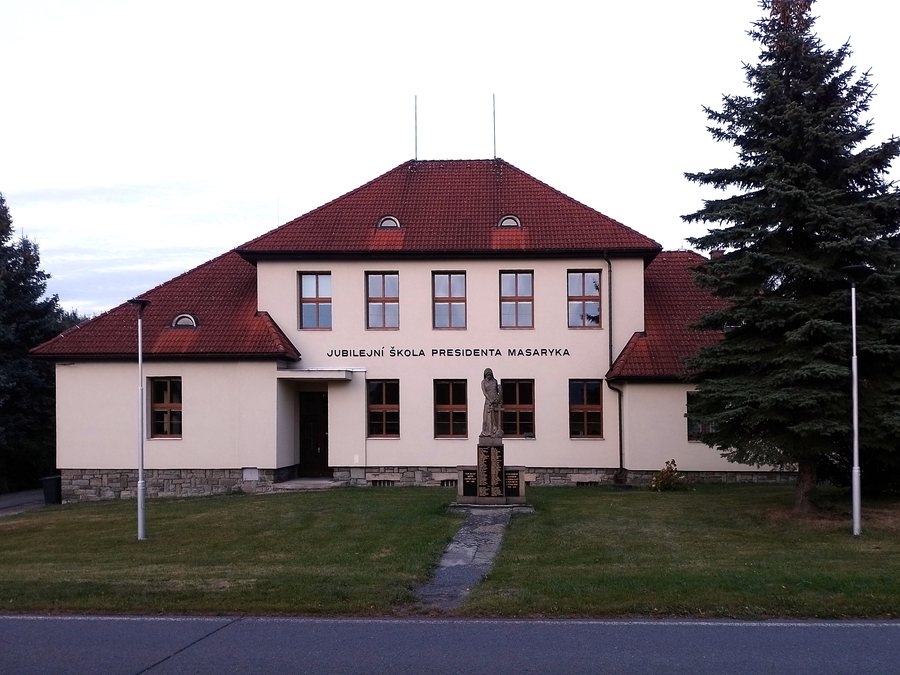 File:Trojanovice, Jubilejní škola presidenta Masaryka.jpg
Photo: Kamil Czaiński via Wikimedia Commons, CC BY-SA 4.0
File:Trojanovice, Jubilejní škola presidenta Masaryka.jpg
Photo: Kamil Czaiński via Wikimedia Commons, CC BY-SA 4.0
Nature and Landscape
Approximately 80 % of the territory of Trojanovice has belonged to the Beskydy Protected Landscape Area since 1973. The Radhošť National Nature Reserve lies on the northern slope of Radhošť at an altitude of 660 to 1,129 m and covers 145 ha. It includes extensive forest stands characteristic of the summit areas of the Moravian-Silesian Beskids.
The Noříčí Nature Reserve protects forest stands on rocky slopes. It is characterised by a diverse, near-natural composition of tree species and trees approximately 150 years old.
The statue of Radegast stands at 1,120 m, exactly halfway along the path from Pustevny to Radhošť. From Pustevny, it can be reached via a broad trail marked in blue. Pustevny itself can be reached from Trojanovice by cable car.
History and Culture
Trojanovice developed from the beginning of the 16th century through the long-term colonisation by shepherds and Pasekáři. Local legends, tales and stories about Radhošť and the mythical figure of Radegast emerged during this period.
Since the 1960s, pilgrimages in honour of Cyril and Methodius have been held on Radhošť. They are celebrated on 5 and 6 July and attract several thousand people. The Chapel of Saints Cyril and Methodius on Radhošť was built from 1896 to 1898, consecrated on 11 September 1898 and opened to the public.
The Strnadel Brothers and Jan Knebl Memorial offers a brief insight into the history of Trojanovice and the way people lived in the past. On display are a historical costume, two sculptures by Jan Knebl – a bust of the writer Bohumír Četyna and an allegory of the economic crisis – as well as a Wallachian nativity scene by Josef Knězek dating from 1930. A festival commemorating the descent of the Holy Spirit is held every year at the Lurdská Chapel on Horečky.
The Pustevny National Cultural Monument comprises folk-style wooden buildings. Maměnka was designed there by Dušan Jurkovič in 1897–1899. The Libušín dining house, also built in 1897–1899, is likewise located at Pustevny. It is the work of the architect Dušan Samo Jurkovič, who drew inspiration from traditional Wallachian log-house architecture.
Trojanovice is also home to the Cupakdesign Gallery. It is a sales gallery for individually designed one-off furniture pieces at the boundary between sculpture and applied art. It is complemented by sculptures, drawings and photographs by the sculptor Pavel Cupák.
Regional Cuisine
A traditional soup in Trojanovice is Zelňačka, also known as Kyselica. It is prepared with sauerkraut, potatoes, bacon or sausage; flour, milk, cream or Kyška can be used for thickening.
Traditional baked goods include Lopaťáky, also known as Frgály: large, thin, round cakes filled with ingredients such as quark, pear purée, poppy seeds, blueberries, raspberries or blackberries.
Activities and Places to Visit
Tarzanie is a high-ropes park in the Beskids in the municipality of Trojanovice, below the valley station of the cable car to Pustevny. For winter sports, cross-country ski route 5A is available; it follows a 16 km loop from Pustevny to Martiňák and back.
TIC Trojanovice plans its tourist routes with a starting point at the Tourist Information Centre on the village square in Trojanovice.
Other Places
Bravantice, Skotnice, Bernartice Nad Odrou, Starý Jičín, Pustějov, Luboměř, Kujavy, Příbor
To the higher-level travel overview: Nový Jičín District.

