
Luleč: Natural swimming pool, educational trail and protected cultural monuments
Accommodation in Luleč
Nature and trails
The “Naučná stezka Luleč” educational trail runs through the cadastral area of Luleč and is divided into two sections. There are 22 information boards in total along the educational trail. The eastern section leads through the Kopaniny weekend-house area and across the grounds of the “kostel sv. Martina” church. In this way, the trail connects different landscape and cultural points within the cadastral area, without the individual sections following the same route. An educational trail with two sections can be considered in the day’s planning as a separate sequence of paths if the route is viewed in stages.
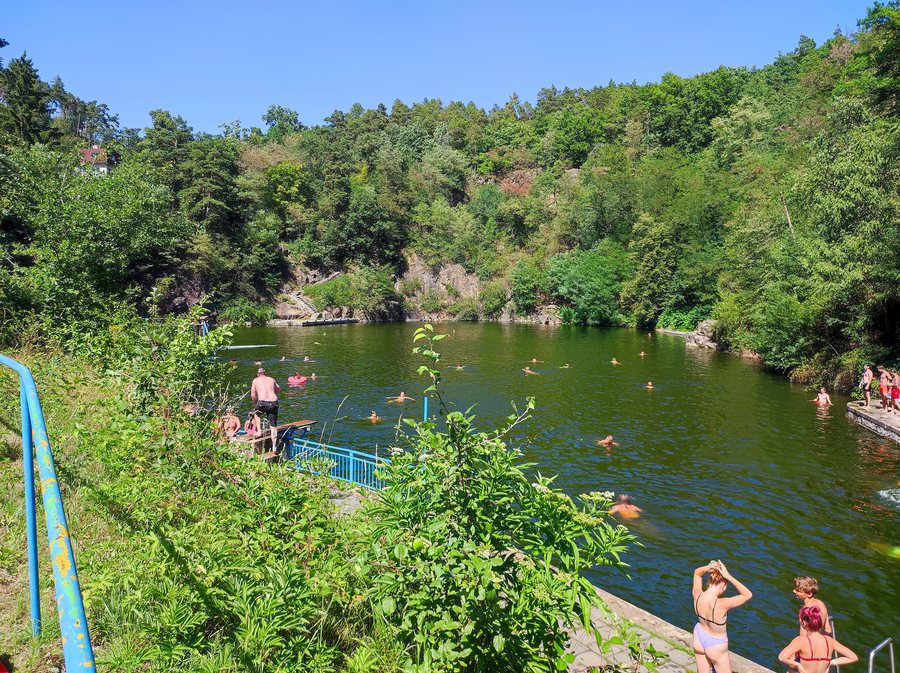
The “U Libuše” natural swimming pool is located in a flooded quarry. In the 1930s, the quarry was converted into a natural swimming pool with a total area of 6,400 m². The public transport stop for the “U Libuše” natural swimming pool is “Luleč, obecní úřad”.
Above the municipality of Luleč, the “Křížová cesta Luleč” Stations of the Cross leads to the “kostel sv. The Stations of the Cross consist of thirteen niche chapels and a Holy Sepulchre. A green-marked tourist route also runs north of Luleč from Vyškov via Drnovice and Ježkovice to Ruprechtov. This route continues into the Moravian Karst.
Cultural monuments
The “kostel sv. Martina” church in Luleč is a protected cultural monument. The “hrad Luleč” castle and the “kostel sv. Isidora” church in Luleč are likewise protected cultural monuments. The three buildings represent different forms of the local cultural heritage: a church, a castle and another church.
Archaeological traces
The “Svatý Martin, Starý zámek” site in Luleč is designated as a significant archaeological locality and comprises a hilltop settlement, a fortification, a burial site, a castle and an unspecified complex. The site also includes a 55-hectare prehistoric hillfort with sections of a double fortification. Three parallel ramparts have been preserved on the southern side.
Of the castle at the “Svatý Martin, Starý zámek” site, a very well-preserved ring wall and moat, as well as isolated remains of stone walls, have survived. The archaeological features therefore range from the fortified hilltop settlement to the structural remains of the castle complex.
Building history
The present-day Baroque “kostel sv. Martina” church was built in 1751–1753 on the site of an older Gothic church. The Baroque branch church “kostel sv. Isidora” was created in 1739–1741 by an extensive reconstruction of an older chapel. The churches thus reveal different construction phases: in both cases, the Baroque building is related to an older predecessor. The periods of construction differ, as do the predecessor buildings: kostel sv. Martina follows a Gothic church, while kostel sv. Isidora follows an older chapel. The years 1739–1741 and 1751–1753 place the two churches in different periods of Luleč’s local building history.
To the higher-level travel overview: Vyškov District.
More destinations
More places within the same destination:

.jpg)