
Örvényes on Lake Balaton: Beach, Cycle Route and Watermill
Accommodation in Örvényes
The Lake Balaton cycle route passes through Örvényes, while the free beach offers waterfront facilities and sports areas. The village is also shaped by a watermill that has been in continuous operation since it was first mentioned in 1211. These features offer ways to enjoy a stay filled with activity, time on Lake Balaton and cultural history.
Örvényes at a glance
- The Lake Balaton cycle route passes through Örvényes.
- The free beach can be reached by car or bicycle. It is about 1 km from the turnoff from Route 71.
- The watermill has been in continuous operation since it was first mentioned in 1211.
What does the free beach offer?
The free beach has a beach volleyball court, a Tengo court and a sandy football pitch. This gives visitors several places to play ball games along the waterfront. Next to the beach are a promenade and a rest park. Both extend for about 100 metres over the water as a boardwalk. If you want to spend time by the water, you can choose between the sports areas and a stretch of the boardwalk.
How do you get to the beach, and what does the cycle route offer?
The Lake Balaton cycle route passes through Örvényes, making it a useful point of reference for cyclists. The free beach can be reached by bicycle or car; it is about 1 km from the turnoff from Route 71. This distance refers to the stretch from the turnoff to the beach. When planning your visit, both the route through the village and the access road from Route 71 are relevant.
What traces of the village’s history can you discover?
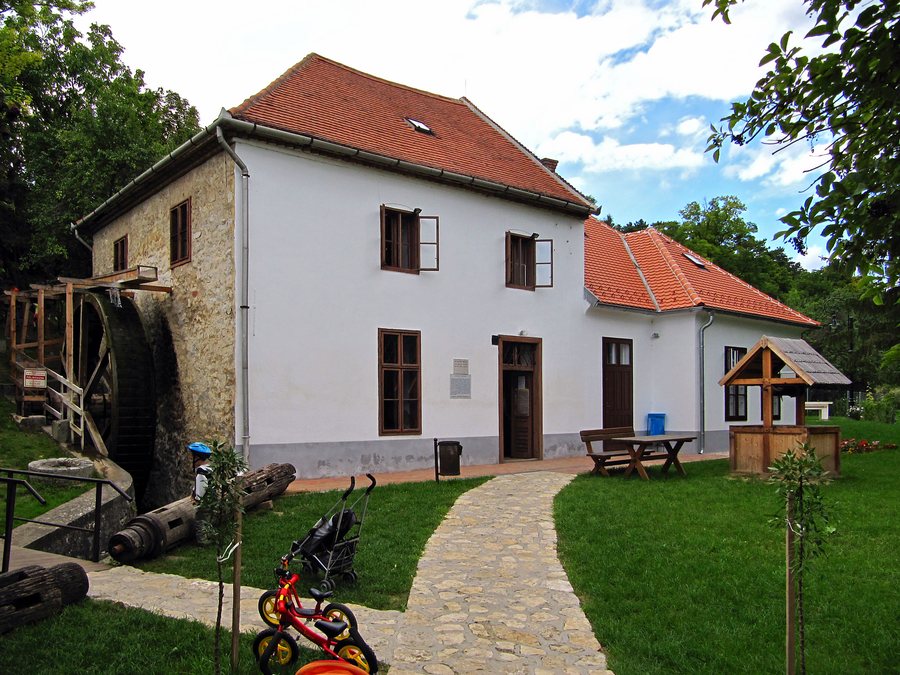
The watermill is a prominent historical and technical attraction. Its wooden overshot waterwheel is powered by the falling water of the Pécsely Stream. The miller’s house, rebuilt in the 18th century, houses an ethnographic and folk art collection. Next to the still-operating mill stands a protected, two-arched stone bridge from the 18th century, built in the Baroque style and adorned with a statue of Saint John of Nepomuk.
The churches also tell stories of different eras. The Abbey of Tihany built the Szent-Imre Church between 1778 and 1783. In the cemetery in the eastern part of Örvényes stands the medieval church ruin: it was built in the 13th century in the Romanesque style as the church of the medieval village. Together, these sites offer insights into Baroque architecture and the village’s older history.
What shapes the waterfront landscape and nature?
As the waterfront was developed, a rest park and a panoramic path were created along the reeds around the former fishing harbour. The development of the Pihenőpark és panorámapont (Rest Park and Panoramic Viewpoint) took account of the habitat of the protected marsh sow-thistle (Sonchus palustris) and the surrounding reeds. The panoramic path is also accessible to wheelchair users from one side. In the bay, a fishing jetty provides anglers with a safe mooring place and a starting point for recreational activities on the water.
Pán-kút Spring, next to Hősök tere, provides fresh spring water all year round, including for visitors. Örvényes is also part of a World Heritage candidate area on the northern shore of Lake Balaton. This area includes natural and cultural heritage sites in and around the Tihany Peninsula, Aszófő and Örvényes.
What events take place every year?
Falunap lasts three days and takes place every year on the last weekend of August. The “Könnyűszárnyak Örvényes Repülős nap,” a traditional major event in Örvényes, is also held every year in early summer. If an event matters to your travel plans, note the stated timing: the two events take place at different times of the year.
To compare more village pages, you can also visit Szentantalfa, Balatonszepezd, Balatoncsicsó, Paloznak, Monoszló, Óbudavár, Aszófő and Tagyon.
FAQ
Does the Lake Balaton cycle route pass through Örvényes?
Yes. The Lake Balaton cycle route passes through the village.
How do you get to the free beach?
The beach can be reached by car or bicycle. It is about 1 km from the turnoff from Route 71.
When does Falunap take place?
Falunap takes place every year on the last weekend of August and lasts three days.
For the wider travel overview: Balatonfüredi.

