
Discover Farkasgyepű: Church and Nature Reserve
Accommodation in Farkasgyepű
The church and the nature reserve south of the village give Farkasgyepű a distinct character. Here you will find historical details about the village and ideas to help you choose what to explore in the wider Lake Balaton – North destination.
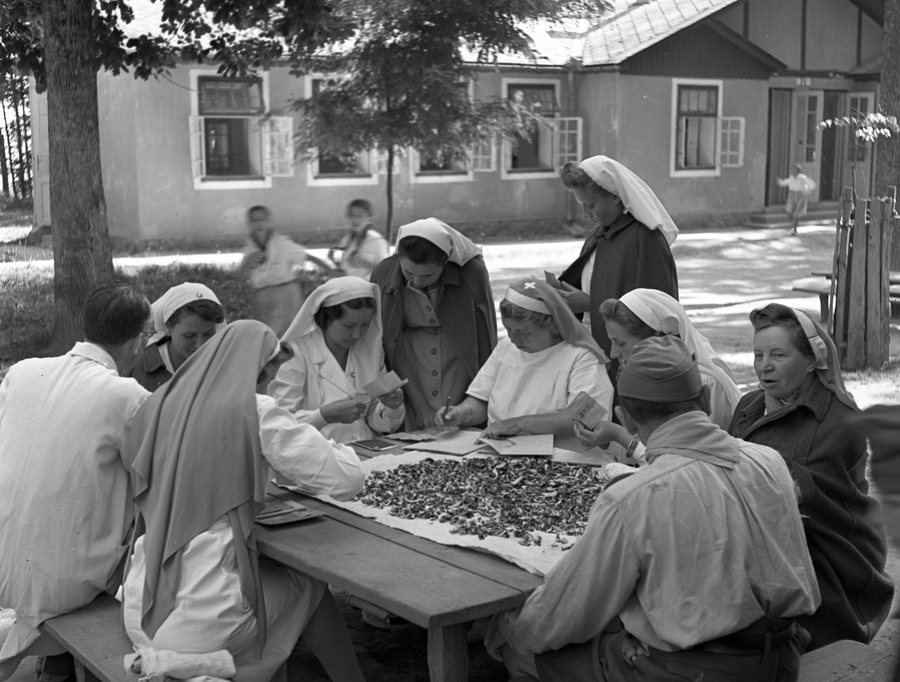 File:Az erdei iskola nevelőnői, 1943 Farkasgyepű. Fortepan 72393.jpg
Photo: FOTO:Fortepan — ID 72393 : Adományozó/Donor: Lissák Tivadar. via Source, CC BY-SA 3.0
File:Az erdei iskola nevelőnői, 1943 Farkasgyepű. Fortepan 72393.jpg
Photo: FOTO:Fortepan — ID 72393 : Adományozó/Donor: Lissák Tivadar. via Source, CC BY-SA 3.0
Accommodation facts about Farkasgyepű
Two places are especially useful for getting your bearings in Farkasgyepű: the church, with its architectural and artistic history, and the Farkasgyepűi Kísérleti Erdő nature reserve south of the village. The church was built by Bishop Károly Hornig and blessed by him on 1 July 1909. The nature reserve has been protected since 1977. These topics can help you decide what interests you before looking for a hotel.
What makes the church in Farkasgyepű special?
Several people are associated with the church’s construction. Baron Károly Hornig, Bishop of Veszprém and the village’s landowner, commissioned it. The architect Adolf Wojta designed it; it was built by the brothers József and Károly Gerle, master stonemasons from Kardosrét.
A precise date marks another historical connection: Bishop Hornig blessed the church on 1 July 1909. The altarpiece also tells its own story. Rudolf Steiner painted Mary, expecting a child, visiting her sister Elizabeth. The architecture, local history and subject of the painting offer different points of interest for culture-minded travellers.
What natural features are part of the village’s character?
The Farkasgyepűi Kísérleti Erdő nature reserve lies south of Farkasgyepű and has been protected since 1977. If you would like to consider nature as well as the church when planning your trip, you can include this nearby protected area in your plans.
What else does Lake Balaton – North have to offer?
The following suggestions relate specifically to the wider Lake Balaton – North destination, not to Farkasgyepű itself. Boat trips are offered at the Tapolcai-tavasbarlang in Tapolca; there is also a guided exhibition called “Csodálatos karszt” (“Wonderful Karst”). The cave is part of an underground cave system beneath the town that has so far been explored for 14.6 kilometres. In Tapolca, a boat trip and an introduction to karst are thus available as two different experiences.
Hegyestű offers a different landscape highlight: the 337-metre-high mountain lies between Zánka and Monoszló. Its inner face exposes the basalt of a volcano that was active around 8 million years ago. At a viewpoint on the western edge of the quarry grounds, visitors can use a panoramic information board to identify the surrounding hills. The mountain also has a rock garden featuring characteristic rock types from Transdanubia, the western half of Hungary.
The wider destination also offers opportunities to explore culture and crafts. The Herend Porcelain Museum features a permanent exhibition and changing exhibitions on the history of the manufactory. The visitor centre introduces porcelain-making, techniques and applied arts traditions; in workshops, visitors can handle porcelain paste and a brush for painting. In Bakonybél, the Pannon Csillagda has an interactive exhibition on space exploration and astronomy. The Levendula Ház in Tihany uses an interactive exhibition to explore the formation of the Tihany Peninsula and lavender cultivation, and also offers a craft workshop and an experience garden.
For those who want to compare landscapes and activities, the region offers a variety of options: the 230-hectare Ámos-hegyi Pihenőerdő has a nature trail, an observation tower, a fitness trail and forest playgrounds. The SkiArena Vibe Park in Eplény has 16 runs, with a total piste system of 7,984 metres; from the Ámos-hegyi lookout there, the view extends across the landscape of the High Bakony. Badacsony, in turn, combines hiking trails and panoramic views with distinctive geological formations, the basalt organ pipes. Grapes for Badacsony wine are grown on its slopes.
The excursion destinations and attractions mentioned are in the wider Lake Balaton – North destination and are not features of the village itself.
Discover more destinations: Nagytevel, Bakonykoppány, Homokbödöge, Pápakovácsi, Marcalgergelyi, Németbánya, Bakonyszücs, Takácsi.
FAQ
Who designed the church in Farkasgyepű?
The architect Adolf Wojta designed the church. It was commissioned by Baron Károly Hornig; the construction work was carried out by master stonemasons József and Károly Gerle.
When was the church blessed?
Bishop Károly Hornig blessed the church on 1 July 1909.
Where is the Farkasgyepűi Kísérleti Erdő nature reserve?
The nature reserve lies south of Farkasgyepű and has been protected since 1977.
What regional interests can be combined with a visit to Farkasgyepű?
The wider Lake Balaton – North destination offers, among other things, cave and karst attractions in Tapolca, the landscape of Hegyestű, porcelain, astronomy and other nature and cultural experiences. These are regional additions, not features of Farkasgyepű.
For the wider travel overview: Pápai.

