
Lovászpatona: Church and Wine Harvest Tradition
Accommodation in Lovászpatona
Lovászpatona brings together medieval traces at the Lutheran church and a lively wine harvest tradition. To help plan your trip, find historical details about the town here, along with other topics from the wider North Balaton destination.
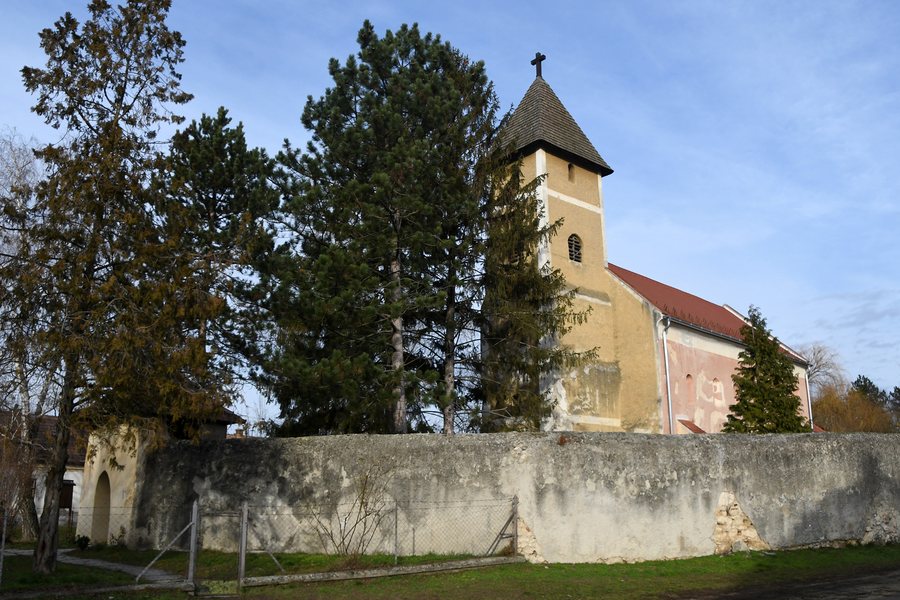 File:Lovászpatona, evangélikus templom 2021 01.jpg
Photo: Pasztilla aka Attila Terbócs via Wikimedia Commons, CC BY-SA 4.0
Lovászpatona at a Glance
- Construction of the Lutheran church began around the turn of the 12th and 13th centuries.
- The nave vault features a fresco dating from around 1500; remains of medieval wall paintings are visible on the exterior wall.
- A 2.5-meter-high, elliptical, bastion-like stone wall surrounds the church and the former churchyard. It was probably built during the Ottoman period.
- A procession for the grape harvest, followed by a ball, is among the town’s lively traditions.
What stories do the church and monument tell?
Several historical layers can be distinguished at the Lutheran church: construction began around the turn of the 12th and 13th centuries, while the fresco in the nave vault dates from around 1500. Remains of medieval wall paintings are visible on the exterior. A distinctive stone wall encloses the church and former churchyard. Its elliptical, bastion-like shape and height of 2.5 meters are documented, as is the cautious dating: the wall was probably built during the Ottoman period.
A monument in front of the church commemorates the heroes of the First World War. The soldier statue there was erected in 1927 and is the work of Istók János. Taken together, the church, wall and monument offer different points of interest for anyone interested in architectural history, wall paintings or local remembrance culture.
How is the wine tradition reflected in Lovászpatona?
The grape harvest procession, followed by a ball, is one of the town’s traditions that remains alive today. It recalls a centuries-old local wine culture. At the same time, this development should not be seen as unchanged: grape growing and wine production have now declined to a minimum. Tradition and current production are therefore in marked contrast. Both are important to understanding Lovászpatona: the custom’s continuing significance and the sharp decline in local cultivation.
What other topics does the wider North Balaton destination offer?
Nature and geology are also central themes in the wider North Balaton destination. Boat rides are offered in the Tapolca Lake Cave, which also features the guided “Csodálatos karszt” (“Wonderful Karst”) exhibition. The cave is part of a system beneath the town that has so far been explored for 14.6 kilometers. This brings together an underground natural attraction, an exhibition and a boat ride.
Another geological perspective can be found at Hegyestű, a 337-meter-high mountain between Zánka and Monoszló. The inner side of a basalt volcano active around eight million years ago has been exposed there. At a viewpoint on the western edge of the quarry grounds, visitors can use a panoramic information board to identify the surrounding hills. Hegyestű also has a rock garden featuring characteristic rock types from Transdanubia. Those more interested in volcanic formations and rocks will find a different experience here than in the Tapolca Lake Cave.
Culture and the regional landscape can also be explored through different themes. Badacsony offers hiking trails and panoramic views; its geological features include basalt organ pipes. Special grapes are also grown on its slopes and used to make Badacsony wine. For a focus on applied arts, the Herend Porcelain Museum has a permanent exhibition and rotating exhibitions on the history of the manufactory. At the Mini-Manufactory, visitors can handle porcelain paste and a painting brush during workshops. The wider destination thus brings landscape, geology, wine and porcelain together as distinct areas of interest.
How do you choose a hotel for your trip?
This distinction gives your search a thematic framework. Which accommodation suits you will then depend on your own travel plans and the information provided by each hotel.
Discover more destinations: Bakonyszücs, Pápakovácsi, Ganna, Takácsi, Bakonyság, Nagytevel, Farkasgyepű, Pápa.
FAQ
What is special about the Lutheran church?
Construction began around the turn of the 12th and 13th centuries. The nave vault features a fresco dating from around 1500; medieval wall paintings have been preserved on the exterior.
What is part of the wine harvest tradition?
A grape harvest procession followed by a ball is one of the town’s living traditions. It recalls the local wine culture, although grape growing and wine production have now declined to a minimum.
What can visitors discover at Hegyestű?
Hegyestű is a 337-meter-high mountain between Zánka and Monoszló. Visitors can see the inner side of an ancient basalt volcano, a viewpoint with a panoramic information board and a rock garden featuring characteristic rock types from Transdanubia.
Go to the wider travel overview: Pápai.

