
Podgorica
Accommodation in Podgorica
Podgorica combines historic neighbourhoods and collections with wine experiences and the 65-kilometre circular route around Korita. Which of these facets shapes your trip depends on whether you are planning to explore culture in the city or take a longer route through the Kuči mountain region.
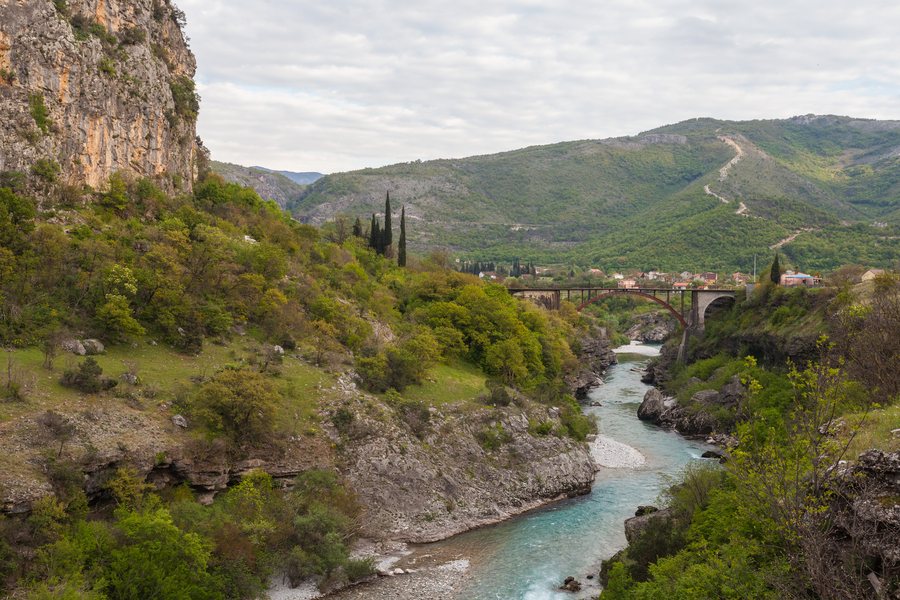 File:Río Moraca, norte de Podgorica, Montenegro, 2014-04-14, DD 05.JPG
Photo: Diego Delso via Wikimedia Commons, CC BY-SA 3.0
File:Río Moraca, norte de Podgorica, Montenegro, 2014-04-14, DD 05.JPG
Photo: Diego Delso via Wikimedia Commons, CC BY-SA 3.0
Podgorica at a glance
The Old Town was Podgorica’s historic core from 1474 to 1879 and was shaped during the Ottoman period by urban and architectural forms, customs and ways of life. Other landmarks include the Clock Tower in Bećir-beg Osmanagić Square and the remains of ancient Doclea. For arrivals, the railway station is close to the city centre and right next to the bus station; Podgorica Airport is a public airport with international traffic.
Which historic places shape the cityscape?
As you stroll through the cobbled streets of the Old Town, you’ll encounter a neighbourhood whose history is tied to the Ottoman period. The Clock Tower, a landmark of the Old Town, was built in the 18th century by Hadži Mehmed-paša Osmanagić. An old stone bridge stands where the Ribnica meets the Morača. It is said to date from Roman times and is regarded as Podgorica’s oldest bridge.
The Orthodox Cathedral of the Resurrection of Christ also stands out with its two pyramid-shaped towers. Each is 26.7 metres high, and the upper floors house a total of 17 bells. The heaviest weighs 11 tonnes and is considered the largest on the Balkan Peninsula. The Kruševac palace complex is located in Kruševac Park on the Morača River. The Petrović Palace there was a former residence of the Petrović dynasty.
Which museums and collections can you include in your plans?
The City Museum’s permanent exhibition includes valuable burial finds from Doclea: ceramic and glass vessels, jewellery, tools, weapons and coins. This gives you the chance to complement a visit to the remains of Doclea with a look at finds from the ancient settlement. The remains date from the first decade of the 1st century AD and lie four kilometres from Podgorica’s centre, on a plateau between the Morača, Zeta and Širijana rivers.
The Modern Gallery displays works that illustrate the development of modern art, as well as important artistic movements and influences in Montenegro’s art scene in the second half of the 20th century. The collection of the Fund of the Centre of Contemporary Art of Montenegro comprises more than 1,000 exhibits from 60 countries and is considered unique in Southeast Europe.
Which excursions and experiences match your interests?
Gorica Hill is close to the centre and includes an adventure park. Those interested in archaeological sites can visit the Medun complex in the surrounding area of Podgorica. It lies about 12 kilometres to the northeast in the Kuči region and includes the remains of the Illyrian city of Meteon and the Church of Saint Nicholas.
The circular route around Korita begins in Podgorica and leads into the Kuči mountain region, reaching the edge of the Cijevna River canyon. At 65 kilometres, it is a longer route; it is also Montenegro’s first fully marked panoramic trail. This makes it a travel option in its own right alongside the city’s experiences.
Wine is another possible focus: at the Plantaže winery, visitors can explore the entire winery, enjoy a glass of sparkling wine and take a leisurely ride through the vineyards on a tourist train. Twenty-nine grape varieties are grown there, including the indigenous Montenegrin varieties Vranac and Krstač. At the Šipčanik wine cellar, visitors can experience its distinctive atmosphere, as well as the aromas and flavours of the wines. In the wider region around Lake Skadar, numerous traditional fish specialities are part of the local food scene.
How do you choose where to stay and which area to explore?
If you’re planning to arrive by train, note that the railway station is close to the city centre and right next to the bus station. If you’re arriving by plane, the international traffic at Podgorica’s public airport is a useful point of reference.
To get your bearings in the different areas, you can visit the pages for Podgorica, Tuzi, Golubovci, Berislavci, Donje Stravče, Mitrovići and Vranjina. Another destination page in the selection is Cetinje.
FAQ
How long is the circular route around Korita?
The circular route around Korita is 65 kilometres long. It begins in Podgorica and leads into the Kuči mountain region, reaching the edge of the Cijevna River canyon.
When did Podgoričko kulturno ljeto 2026 take place?
The traditional Podgoričko kulturno ljeto, also known as Podgorica Cultural Summer, ran from 2 June to 22 September 2026. The programme included events in literature, music, film, theatre, visual arts and opera.
How are the railway and bus stations located in relation to each other?
Podgorica’s railway station is right next to the bus station and close to the city centre.
For the broader travel overview: Montenegro.

