
Kopanica
Accommodation in Kopanica
Kopanica brings together traces of a historic town layout with attractions for culture enthusiasts and travellers who want to explore by water or by bike. Two market squares, several churches and routes with clearly stated distances give you points of reference when choosing a hotel and deciding what to focus on during your stay.
Kopanica facts at a glance
- The historic town layout has two preserved market squares.
- The New Market was laid out in 1641; the buildings around the Old Market date from around the mid-19th century.
- A section of the Obra accessible to kayaks is 112.5 km long and runs from Kopanica to Skwierzyna.
- The “Miejsca pamięci” cycling route passes through Żodyń, Kopanica and Wielka Wieś and is 20 km long.
What do the two market squares tell us about Kopanica?
Kopanica’s two preserved market squares make its historic town layout tangible. The New Market, also known as Nowe Miasto, is associated with a specific year and person: Lampart Sierakowski laid it out in 1641. This gives the New Market a clear historical date, without conflating it with the later development of the other square.
The Old Market, Stary Rynek, offers a different point of reference. Its appearance is defined by compact masonry buildings dating from around the mid-19th century. Together, the two squares show different aspects of the townscape preserved over time: the layout of the New Market in the 17th century and the built character of the Old Market from a later period. Those interested in local history and historic architectural styles will find two distinct points of reference within Kopanica.
What churches and historical connections are there?
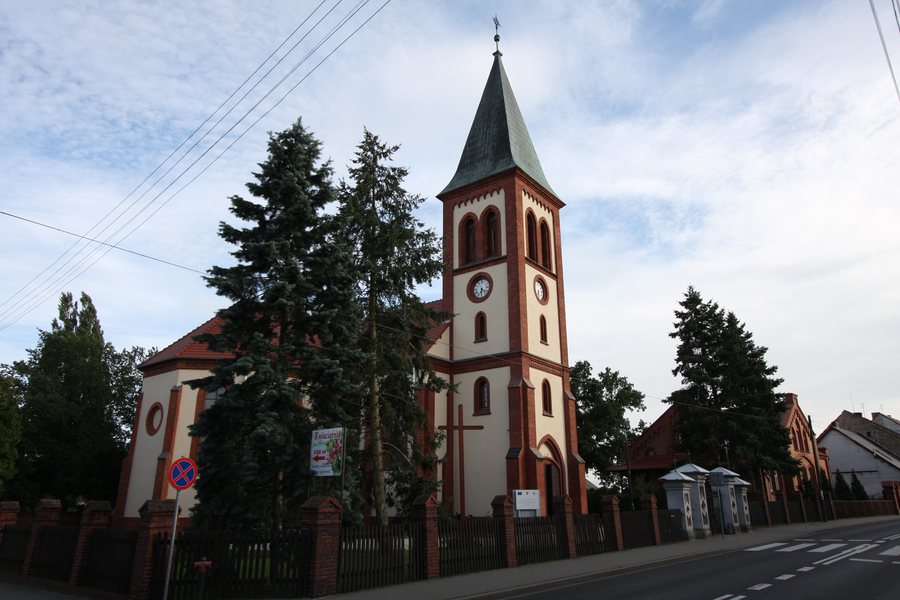
The religious buildings include the former Evangelical church. It is Neo-Romanesque and dates from 1858–1859. Its historical designation and architectural style give culture-minded visitors specific points of reference for exploring Kopanica’s architectural history.
The parish church of the Assumption of the Virgin Mary is listed in the register and inventory of historic monuments. The history of the associated parish goes back further: it was founded in 1408. This date refers to the founding of the parish, not to the construction date of the church building. When comparing historic sites, it is worth distinguishing between these details: the former Evangelical church has a stated construction period and Neo-Romanesque style, while the parish church is identified by its listing status and the year the parish was founded.
What water and cycling routes are mentioned?
For a kayaking trip, the “Szlak kajakowy – rzeka Obra” (Obra River Kayak Trail) provides a concrete point of reference: the section accessible to kayaks is 112.5 km long and runs from Kopanica to Skwierzyna. This figure describes the route’s length, not a specific travel time. The route offers a different way to experience Kopanica than the squares and churches in town; it extends travel planning beyond a single place to stay, following the Obra.
The Obra can also be located geographically at a named point: at the road bridge in Kopanica, the North Obra Canal nominally ends and the Obra River begins. For cycling travellers, the 20 km “Miejsca pamięci” route is a separate option. It passes through Żodyń, Kopanica and Wielka Wieś. In addition, part of a route through Kopanica follows the Szlak Koźlarski. These details refer to different routes and should not be combined into one.
What does the town offer to help plan your stay?
Facilities in Kopanica include shops, a bar and PKS. Together with the historic squares, churches and the water and cycling routes mentioned above, they provide a straightforward overview of what you might consider when choosing a hotel in Kopanica. The key question is whether you are particularly interested in local history, religious architecture, a longer kayaking route or the cycling route. The route details give distances and points along the way, but not walking or travel times.
If you would like to include other places in your selection, you can also compare the pages for Chorzemin, Grójec Mały, Wilcze, Tuchorza, Solec Nowy, Bucz, Barchlin and Wolsztyn.
FAQ
How many historic market squares are preserved in Kopanica?
Remnants of a historic town layout with two market squares are preserved: the New Market (Nowe Miasto) and the Old Market (Stary Rynek).
How long is the kayak route from Kopanica to Skwierzyna?
The section of the “Szlak kajakowy – rzeka Obra” accessible to kayaks is 112.5 km long.
Which places does the “Miejsca pamięci” cycling route connect?
The 20 km route passes through Żodyń, Kopanica and Wielka Wieś.
When was the parish of the parish church founded?
The parish of the Church of the Assumption of the Virgin Mary in Kopanica was founded in 1408.
For the main travel overview: Wollstein.

