
Gilów – Historic Buildings and Hiking Trail
Accommodation in Gilów
Gilów combines notable architectural history with a hiking trail that passes through the village. Two different highlights may be of interest when planning your trip: the historic churches and palace in the village, and the nearby Gilów hillfort site and the long hiking route from Bielawa to Gromnik.
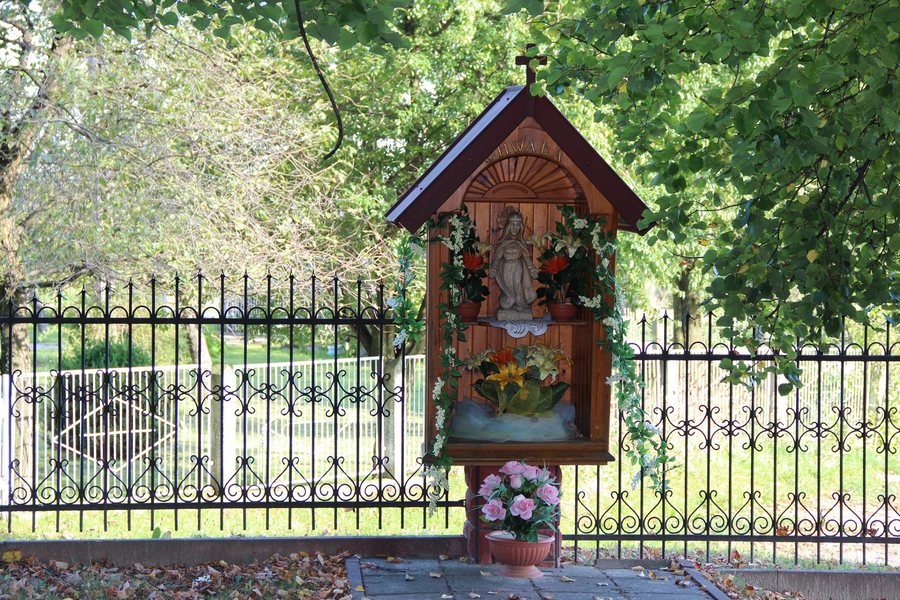
Gilów at a glance
- The filial Church of St. Jadwiga is a listed historic building dating from the 16th to the 18th century; its complex includes an enclosing wall and a gate at the parish church.
- The palace was built around the turn of the 17th and 18th centuries and was given a Neoclassical design in the mid-19th century.
- The hillfort site lies east of Gilów on a partly rocky hill 281 metres high.
- The yellow hiking trail passes through Gilów and is a long, easy day hike along its entire route.
Which historic buildings define Gilów?
St. Jadwiga and the Church of the Sacred Heart of Jesus represent different periods of construction. St. Jadwiga dates from the 16th to the 18th century. The enclosing wall and gate at the parish church complement the church complex. The Church of the Sacred Heart of Jesus, by contrast, dates from the mid-19th century; its tower was built in 1939. Gilów’s buildings thus offer a way to explore several clearly distinct periods in the village’s history.
The palace also has distinctive architectural features: the two-storey building has a rectangular floor plan, a hipped roof, and dormer windows. It was originally built for the Tschirsky family. In the mid-19th century, the Nitschke family gave it a Neoclassical design with a columned portico and a loggia accessible from the park. An unkempt park lies to the east of the palace. These details help place the building’s history and its different features in context.
Another historic connection can be found in the Church of the Sacred Heart of Jesus: its Neo-Renaissance altar originally came from the former convent of the Grey Sisters in Gilów. The altar’s origins link it to a former religious institution in the village, without conflating it with the church’s construction period or the building of its tower.
What is known about the Gilów hillfort site?
East of Gilów, near the road from Gilów to Niemcza, the hillfort site lies on a partly rocky hill at an elevation of 281 metres. It covers approximately 4.5 hectares. The surviving ramparts are up to 8 metres high and up to 12 metres wide at the base. The height and width refer to the surviving ramparts; the area of the site is explicitly approximate.
The large hillfort site was a fortified complex and was used for only a short time. It was built by a population group that came from the Great Moravian Empire into territories controlled by the Ślężans. Alongside the churches and palace, it is another historic site in the area around the village, with a history that connects to a wider regional context.
How can you factor the hiking trail into your travel plans?
The yellow hiking trail runs from Bielawa to Gromnik, passing through Myśliszów, Owiesno, Piława Dolna, Marianówek, Gilów, Niemcza, Wojsławice, and Piotrówek. It connects the Owl Mountains with the Niemczańsko-Strzelińskie Hills. The route is long but easy; completing it takes a full day. If you plan to hike this trail, you can count Gilów among the places along the route and plan your day around the entire distance.
What should you consider when choosing a hotel in Gilów?
The route takes a full day, while the buildings showcase the village’s history through different periods and architectural features.
If you’d like to compare other local pages, find information about Dzierżoniów, Pieszyce, Niemcza, Bielawa, and Mościsko.
FAQ
How large is the Gilów hillfort site?
It covers approximately 4.5 hectares. The surviving ramparts are up to 8 metres high and up to 12 metres wide at the base.
How long does the full hike take?
The long, easy yellow hiking trail from Bielawa to Gromnik takes a full day to complete.
Which historic churches are in Gilów?
Gilów has the filial Church of St. Jadwiga and the Church of the Sacred Heart of Jesus. They date from different periods; the tower of the latter church was built in 1939.
For the wider travel overview: Dzierżoniów.

