
Bojszów
Accommodation in Bojszów
Bojszów combines a significant wooden church with historic crosses and routes through the village. If you are planning a cultural trip, you will find concrete starting points here to help guide your choices.
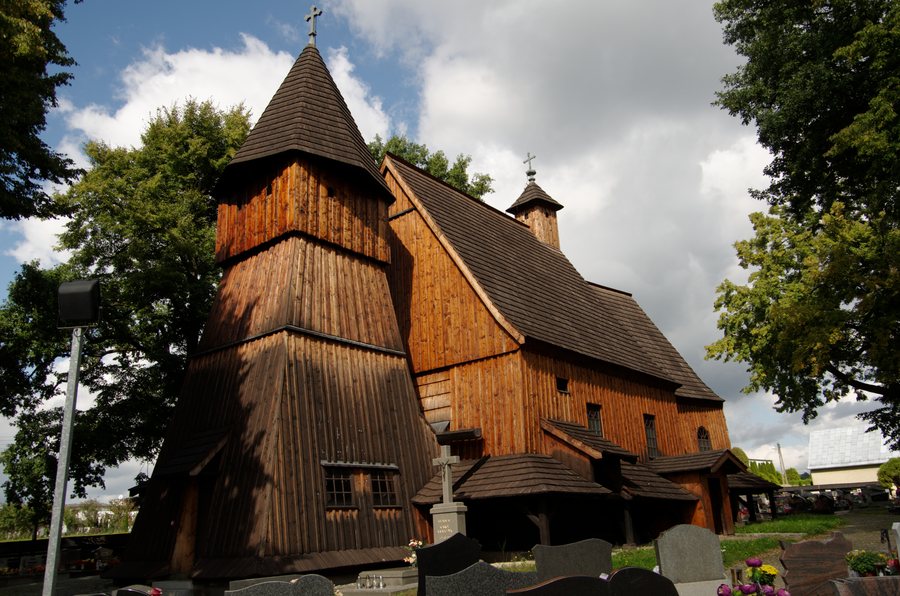 File:Kościół Wszystkich Świętych w Bojszowie bok Q11745929.jpg
Photo: Aneta Kolonko via Wikimedia Commons, CC BY-SA 4.0
File:Kościół Wszystkich Świętych w Bojszowie bok Q11745929.jpg
Photo: Aneta Kolonko via Wikimedia Commons, CC BY-SA 4.0
Bojszów at a glance
- The Church of All Saints (pw. Wszystkich Świętych) stands in the village center at the intersection of Kościelna and Szkolna streets.
- The wooden church is on the Silesian Wooden Architecture Trail and is considered one of Poland’s oldest wooden churches.
- The green Szlak Stulecia Turystyki trail and cycling route 402 pass through Bojszów.
- The churchyard dates from the late 16th century; its wooden enclosure was built in 1728.
What makes the church in Bojszów special?
The Church of All Saints (pw. Wszystkich Świętych) is a distinctive landmark in the village center. Its wooden log construction makes the building technique an immediate focus of a visit. Its classification is also notable: it is considered one of Poland’s oldest wooden churches and is on the Silesian Wooden Architecture Trail. This makes Bojszów particularly well suited to exploring the subject of wooden architecture.
Inside, the design is predominantly Baroque, while also featuring Late Gothic elements. This combination of different stylistic features adds another cultural perspective to the impression made by the wooden structure. For travelers interested in church art and regional architectural forms, Bojszów offers more than a single architectural feature: the church’s construction, style and location on the Wooden Architecture Trail are distinct aspects to consider when exploring the village.
What historical details can you find at the churchyard?
The churchyard dates from the late 16th century. Its wooden enclosure dates to 1728. Old trees grow around the church and churchyard. These details refer to different parts of the ensemble: the age of the churchyard, the year the enclosure was built and the trees in its surroundings. This makes it possible to consider the site through its individual features without reducing it to a single construction date.
Crosses are also part of the village’s cultural character. The stone cross next to the church and churchyard at Kościelna 1 dates from the late 19th century. Granite plaques on the memorial cross at Kościelna 1 bear the names of the fallen. Another stone cross near 20 Kościuszki Street is an example of traditional religious roadside architecture, typical of Silesian villages. Those interested in regional religious monuments can consider these different features as distinct topics.
Which routes pass through Bojszów?
The green Szlak Stulecia Turystyki trail passes through Bojszów. Cycling route 402 also runs through the village, from Gliwice railway station to Rudziniec railway station. This distinguishes two different travel interests: the green trail and a cycling route whose named endpoints are railway stations. Which route is most relevant to your plans depends on whether you want to explore the village in connection with the hiking trail or the cycling route.
The area around Bojszów is also suitable for peaceful relaxation and discovering the cultural heritage of the Rudziniec municipality. Together with the wooden church, churchyard and crosses, this offers a cultural reason to include the village in your travel plans. If you would like to compare other destinations, you can also view the pages for Rudziniec, Knurów, Paczynka, Poniszowice, Paniówki, Chudów, Przyszowice and Niewiesze.
FAQ
Where is the Church of All Saints (pw. Wszystkich Świętych)?
It stands in the center of Bojszów at the intersection of Kościelna and Szkolna streets.
What architectural features does the church have?
It has a wooden log construction. Its interior is predominantly Baroque in style and includes Late Gothic elements.
Which routes pass through the village?
The green Szlak Stulecia Turystyki trail and cycling route 402 pass through Bojszów. The cycling route runs from Gliwice railway station to Rudziniec railway station.
What historical dates are associated with the churchyard?
The churchyard dates from the late 16th century; the wooden enclosure dates to 1728. The stone cross next to the church and churchyard at Kościelna 1 dates from the late 19th century.
For the broader travel overview: Gliwice.

