
Knurów – Sacred Heritage and a Miners’ Settlement
Accommodation in Knurów
Knurów combines sacred buildings with a historic miners’ settlement. Also here are the salt cave on Szpitalna Street and the seasonal Leśne Zacisze outdoor swimming pool. This lets you consider different sides of the city when planning your trip: religious heritage, settlement history, and leisure activities.
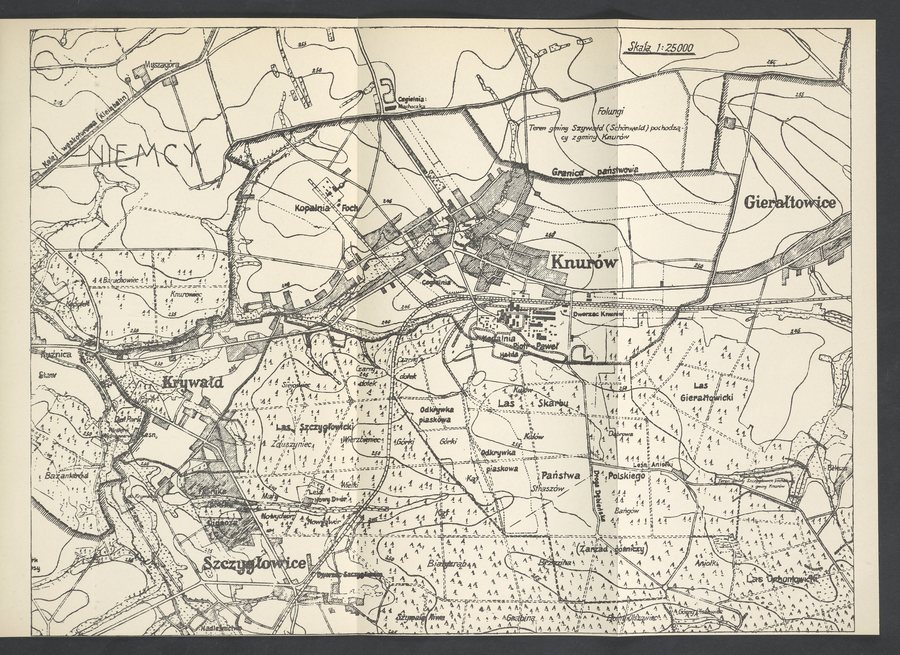 File:Knurow i Krywald 1937 (108923429).jpg
Photo: Alojzy Koziełek via Wikimedia Commons, Public domain
File:Knurow i Krywald 1937 (108923429).jpg
Photo: Alojzy Koziełek via Wikimedia Commons, Public domain
Knurów at a glance
- The Chapel of Saint Barbara was built in 1887 and is considered the oldest sacred building in Knurów.
- The III Kolonia Robotnicza was established between 1903 and 1921 as a company settlement for miners.
- The Church of Saint Anthony of Padua in Krywałd houses a copy of the Piękna Madonna z Knurowa, a sculpture dating from 1420.
- The Leśne Zacisze outdoor swimming pool is seasonal; a Metrorower bike-sharing station is also located there.
Which sacred buildings shape Knurów?
The Neo-Gothic Chapel of Saint Barbara links a specific construction date with local history: it was built in 1887 with funds from Paulina Güttler, the owner of the local powder factory. In addition to its architectural character, its status as the city’s oldest sacred building is a defining part of its significance. The chapel thus offers a distinctive way to explore Knurów’s religious heritage.
Another place of worship is the Church of Saint Anthony of Padua in Krywałd. This historic building is protected by the voivodeship heritage conservation authority. The church houses a copy of the Piękna Madonna z Knurowa; the sculpture referred to by the name dates from 1420. Services in honor of the Piękna Madonna are held there regularly, once a month. The building, sculpture, and services each represent different aspects of this religious site.
What does the III Kolonia Robotnicza tell us?
The III Kolonia Robotnicza is a company settlement built for miners. Its houses were built between 1903 and 1921 along a road that runs through Knurów. The settlement can therefore be understood both in terms of when it was established and its purpose: it was intended for the mining workforce.
The design also sets the colony apart. The houses draw on traditional Silesian building styles and English models. Each dwelling had its own garden plot. These features give the settlement a distinct character without reducing its architecture to a single influence. Those interested in regional building styles or the history of workers’ settlements will find a different focus here than at Knurów’s sacred buildings.
What other places are part of the cityscape?
The salt cave, or graduation tower structure, on Szpitalna Street is considered a landmark and attraction of Knurów. It adds another urban point of interest to the historic buildings. A Metrorower bike-sharing station is located at the seasonal Leśne Zacisze outdoor swimming pool. The pool and the station thus share a named location; the seasonal designation applies to the pool.
Another change in the cityscape can be seen on Spacerowa Street: the historic cemetery there is now Park Pamięci. The place name reflects its current use as a park, while its former role as a cemetery remains part of its history. Together with the chapel, church, and miners’ settlement, this place offers a view of various historical and present-day aspects of Knurów.
If you would like to compare other destination pages in the catalog, you can also explore Paczynka, Rudziniec, Bojszów, Przyszowice, Pyskowice, Poniszowice, Gliwice and Paniówki.
FAQ
Which sacred building is considered the oldest in Knurów?
The Chapel of Saint Barbara is considered the city’s oldest sacred building. It was built in 1887.
When was the III Kolonia Robotnicza established?
The company settlement built for miners was constructed between 1903 and 1921.
Where is there a Metrorower station?
A Metrorower bike-sharing station is located at the Leśne Zacisze outdoor swimming pool in Knurów.
For the higher-level travel overview: Gliwice.

.jpg)