
Discover Bóbrka’s oil history and Neo-Gothic architecture
Accommodation in Bóbrka
Bóbrka combines the history of oil extraction with a museum at the site of a historic mine and a Neo-Gothic church. A tourist cycling route also leads to Bóbrka. Whether you are choosing between industrial history, architecture and a cycling tour, you will find distinct, clearly defined highlights here.
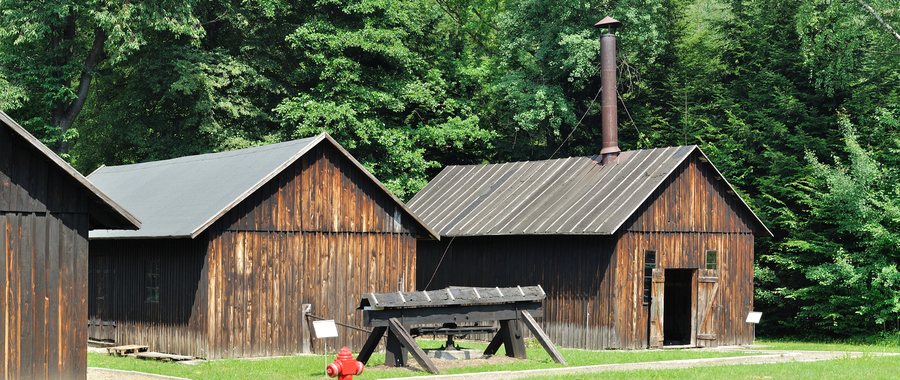 The boiler house and the treadmill in Museum of Oil and Gas Industry in Bóbrka
Photo: Kroton via Wikimedia Commons, CC BY-SA 3.0 pl
Bóbrka at a glance
- The Ignacy Łukasiewicz Museum of Oil and Gas Industry was established at the site of the oil mine founded in 1854.
- Between 1854 and 1880, more than 60 hand-dug shafts were created there, reaching depths of up to 150 metres.
- The exhibition covers about 20 hectares. The Franek and Janina shafts date from 1860 and are still in operation today.
- The Neo-Gothic church was built in 1905 to designs by Teodor Talowski.
- A tourist cycling route leads from Kopytowa through Zręcin, Szczepańcowa and Wrocanka to Bóbrka.
What does the oil mine tell us about Bóbrka?
The Ignacy Łukasiewicz Museum of Oil and Gas Industry is located at the site of the mine that Ignacy Łukasiewicz founded in 1854. The municipality describes it as the oldest oil mine in the world. Its history can also be understood through concrete figures: from 1854 to 1880, more than 60 shafts were dug by hand, reaching depths of up to 150 metres. Franek and Janina, both dating from 1860, are still in operation today.
These details reveal different aspects of oil extraction: the long period during which the shafts were created, their considerable depth, and two named examples that remain in operation. The museum’s exhibition on oil mining covers about 20 hectares. Bóbrka therefore highlights not only the origins of the mine but also an extensive exhibition devoted to the subject.
What educational activities does the museum offer?
The activities are intended for specific age groups and school grades. For school classes in grades 6 to 8, the museum offers a lesson on the history of oil drilling; sessions must be booked in advance. At “Naftusia,” pupils learn about three drilling technologies in a hands-on way using selected exhibits.
Another workshop is intended for kindergarten children and pupils in grades 1 to 4. It concludes with the children making an oil lamp. The two formats therefore have different emphases: the activity for older classes covers drilling technologies and the history of oil, while making a lamp is part of the workshop for younger groups.
What does the Neo-Gothic church show?
Alongside industrial history, architecture is another documented theme in Bóbrka. The Neo-Gothic church was built in 1905 to the designs of architect Teodor Talowski. “Neo-Gothic” describes an architectural style that revives forms from the earlier Gothic period. The year and architect give the church a clear historical and architectural point of reference, distinct from the focus on the oil mine.
Those primarily interested in the history of oil extraction will find figures, named shafts and a dedicated exhibition on the subject in Bóbrka. The church offers a different focus: its significance is defined by its architectural style, year of construction and architect. Together, these themes show two different sides of the place, without assuming that visitors have the same interests.
Which cycling route leads to Bóbrka?
A tourist cycling route leads from Kopytowa through Zręcin, Szczepańcowa and Wrocanka to Bóbrka. The sequence of place names provides a concrete guide to the route. When planning a cycling trip, it is also worth checking current route conditions locally before setting off.
The route offers a different approach to travel planning than the museum and architecture themes: here, the connection between the places along the cycling route is the relevant point of reference.
Discover more destinations: Tylawa, Węglówka, Jedlicze, Krosno, Korczyna, Wisłoczek, Iwonicz-Zdrój, Moderówka.
FAQ
How large is the oil-mining exhibition?
It covers about 20 hectares.
Which groups are educational activities available for?
For school classes in grades 6 to 8, there is a lesson on the history of oil drilling, which must be booked in advance. A workshop involving oil-lamp making is intended for kindergarten children and pupils in grades 1 to 4.
Which places does the cycling route to Bóbrka connect?
It leads from Kopytowa through Zręcin, Szczepańcowa and Wrocanka to Bóbrka. Check current route conditions locally.
Go to the broader travel overview: Krośnieński.

