
Iwonicz-Zdrój: Spring Paths and Historic Buildings
Accommodation in Iwonicz-Zdrój
Iwonicz-Zdrój can be explored from various perspectives: Bełkotka is a mineral spring and a natural monument, several hiking trails have named routes, and historic buildings shape the town’s history. These points of interest can help you weigh your interests in nature and culture when planning your trip.
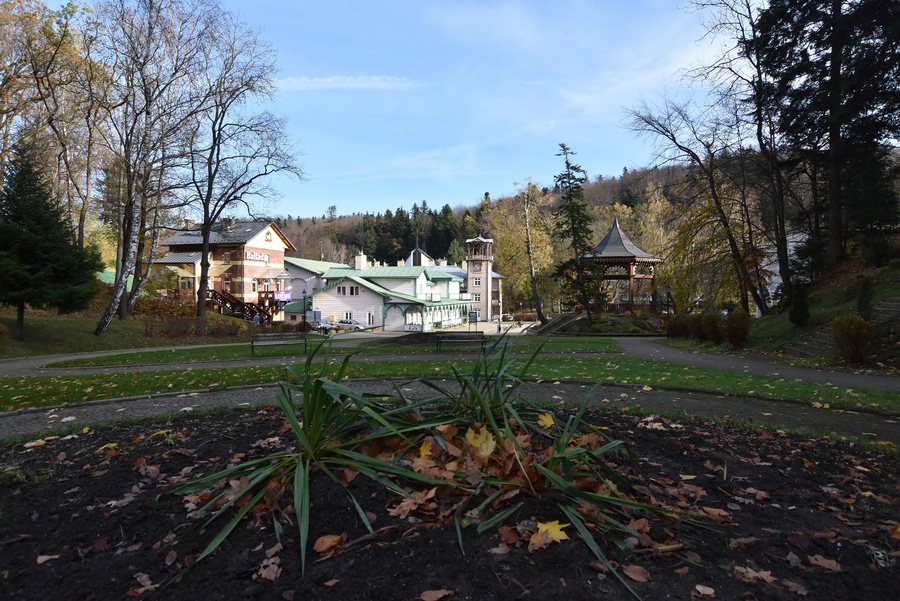
Quick Facts about Iwonicz-Zdrój
- Bełkotka is the oldest spring in Iwonicz-Zdrój and lies on the slopes of Mount Przedziwna.
- A hiking trail leads from the CIT through the Bełkotka stream valley to the spring and onward to Przedziwna, also known as Łysówka.
- The Bazar was built as a two-storey building in 1875; the Stary Pałac is considered the oldest building in the town.
Which nature and hiking destinations are named?
Bełkotka has two specific features: it is described as a mineral spring and is also a natural monument. As the oldest spring in Iwonicz-Zdrój, it also has a special place among the town’s springs. Its location is given as the slopes of Mount Przedziwna. The name of this mountain also appears in the hiking trail description as a destination; there it is additionally called Łysówka.
This hiking trail starts at the CIT. From there, it runs through the Bełkotka stream valley to its springs and continues up Mount Przedziwna. At the pass below, it meets a white-and-green-marked trail. The route can therefore be followed using the named waypoints, without adding a hiking time or distance to the description.
Another marked trail is the white-and-red Armia Krajowa Trail. It leads from Iwonicz-Zdrój to Las Grabiński in Iwonicz. The destinations are therefore clearly distinct: the trail from the CIT leads to the springs of the Bełkotka stream and then up the mountain, while the Armia Krajowa Trail leads to Las Grabiński.
There is also a precisely identified landmark on the footpath to the Bełkotka spring: at the intersection of Aleja Naftowa and Aleja Wincentego Pola stand four freestanding wooden graduation towers. Their number, construction and location provide a specific reference point for planning your trip.
Which historic buildings and features shape the town?
The Stary Pałac was the summer residence of the Załuski family and is considered the oldest building in Iwonicz-Zdrój. The Bazar offers a different historical connection: it was built as a two-storey building in 1875. The history of the architecture therefore focuses on a building with a named former function and one with a documented construction date.
The former parish church in Iwonicz-Zdrój has a Neo-Gothic main altar and two eclectic side altars dating from the late 19th century. The different style descriptions apply to the altars: the main altar is Neo-Gothic, while the two side altars are eclectic. The promenade and Dietl Square together form the axis of Iwonicz-Zdrój’s built-up area. Information about the buildings and the town’s urban layout thus complements its nature and hiking themes.
To help you choose, you can first consider whether you are especially interested in the spring and named hiking trails or in the historic buildings. Bełkotka, the trail routes, the graduation towers and the buildings offer different specific topics through which you can get to know Iwonicz-Zdrój better. You can also find Chyrowa, Krosno, Moderówka, Wrocanka, Odrzykoń, Wisłoczek, Krasna and Jedlicze in this travel section.
FAQ
What is Bełkotka?
Bełkotka is a mineral spring and a natural monument. It is considered the oldest spring in Iwonicz-Zdrój and lies on the slopes of Mount Przedziwna.
Where does the white-and-red-marked Armia Krajowa Trail lead?
It leads from Iwonicz-Zdrój to Las Grabiński in Iwonicz.
Which historic altars are mentioned for the former parish church?
It has a Neo-Gothic main altar and two eclectic side altars dating from the late 19th century.
For the overarching travel guide: Krośnieński.

.jpg)