
Tyrawa Solna
Accommodation in Tyrawa Solna
Tyrawa Solna offers several distinct points of interest to consider when planning a trip: a wooden church with its own history of construction, the Warzelnia spring and its location within the Góry Słonne Landscape Park. A rafting route on the San also ends nearby. This lets you consider cultural, landscape and water-related interests separately, without presenting them as a single visit offering.
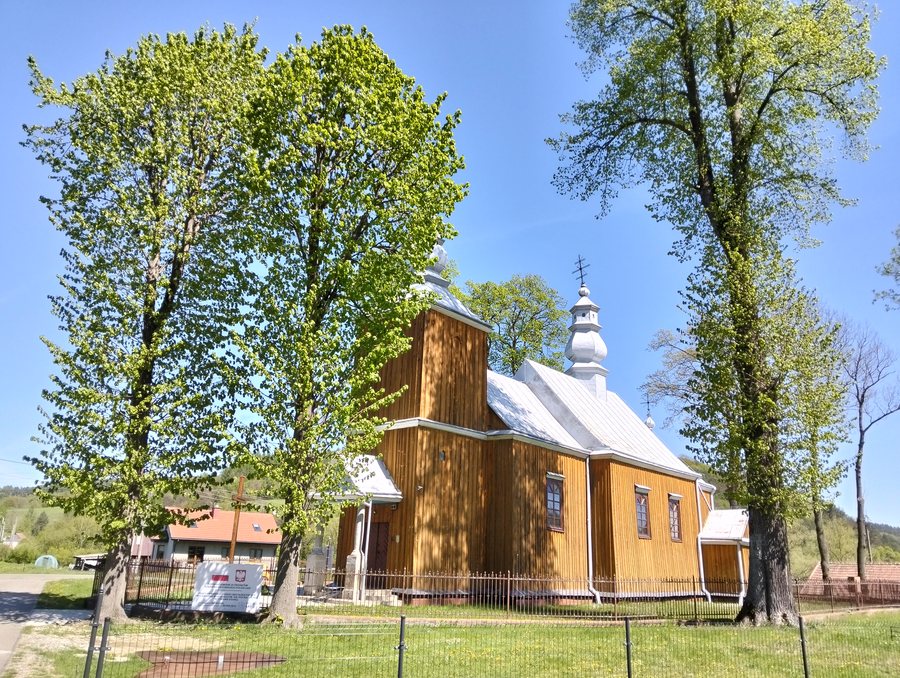
Tyrawa Solna: key facts
- The current church was built in 1837 and is a wooden log structure.
- Its interior polychrome decoration dates from 1927.
- Tyrawa Solna is located within the Góry Słonne Landscape Park.
- The Warzelnia spring is a legally protected natural monument of inanimate nature.
- The village was known for extracting salt from brine.
What makes the wooden church distinctive?
The church is a specific cultural point of interest in Tyrawa Solna. Its construction combines two different methods: the building is a wooden log structure, while the tower is built using a post-and-beam construction. Thus, the main body and the tower differ not only in form but also in their described construction methods. Those interested in traditional wooden buildings can take these features into account when learning about the church.
The two dates also refer to different aspects of the building. The current church was built in 1837; the interior polychrome decoration—that is, the multicoloured treatment of the interior—dates from 1927. This distinction in time helps keep the building’s history separate from its interior design. The church can therefore be considered both in terms of its wooden construction and the later date of its interior polychrome decoration.
What natural features are associated with the village?
Tyrawa Solna is located within the Góry Słonne Landscape Park.
The Warzelnia spring is a natural attraction in its own right. It is legally protected as a natural monument and classified as inanimate nature. This classification distinguishes it from protected sites focused on plants or animals. Travellers interested in natural monuments and landscape protection can consider Warzelnia and the landscape park as two distinct aspects of Tyrawa Solna’s natural setting.
What role do brine and the rafting route play?
Tyrawa Solna was known for extracting salt from brine. This connection with brine adds an economic-history dimension to the village’s cultural and landscape features. For orientation, the main point of interest is the connection between the village’s name and this former significance.
A rafting route on the San ends near Tyrawa Solna and Mrzygłód. This makes rafting a separate possible interest in the surrounding area. The stated endpoint is the key geographical connection: the route is not described as an activity within the village itself.
Which other places can you compare?
If you would like to include other destinations in your selection, you can also find Nowy Łupków, Bukowsko, Dębna, Rzepedź, Wysoczany, Mokre, Kalnica and Tarnawa Dolna here. Use the place names as a starting point for your own comparison; their shared links do not imply anything about distances or a common route.
FAQ
When was the current church built?
The current church in Tyrawa Solna was built in 1837.
What is known about the church’s interior?
The church has interior polychrome decoration dating from 1927.
What is the Warzelnia spring?
Warzelnia is a legally protected spring and a natural monument of inanimate nature.
Where does the rafting route on the San end?
It ends near Tyrawa Solna and Mrzygłód.
To the main travel overview: Sanok.

_03.jpg)