
Kielce: Discover Culture and History
Accommodation in Kielce
The destinations mentioned are quite different: Tokarnia focuses on rural architecture and settlement patterns, Oblęgorek on the life and work of Henryk Sienkiewicz, Chęciny on a medieval royal castle, and Święty Krzyż on an active monastery. First consider which of these themes you want your trip to focus on; you can then choose a hotel based on your own travel plans.
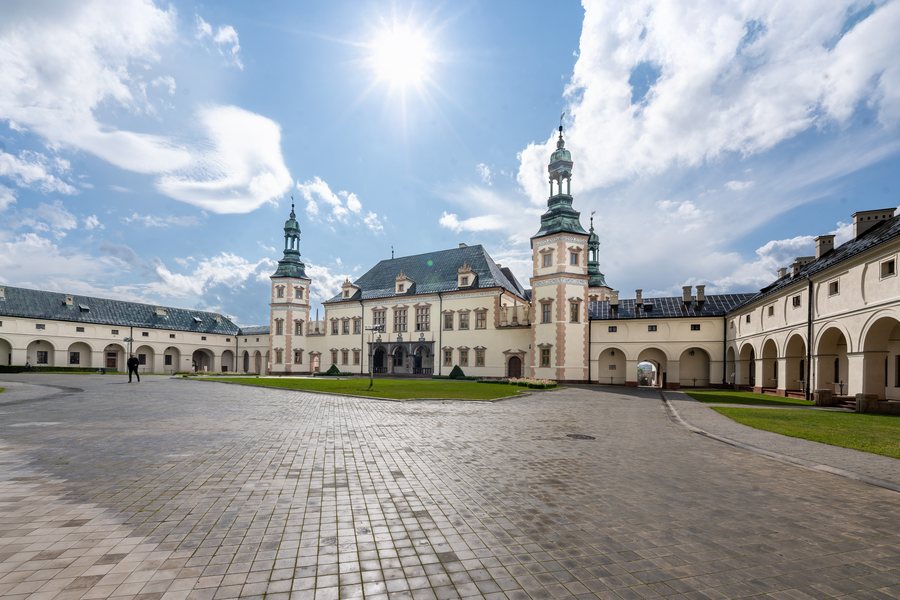 Courtyard of the Bishops’ Palace in Kielce
Photo: Krzysztof Popławski via Wikimedia Commons, CC BY 4.0
Kielce facts
The Ethnographic Park in Tokarnia covers more than 65 hectares and contains over 80 historic buildings, including farmhouses, barns, windmills, churches and manor houses. It aims to recreate typical village settlement patterns from four subregions of the Kielecczyzna: the Świętokrzyskie Mountains, the Kraków-Częstochowa Upland, the Sandomierz Upland and the Nida Basin. In 1958, Poland’s first museum devoted to the life and work of Nobel Prize winner Henryk Sienkiewicz opened in the manor house at Oblęgorek. In the Middle Ages, the Royal Castle in Chęciny was one of the Crown’s most important fortresses.
What does the Ethnographic Park in Tokarnia showcase?
The collection of historic buildings ranges from farmhouses and barns to windmills, churches and manor houses. Residential and agricultural buildings stand alongside religious and aristocratic architectural styles. The park’s concept is also important for understanding it: it aims not only to showcase individual buildings, but to recreate typical village settlement patterns from four subregions. Those interested in regional architecture and settlement patterns can thus broaden their perspective from individual buildings to the structure of a village.
The four subregions give the project a broad geographical scope: the Świętokrzyskie Mountains, the Kraków-Częstochowa Upland, the Sandomierz Upland and the Nida Basin. These names indicate different areas of the Kielecczyzna, but do not allow the specific origin of each individual building to be determined. Groups and individual visitors can take themed guided tours; reservations are required. So plan ahead if you want a guided tour to be part of your visit.
What historical themes can you encounter at other places?
Henryk Sienkiewicz is the focus at Oblęgorek. The museum, which opened in 1958, was the first in Poland devoted to the life and work of the Nobel Prize winner. His living quarters have been reconstructed in the historic rooms on the manor house’s ground floor. They include a study, living room, dining room, smoking room and bedroom. The rooms bring the site’s personal and literary-historical focus to life, offering a different perspective from Tokarnia’s broad presentation of historic architectural styles.
Chęciny offers another focal point: in the Middle Ages, its Royal Castle was one of the Crown’s most important fortresses. At Święty Krzyż, meanwhile, the monastery is an active religious institution. The Benedictine order once served there; today, it is home to the Missionary Oblates of Mary Immaculate. A medieval fortress and a monastery with an active religious community thus stand alongside the literary museum and Tokarnia’s rural architecture. These differences can help you weigh your travel group’s cultural interests as you plan.
What should you plan for tours and routes?
Reservations are required for themed tours of the Ethnographic Park in Tokarnia. When travelling to other destinations in the wider region, bus information is another planning consideration. Before travelling to Raj Cave, check with the operator whether city bus route No. 31 is currently running. The “Jaskinia Raj” stop is about 1,300 metres, or a 15–20-minute walk, from the cave entrance.
City bus route 31 towards Chęciny stops on Żytnia Street in Kielce. As routes and stops may change, check the operator’s current information for this connection before travelling as well. Another option for exploring the wider region is the red Sylwester Kowalczewski hiking trail between Kielce and Chęciny. It is about 20 kilometres long, starts at Góra Karczówka in Kielce, ends at the market square in Chęciny and passes Raj Cave. The roughly 1.3 kilometres between the “Jaskinia Raj” bus stop and the cave entrance is a much shorter distance than the full hiking trail; the two figures help you distinguish between different route lengths when planning.
Discover more destinations: Kielce, Bęczków, Zaborowice, Daleszyce, Masłów, Cedzyna, Chęciny, Ciosowa, Cisów, Chałupki, Suchedniów, Wielebnów, Płucki, Jaworznia, Miedziana Góra, Stara Słupia, Tokarnia, Święta Katarzyna, Sitkówka, Micigózd, Brynica, Mniów, Rykoszyn, Bieliny, Polichno, Kołomań, Nowa Huta, Piekoszów, Krajno Pierwsze, Lechów, Ciecierze, Radlin, Zagnańsk, Chmielnik, Nowa Słupia, Borków, Strawczyn, Chrusty, Górno, Bodzentyn, Huta Nowa, Łopuszno, Milanowska Wólka, Niestachów, Snochowice.
FAQ
How many historic buildings are in the park in Tokarnia?
The Ethnographic Park contains over 80 historic buildings, including farmhouses, barns, windmills, churches and manor houses.
Do you need to reserve a themed tour in Tokarnia?
Yes. Themed guided tours are available for groups and individual visitors; reservations are required.
How long is the hiking trail between Kielce and Chęciny?
The red Sylwester Kowalczewski hiking trail is about 20 kilometres long. It starts at Góra Karczówka in Kielce, ends at the market square in Chęciny and passes Raj Cave.
See the overview of the wider region: Świętokrzyskie.

