
Discover Klimontów: Churches, Synagogue and Loess Landscapes
Accommodation in Klimontów
Klimontów combines a rich architectural history with a landscape shaped by loess valleys and ravines. The following facts can help you consider cultural interests and travel arrangements together when choosing your destination.
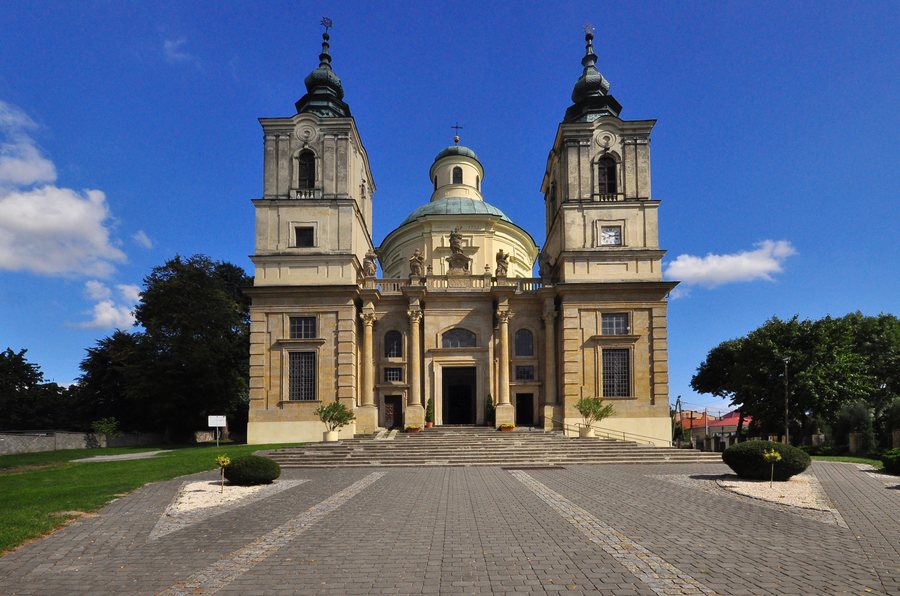 The front of the Church of St. Joseph in Klimontów, Poland
Photo: Andrzej2021 via Wikimedia Commons, CC BY-SA 4.0
The front of the Church of St. Joseph in Klimontów, Poland
Photo: Andrzej2021 via Wikimedia Commons, CC BY-SA 4.0
Klimontów at a glance
Klimontów was founded around 1240 by Klemens, the castellan of Kraków; the town’s name derives from his. It lies at the intersection of National Road No. 9 (Radom–Barwinek) and Voivodeship Road No. 758 (Iwaniska–Tarnobrzeg). For a journey from Kielce, the described route follows National Road No. 74 to Opatów, then National Road No. 9 towards Rzeszów and via Lipnik. Check the current route before setting off.
Which buildings and stories shape Klimontów?
St. Jack’s Church was built between 1617 and 1620 and consecrated by Bishop T. Oborski on 10 July 1633. The church contains a copy of the miraculous image of Our Lady of the Rosary, dating from the first third of the 15th century. It is part of the former Dominican monastery, whose architecture combines late Gothic, Mannerist and early Baroque forms. The church interior is decorated in Baroque and Rococo styles.
The synagogue also has distinctive architectural features: behind the Ionic portico, two transverse staircases lead to the women’s gallery. The partition between the main hall, vestibule and women’s gallery has been preserved. The synagogue is the only surviving material remnant of the former Jewish population in the Klimontów landscape; it is not usually in use. The different architectural forms and their historical associations give the town a distinctive cultural character.
Another point of comparison is the Collegiate Church of St. Joseph, which resembles St. Peter’s Basilica in Rome. Klimontów is also the birthplace of Wiktor (Bruno) Jasieński. Together, these connections offer different ways to explore the town’s history, from sacred architecture to a personal connection with the place.
What does the landscape offer, and when is the fair held?
A very dense network of loess valleys and ravines shapes the landscape around Klimontów, complementing the Koprzywianka Valley. This means that, alongside the buildings, the terrain is also a key consideration when deciding which aspects of a destination interest you. The landscape is an integral part of the town’s character and adds a natural perspective to its cultural impressions.
The Jarmark na św. Jacka (St. Jack’s Fair) is held annually from 15 to 17 August. Exact dates may vary in future years, so check the dates for the relevant edition before travelling.
What visitor information is available locally, and how can you plan your journey?
The tourist information office is located in the Public Municipal Library, at 19 Krakowska Street, Klimontów. It provides information about sacred and secular architectural monuments in the municipality. As location details and services may change, confirm the information before visiting in person.
Two details are useful for planning your drive: Klimontów lies at the intersection of the aforementioned national and voivodeship roads, and the described route from Kielce goes via Opatów and Lipnik. This is route guidance, not an indication of journey time or traffic conditions. Check the route for your travel date. When choosing accommodation to suit your travel interests, you can also consider whether architectural history, the landscape or the fair is your main priority.
If you’d like to compare more destinations, also discover Samborzec, Sandomierz, Ocinek, Koprzywnica, Dwikozy, Kolonia Gałkowice, Wielogóra and Pielaszów.
FAQ
What is known about the history of St. Jack’s Church?
It was built between 1617 and 1620 and consecrated by Bishop T. Oborski on 10 July 1633. It contains a copy of a miraculous image dating from the first third of the 15th century.
When is the Jarmark na św. Jacka held?
Annually from 15 to 17 August. Exact dates may vary in future years; check the date before travelling.
Where can you get information about the architectural monuments?
The tourist information office is located in the Public Municipal Library, at 19 Krakowska Street, and provides information about sacred and secular architectural monuments in the municipality. Confirm the location and services before visiting in person.
For the broader travel overview: Sandomierz County.

