
Discover Koprzywnica
Accommodation in Koprzywnica
Koprzywnica combines a reservoir with a distinctive Easter custom and buildings from different periods. These facts will help you get a sense of what the town has to offer and plan your trip around the lake, local traditions, architecture or a longer route.
Koprzywnica at a glance
The reservoir consists of the “DANUSIA” and “HANIA” basins, which cover a total of 17 ha. Every year, the municipal authorities set up a supervised bathing area at the lake for two months, staffed by two WOPR lifeguards. The town’s cultural heritage includes the Bziuki, an Easter custom added to Poland’s National List of Intangible Cultural Heritage in 2021. Church architecture and a 52.5 km loop through several towns also offer more ways to explore the area.
What should you plan for a visit to the reservoir?
If you are considering Koprzywnica for its supervised bathing area, bear in mind that it is seasonal: the area is set up for two months each year. Check the dates and regulations for the relevant season locally when planning your trip. This lets you consider the lake as a possible focus for your visit without assuming specific bathing dates.
The two basins have their own names: the main basin is called “DANUSIA” and the second “HANIA”. Together, they make up the 17 ha reservoir. These details describe the lake as a place to consider when planning your trip; the supervised bathing area is a separate, time-limited offering. So if swimming is your main priority, check when the area is set up for the season. If you are more interested in the town’s character or local traditions, the topics below offer other ways to shape your visit.
What are the Bziuki?
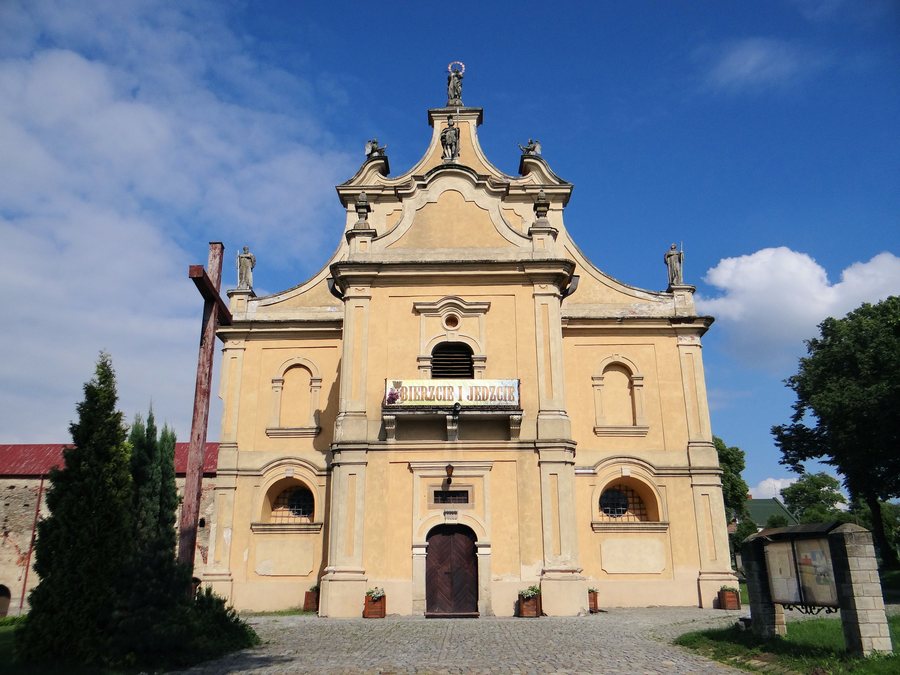
The Bziuki are Koprzywnica’s Easter fire-blowing custom. The Church of Matki Boskiej Różańcowej is associated with the Bziukanie tradition, which has been observed for more than 100 years: the fire is blown during the Easter Resurrection celebration on Holy Saturday. In 2021, the Bziuki were added to Poland’s National List of Intangible Cultural Heritage. This connects a specific festive custom with a long-standing local tradition and its later recognition as intangible cultural heritage.
When choosing a theme for your visit, it helps to distinguish between local traditions and architectural history: the Bziuki are an Easter custom, while the churches and monastery offer further cultural points of interest through their architectural details. Koprzywnica is also located on the so-called European Cistercian Route.
Which buildings and details define the town?
The Baroque tower of the Church of św. Floriana is visible from afar and has a distinctive shape: it resembles an upside-down, bottomless chalice and is called a “kulawka”. The same church houses the sarcophagus of the Niedrzwicki family, created by Santi Gucci in 1581. The fully preserved Romanesque stepped portal with its smooth tympanum is another striking architectural detail.
Another landmark is the Church of Matki Boskiej Różańcowej on the market square, which forms part of the town layout dating from the 13th century. The chapter house is in the eastern wing of the monastery: a spacious room with a stone floor and a stone cross vault supported by two columns. The tower, portal, sarcophagus, market square and chapter house offer different points of interest if you want to explore Koprzywnica through its architecture and history rather than its reservoir.
What is the route of the loop through Koprzywnica?
The 52.5 km Klimontów–Sulisławice–Koprzywnica loop passes through Koprzywnica at kilometre 18.5. The route runs from Klimontów through Byszów, Jachimowice, Sośniczany, Błonie, Koprzywnica, Sulisławice, Bukowa, Wiązownica Kolonia, Smerdyna, Jurkowice, Nawodzice and Szymanowice Dolne, then back to Klimontów. This places Koprzywnica within a route that takes in several named towns. Check current route conditions before setting out.
Discover more destinations: Klimontów, Samborzec, Konary, Czyżów Szlachecki, Kolonia Gałkowice, Pielaszów, Sandomierz, Ocinek.
FAQ
How large is the reservoir in Koprzywnica?
The “DANUSIA” and “HANIA” basins cover a total of 17 ha.
When is the supervised bathing area open?
The municipal authorities set it up for two months each year and staff it with two WOPR lifeguards. Check the specific dates for the season locally.
Which places does the 52.5 km loop connect?
It runs from Klimontów through Byszów, Jachimowice, Sośniczany, Błonie, Koprzywnica, Sulisławice, Bukowa, Wiązownica Kolonia, Smerdyna, Jurkowice, Nawodzice and Szymanowice Dolne, then back to Klimontów.
For the wider travel overview: Sandomierz County.

