
Ampoița: Limestone Formations, Archaeology and Biserica
Accommodation in Ampoița
Ampoița can be explored through several clearly distinct themes: geological formations, protected landscapes, a settlement history reaching far back in time, and the Biserica din Ampoița. This gives the place an interesting basis for travellers who do not want to view nature and culture separately, but instead wish to compare different focuses when planning their trip.
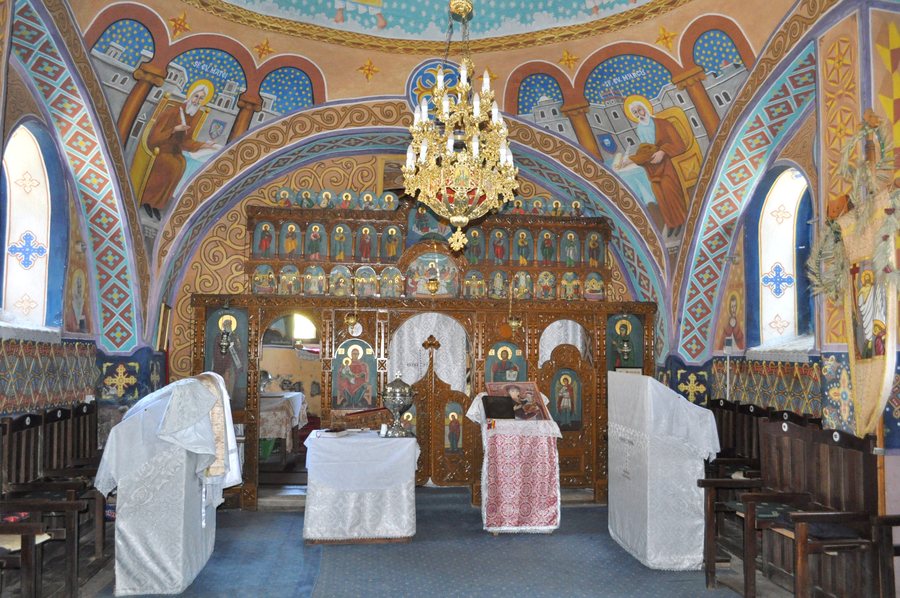 File:RO AB Biserica Cuvioasa Paraschiva din Ampoita (1).jpg
Photo: Țetcu Mircea Rareș via Wikimedia Commons, CC BY-SA 4.0
File:RO AB Biserica Cuvioasa Paraschiva din Ampoita (1).jpg
Photo: Țetcu Mircea Rareș via Wikimedia Commons, CC BY-SA 4.0
Which natural formations shape Ampoița?
The Piatra Boului rock formation lies near the summit of the route at Ampoița and is a nature reserve. Its location makes it a specific landscape feature for visitors interested in striking rock formations and protected natural areas.
Another nature reserve is the Rezervația Naturală Calcarele de la Ampoița. It consists of three isolated limestone blocks measuring 44 m, 27 m and 15 m in height. The different dimensions give the landscape a clearly distinguishable geological profile. Those who consider natural formations when planning their trip will therefore find a subject here that is clearly distinct from the settlement history and church architecture.
The main purpose of the Rezervația Naturală Calcarele de la Ampoița is to preserve geological and geomorphological diversity. Geomorphological diversity refers to the different forms and structures of a landscape. At the Calcarele, therefore, the focus is not only on the individual rock feature, but on protecting the geological and landscape characteristics as a whole. For your trip planning, the area should therefore be classified more as a nature and geology destination than as an ordinary viewpoint.
What makes the archaeology of Ampoița special?
The Situl arheologic de la Ampoiţa - La Pietre is documented as a settlement with settlement phases from the Eneolithic, the Early and Middle Bronze Age, the Geto-Dacian La Tène period, and the Early and High Middle Ages. The chronological sequence thus extends from prehistoric periods into the Middle Ages. For non-specialists, the most important aspect is the span: the archaeological subject is not limited to a single culture or period.
The Situl arheologic de la Ampoiţa - La Pietre has the longest and best-preserved stratigraphic sequence relating to prehistoric settlement in the southwestern Apuseni Mountains. A stratigraphic sequence describes the chronological order of settlement layers. In connection with La Pietre, the term therefore refers to the historical depth of the site and the sequence of different prehistoric settlement phases. This makes Ampoița relevant to your travel interests even if you prefer archaeological sites that show development across several periods.
What history does the Biserica din Ampoița tell?
The Biserica din Ampoița is regarded as an important monument of old art. At the same time, it contains transitional elements from Gothic to Renaissance dating from the 15th century, as well as additions from the 18th century. For a culturally focused visit, this combination of stylistic change and subsequent expansion is particularly interesting.
The first indications of an original monument at the Biserica din Ampoița date from the 15th and 16th centuries.
The present appearance of the Biserica din Ampoița is primarily the result of alterations carried out in the 18th century.
How can you set the focus of your trip?
Ampoița is suitable for planning a trip in which you first distinguish between the desired focus: the limestone blocks and protected areas represent geology and landscape, La Pietre represents settlement history, and the Biserica din Ampoița represents art and architectural history. These subjects can be clearly separated conceptually without any one of them having to define the entire character of the place.
For travellers with different interests, this thematic division provides simple guidance. Nature enthusiasts can focus on the geological and geomorphological aspects, while visitors interested in culture can consider the historical sequence at La Pietre or the various construction phases of the Biserica. It is also helpful when planning a trip together if such different interests can be compared using specific places and themes.
For further comparison, you can also access Răchita, Lancrăm, Kudsir, Blaj, Straja, Alba Iulia, Vințu de Jos and Jidvei.
FAQ
Which activities are among the experiences at Cheile Ampoiței?
Activities at Cheile Ampoiței include hiking, climbing, photography and picnicking.
How long does the circular trail at Cheile Ampoiței take?
Cheile Ampoiței can be explored on an easy circular trail that takes 1–2 hours.
Which places provide access to the Biserica din Ampoița?
The Biserica din Ampoița can be reached via Alba Iulia, Șard (DN 74) and Ampoița (DJ 68).
To the overarching travel overview: Alba.

.jpg)