
Alba Iulia – Fortification History, Museums and Cathedrals
Accommodation in Alba Iulia
In Alba Iulia, the route of the three fortifications leads through the remains of three fortifications from three different periods. They were built one after another in the same location; each new complex enclosed the older one.
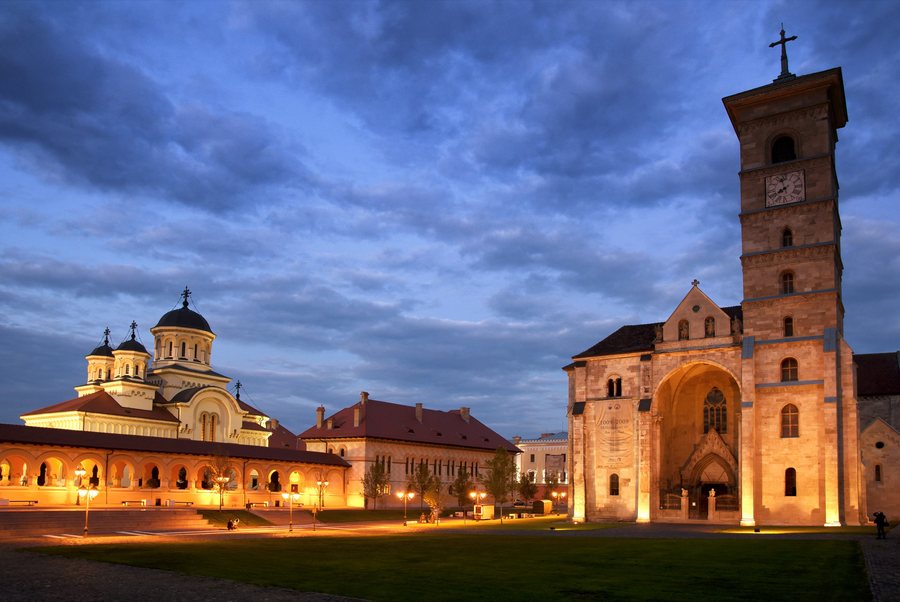 File:Alba Iulia - Catedrala Incoronarii si Catedrala Sfantul Mihail.jpg
Photo: Tudor evi via Wikimedia Commons, CC BY-SA 3.0 ro
File:Alba Iulia - Catedrala Incoronarii si Catedrala Sfantul Mihail.jpg
Photo: Tudor evi via Wikimedia Commons, CC BY-SA 3.0 ro
Culture
The Alba Carolina Fortress was built between 1715 and 1738 on the initiative and with the involvement of the Habsburg authorities. It follows the Vauban system and has the layout of an irregular heptagon. The restored route of the gates crosses the fortress from Gate I in the east to Gate VI in the west and presents seven gates of the complex.
Sala Unirii is also one of the city's historically significant places. On 1 December 1918, it hosted the session in which 1,228 delegates decided on the union of Transylvania with Romania. The present-day building of the Roman Catholic “Sfântul Mihail” Cathedral was built around the middle of the 13th century and constructed entirely from hewn stone blocks taken from the ruins of the Roman fort of Legio XIII Gemina.
The Orthodox Coronation Cathedral was built in Alba Iulia in 1921–1922 in connection with the coronation of King Ferdinand and Queen Maria on 15 October 1922 as rulers of Greater Romania. Museikon houses a collection of Romanian icons from Transylvania, old books and other religious objects.
History
The Roman fort of Apulum was built on a terrace of the Mureș and at that time stood along a navigable section of the river. The Principia Museum preserves part of the former building of the fort of Legio XIII Gemina in Apulum. Visitors can also see a Roman hypocaust there.
The historical sites emphasize different aspects: the fortifications show the development of a place across several periods, while Sala Unirii, the cathedrals and Museikon bring together political, religious and art-historical themes. At the Principia Museum, the connection to the Roman fort remains directly linked to the city's history through the former building and the hypocaust.
Routes
A cycling path runs along Mamut Hill and is also called “Transalpina de Mamut”. It is more than 5 kilometres long, passes through the forest and connects Micești and Pâclișa, two districts of Alba Iulia.
Public transport in Alba Iulia offers electronic ticketing. Passengers can pay for their tickets by SMS or via the mobilPay Wallet. This means that daily planning can take into account both a clearly designated route through the history of the fortifications and a specific way to use the city's public transport.
When choosing accommodation for a hotel in Alba Iulia, travel dates, room category and cancellation conditions stand alongside one another as separate points of comparison. Depending on your own plans, this can make it clearer which details are important before making a decision.
Further destinations:Arieşeni, Sebeş, Câlnic, Pleșcuța, Albac, Rimetea, Sălciua De Sus, Jidvei
Museikon regularly hosts temporary exhibitions, painting and restoration workshops, conferences and academic symposia.
For the overarching travel overview: Alba.

