
Laz: Icon Painting, Treasure Find and Transalpina
Accommodation in Laz
Laz in the Sebeș Valley is known for an uninterrupted tradition of icon painting that is more than 200 years old. The DN67C national road, the Transalpina, also runs through Laz. This brings together a traditional craft and a well-known road route.
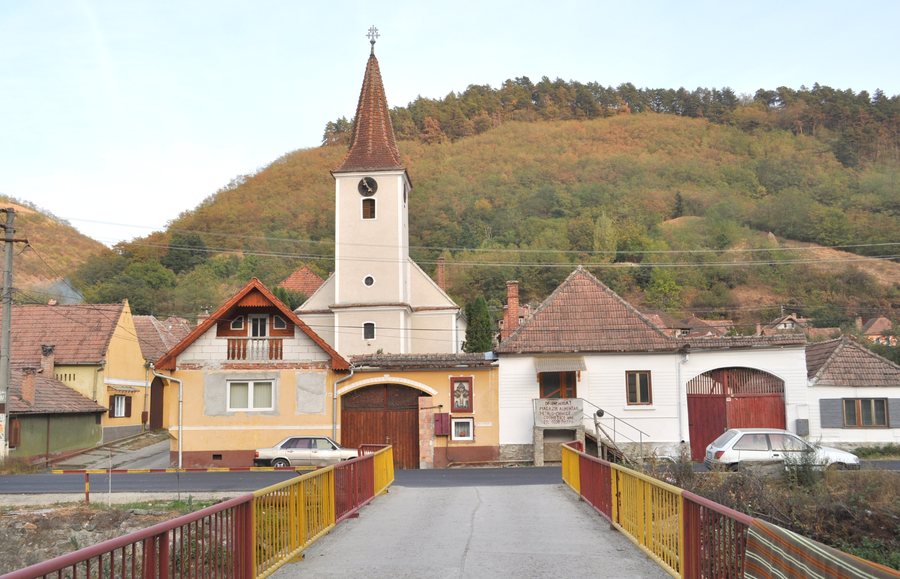 File:RO AB Sasciori Laz 2011.35.jpg
Photo: Utilizator:Țetcu Mircea Rareș at ro.wikipedia via Wikimedia Commons, CC BY-SA 3.0
File:RO AB Sasciori Laz 2011.35.jpg
Photo: Utilizator:Țetcu Mircea Rareș at ro.wikipedia via Wikimedia Commons, CC BY-SA 3.0
Culture
The Casa memorială “Maria Poenariu” in Laz is a village museum collection dedicated to painting icons on glass. The Casa Poienarilor houses a collection of glass and wood paintings as well as folk textiles belonging to the Poenaru family. The Casa Poienarilor is considered the place where a Romanian folk-art tradition emerged in the 18th century.
This tradition also includes the icons of Florin Nicolae Poenariu. Their frames are decorated with hand-carved traditional Romanian motifs. Since 2007, Florin Nicolae Poenariu has worked in an icon-painting workshop set up in his home in Laz. Florin Poenariu continues this icon-painting tradition.
Laz therefore brings together a village museum collection, the family holdings of the Casa Poienarilor and work that continues to this day in a workshop. Glass and wood paintings, folk textiles and carved frames show different material aspects of this local artistic tradition.
History
Near Laz lies the fortification known as “Cetatea de lemn”. It is attributed to the Early Middle Ages, more precisely to the 10th to 11th centuries; however, this dating is not certain. This earth-and-timber fortification is located on Gherghelău Hill above Laz, on the right bank of the Sebeș River.
Cetatea de lemn has the shape of an elliptical earthwork and measures approximately 40 by 28 to 30 metres. Around 1879, a treasure find was discovered in Laz. Based on the ring bearing an Agnus Dei, it is interpreted as part of a medieval Saxon woman’s ceremonial garment worn by the elite of the Sebeș area.
Geographical Context
Gherghelău Hill lies above Laz on the right bank of the Sebeș River, while the Transalpina runs through the village itself. In addition to these geographical references, Laz’s fulling mill provides another indication of traditional local work; it is considered to still be functional.
The fortification thus combines an earthwork and timber construction with an uncertain Early Medieval dating. Through the ring bearing an Agnus Dei, the treasure find points to a medieval Saxon woman’s ceremonial garment and to the elite of the Sebeș area. These historical details complement Laz’s cultural evidence with an archaeological reference and a reference connected to the history of the find.
Anyone choosing a hotel in Laz can take travel dates, room category and cancellation conditions into account when planning their trip; depending on the date and the desired flexibility, these details may carry different weight in the individual selection.
More destinations
You can open more location pages inline: Scărișoara, Vințu de Jos, Kudsir, Sălciua De Sus, Ocna Mureș, Ighiu, Sebeş, Lancrăm.
To the higher-level travel overview: Alba.

