
Oradea: Culture, Museums and Green Ways
Accommodation in Oradea
Oradea has 77 officially registered listed buildings. The city combines important evidence of Jewish, religious, political and architectural history with museums, parks, walking paths and water attractions.
 File:Black Eagle Palace, Oradea, Romania, 2020.jpg
Photo: Paralelogram via Wikimedia Commons, CC BY-SA 4.0
File:Black Eagle Palace, Oradea, Romania, 2020.jpg
Photo: Paralelogram via Wikimedia Commons, CC BY-SA 4.0
Culture and History
The Sion Neolog Synagogue was built in 1878 by Oradea’s Reform Jewish community. Following its restoration, it serves as a venue for contemporary art as well as concerts, exhibitions, book presentations and other cultural or religious events.
The Greek-Catholic Bishop’s Palace features an eclectic design with Neo-Romanesque, Neo-Byzantine and Art Nouveau accents. In a room of the Lazăr House, the declaration of independence of the Romanians from Transylvania, the Banat, Crișana and Maramureș from the Austro-Hungarian Monarchy was signed on 12 October 1918.
Oradea Fortress developed into one of the most important European centres of Humanism and the Renaissance in the 15th century. Construction of Oradea’s Baroque complex took place from 1750 to 1875.
Museums and Buildings
Oradea City Museum is located in Oradea Fortress and presents permanent and temporary exhibitions as well as art galleries for adults and children. Following its restoration, the Darvas-La Roche House houses Oradea’s Art Nouveau Museum; it was built between 1909 and 1912 by the brothers László and József Vágó.
The Aurel-Lazăr Memorial Museum houses a collection of authentic furniture, works of art, books and family photographs. It has five exhibition halls, including two rooms for temporary exhibitions.
The permanent exhibition of the Pharmacy Museum is located in the pharmacy’s original rooms and includes original furniture as well as recently discovered 18th-century murals. In four exhibition rooms, the museum displays more than 1,500 artefacts, including historic interiors as well as handmade tools and technologies of pre-industrial pharmacy.
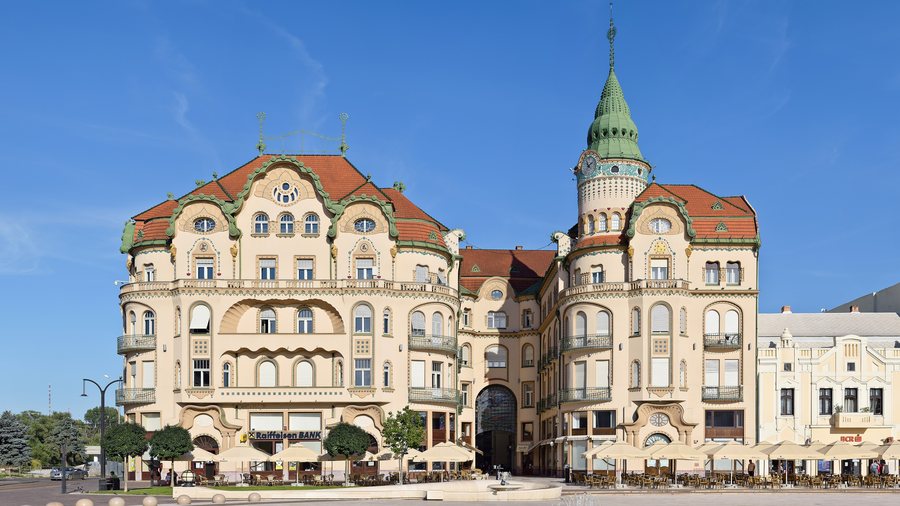
The Town Hall Tower is almost 50 metres high and has four main floors and three viewing levels. The Black Eagle Palace features a Y-shaped, three-winged passageway with a glass-roofed interior. Eight sphinxes stand on the roof of the Masonic Temple.
Leisure and Exercise
The Sovata Promenade offers running and cycling paths, spacious green areas with pavilions, a sports field, a pump track, playgrounds and other recreational facilities for visitors. Oradea also has a cycling network of more than 30 kilometres.
Nymphaea Aquapark combines indoor and outdoor pools with wave pools, slides and wellness facilities such as saunas and Turkish baths with thermal water. The aquapark also has its own swimming pool and diving pool for water sports enthusiasts.
I. C. Brătianu Park has basketball courts, specially equipped fitness areas and a 1,054-metre synthetic running track. A walking path through the park leads to Dealul Ciuperca hill, which offers a panoramic view of Oradea.
Landscape and Other Destinations
Salca Park has a green labyrinth, a lake with a jetty, playful educational areas and paved paths. In the wider regional surroundings of Oradea are the Biserica Ateaş church and the Biserica Ortodoxă Marţihaz Orthodox church. The Fântâna Toşa spring and Vizurişte hill are also located in the wider regional surroundings.
More destination pages: Sâmbăta, Almașu Mic, Nucet, Oșorhei, Chișcău, Finiș, Şoimi, Auşeu
To the main travel overview: Bihor.

