
Cincșor: Fortified Church, Farmsteads and the Olt Landscape
Accommodation in Cincșor
Landscape and Historical Setting
Cincșor lies on flat terrain surrounded by hills on three sides. To the south, the landscape opens towards the Făgăraș Mountains. Thus, the townscape brings together the surrounding hills and a clearly defined southern long-distance view. Historically, Cincșor had a particularly important strategic location on the banks of the Olt River. The landscape and the river therefore define two distinct spatial relationships of the village.
The Cincșor-Cetate archaeological site lies 6 km east of Cincșor on the right bank of the Olt. It therefore forms a separate eastern point of reference alongside the historic village centre. A modernised road leads through the wider regional area from Agnita via Dealu Frumos, Mergindeal, Cincu and Cincșor, reaching the Făgăraș Depression near Voila. This sequence connects several of the places mentioned and ends in a landscape area distinct from Cincșor. In addition to the individual archaeological site and the village itself, a regional road connection is therefore also part of the geographical context.
Culture and History
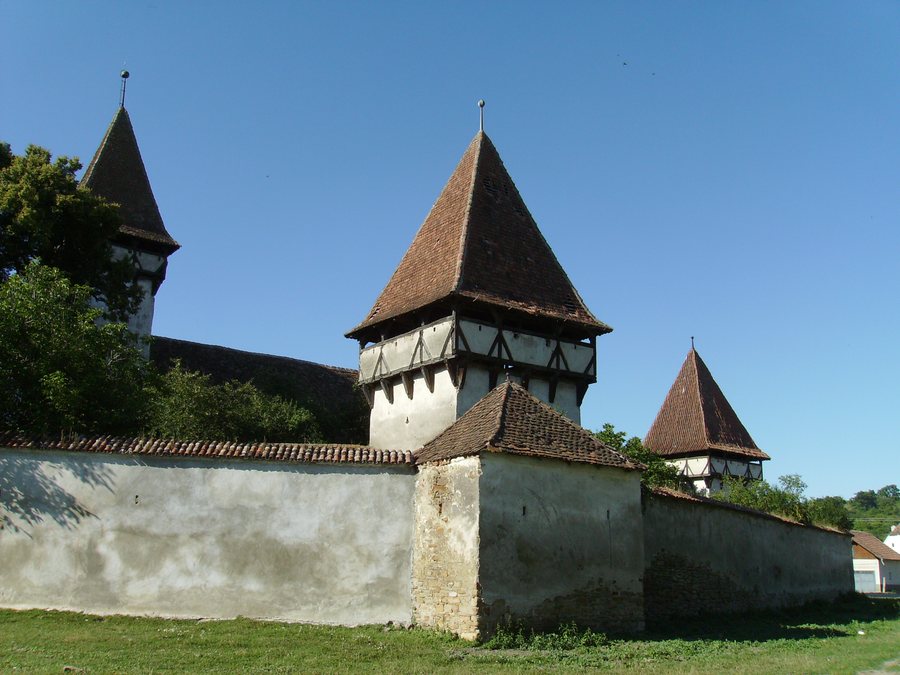
The Evangelical church in Cincșor was built in 1421 in the Gothic style on the foundations of an older 13th-century church. In the 15th century, it was given two defensive walls. Stones from an older Roman fort were incorporated into these walls. Four defensive towers are part of the church's fortifications. The building history thus combines a church building with an older sacred foundation, a medieval defensive structure and architectural elements from the Roman period. Several historical layers can therefore be read in the building: the older foundation, the Gothic church, the medieval fortifications and the reused material from the Roman fort.
The former Evangelical rectory dates from the 16th century and is the oldest building in Cincșor after the fortified church. Frescoes from the Transylvanian Renaissance have been preserved in one room. The former Evangelical school was restored in 2014. The historic townscape also includes numerous well-preserved traditional Saxon farmsteads. Alongside the church, the rectory, school and farmsteads are further examples of Cincșor's architectural history. They represent different building types within the same historic townscape: a rectory, a school and farmsteads shaped by agriculture.
Other Places
Further town pages lead to Predeluț, Cristian, Zărneşti, Holtesdorf, Rupea, Ghimbav, Recea and Petersberg.
Music in the Church
Alongside its landscape and architectural history, Cincșor has a musical connection to the church. Summer there is associated with organ music. The Samuel Mätz organ in Cincșor was used by a music group for one of its pieces. The organ is therefore connected both with the village's summer cultural association and with its documented use by this music group. This musical connection adds a distinct, contemporary documented use of the instrument to the historical information about the church.
For the overarching travel overview: Brasov.

