
Rupea: Market, Fortresses, Churches and Nature
Accommodation in Rupea
A market takes place in Rupea every Friday. Its history has been documented since 1434 and was reaffirmed in 1589 by a document issued by Prince Sigismund Báthory. Those wishing to compare dates, historical sites and landscapes together can consider these topics separately and organize the focus of their own travel planning.
When looking for a hotel in Rupea, accommodation websites primarily allow you to compare travel dates, room categories and cancellation policies. Such a comparison helps you place the overnight stay in terms of time and cost alongside your planned cultural and natural destinations and compare the information at your leisure.
Dates
The traditional singing of men's groups takes place in Rupea at Christmas and has been included in the UNESCO Intangible Cultural Heritage list. The Fortress Festival takes place in Rupea every year in September.
Culture
Rupea's Evangelical Church dates from the 15th century and continues to serve as a parish church. It has a Baroque altar from 1709 depicting the Apostles Peter and Paul and preserves a valuable collection of Oriental carpets.
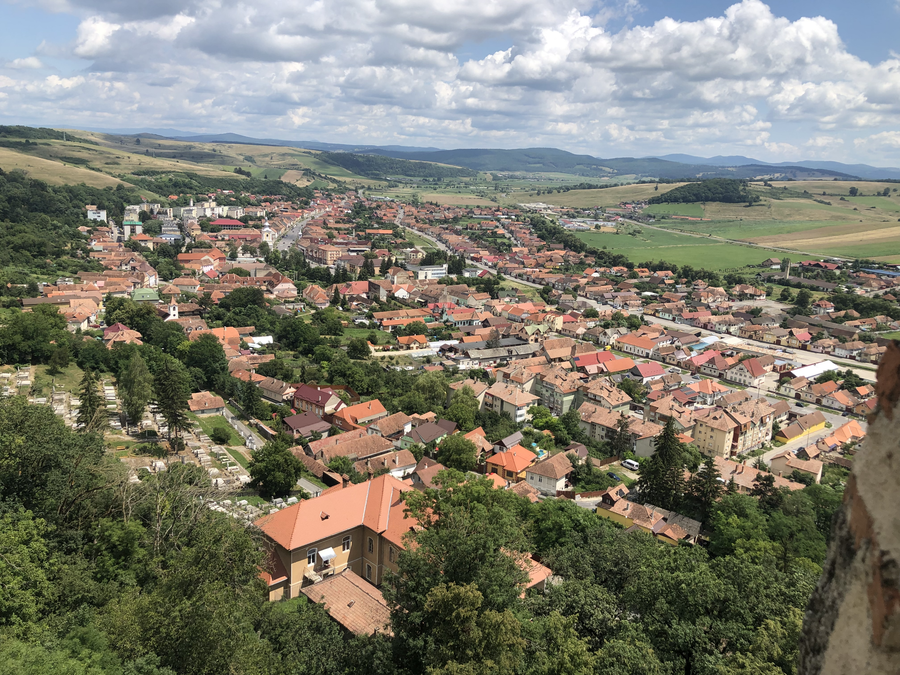
Cetatea Rupea is divided into the upper, middle and lower fortresses. Each of these complexes has its own surrounding wall, corresponding to a different historical period. The three fortress sections reveal different historical construction phases within the same complex, without being combined into a single structural element.
At the Gheorghe-Cernea Ethnographic Museum, guided tours for groups are offered by prior appointment. The exhibitions can help visitors understand the lives of the inhabitants of the surrounding region over the past thousand years. Sacred art, military architecture and ethnographic topics provide different focuses for your visit.
Nature
Stânca bazaltică de la Rupea is the westernmost occurrence of the basalts of the Perșani Mountains and lies in isolation within the Tertiary formations of the Transylvanian Basin. The natural site can be reached via DN 13 between Brașov and Sighișoara, up to kilometer 66. From the center of Rupea, an approximately 500-meter-long access road leads uphill, reaching an elevation of 579 meters.
For personal planning, the approximate length of the access road and the stated elevation can be considered separately. This keeps the geological classification, distance information and elevation as distinct pieces of information.
Other destinations
In the wider surrounding region of Rupea are Piscul Frumos and Dealul Soldului, both peaks. In the vicinity of Rupea are Capu Mare and Magura Pleasa, also both peaks. The churches Biserica Lutherană Caţa, Biserica Caţa, Biserica Paloş and Biserica Fortificata Viscri are also located in the vicinity.
The other names can be distinguished by their spatial relationship and type of destination: Piscul Frumos and Dealul Soldului are assigned to the wider surrounding region, Capu Mare and Magura Pleasa to the vicinity; the churches mentioned form a separate group of cultural destinations.
Other travel destinations: Moieciu De Jos, Bunești, Drumul Carului, Honigberg, Codlea, Tohanu Nou, Tărlungeni, Cristian
For the higher-level travel overview: Brasov.

.png)