
Discover Ciuta: History, Landscape and Routes in the Buzău Valley
Accommodation in Ciuta
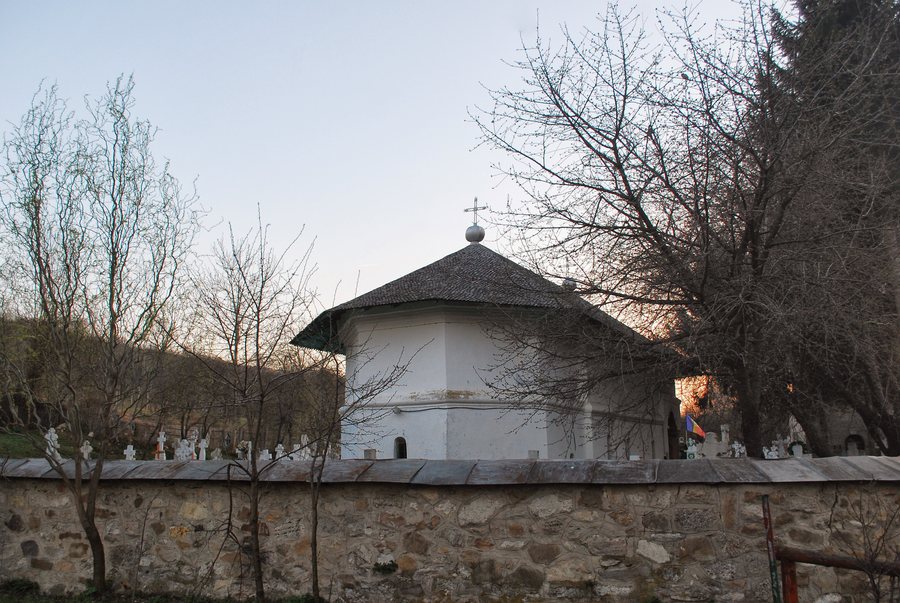
For those interested in culture, Ciuta begins with a clearly dated sacred building: the church „Intrarea în Biserică a Maicii Domnului“ was founded or built in Ciuta on 2 August 1762. The Fântâna lui Mihai Viteazul commemorates here the 375th anniversary of Mihai Viteazul’s march through the Buzău Valley towards Transylvania. The Fântâna lui Mihai Viteazul is a concrete monument approximately 15 metres long, clad in shell limestone.
Culture
In the cemetery of Ciuta, in front of the church „Intrarea Maicii Domnului în Biserică“, stands a cross-shaped monument with a statue of an introspective soldier. The sculptor Vasile Ștefănoiu, who was born in Ciuta, grew up among stoneworkers who supported the artists of the Măgura sculpture workshop. Stone from the Ciuta–Măgura quarry area was used for the sculptures of the Măgura Open-Air Museum.
In the Măgura commune, the residents’ crafts included not only agriculture but also stonework and pottery. You can understand this cultural aspect in two ways: as a concrete local history with a church and monument, and as a craft tradition that connects Ciuta with the wider surrounding area. The various details each create their own focus rather than presenting a single cultural theme.
Nature
The summit of Cetățuia on Dealul Ciolanu rises above Ciuta at 631.7 metres. At Ciuta, the Buzău Valley, or Buzău River, depression corridor begins as a gorge-like valley constriction 300 to 500 metres wide. Gypsum and salt outcrops, as well as limestone deposits, can be found in the area around the village of Ciuta.
The Fântâna lui Mihai Viteazul is located at a viewpoint with expansive views over the Buzău Valley. For personal orientation in the area, the summit elevation, valley shape, geological deposits and viewpoint can be considered as distinct aspects of the landscape alongside one another. The exact elevation and the valley width given only as a range each retain their own specific significance.
Routes
The tourist route through Valea Nișcovului leads to the Fântâna lui Mihai Viteazul in Ciuta. The Fântâna lui Mihai Viteazul stands at the intersection of DJ 203G and DN10 Buzău–Brașov. From Haleș, the route follows DJ 203G towards Ciuta to the intersection with DN10 Buzău–Brașov.
As another regional connection, the Fântâna lui Mihai Viteazul forms one endpoint of the tourist wine route Drumul turistic al Cramelor; the other endpoint is in Pietroasele. The routes can be distinguished by their course, intersection and thematic endpoint. Considering culture, landscape and the wine connection separately provides a clear basis for personal planning, without combining the routes into a single itinerary.
The two route references differ in function: the route through Valea Nișcovului describes the course to a destination in Ciuta, while the wine route places the Fântâna among its two endpoints. This keeps the road layout and thematic regional connection separately comprehensible.
Further local pages
Valea Sălciilor, Cozieni, Plaiu Nucului, Buzău, Cislău, Poşta Câlnău, Măgura, Lopătari
For the higher-level travel overview: Buzau.

