
Ozun: Churches, Cultural Landscape and Nature
Accommodation in Ozun
Ozun preserves a cultural landscape that faithfully reflects the medieval landscape of Europe: at the centre of the village stands the church, surrounded by houses; beyond these are vegetable gardens, orchards, arable land, hay meadows and pastures, while the forest forms the outer ring. This clear sequence connects the individual landscape elements with the broader landscape context.
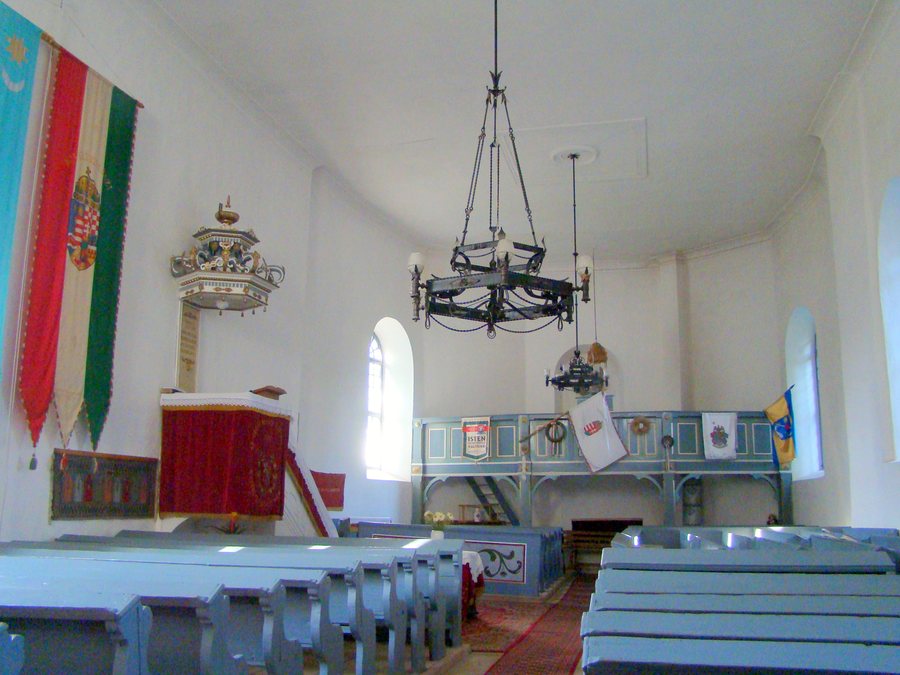 File:Biserica reformata din Ozun - interior.jpg
Photo: Țetcu Mircea Rareș via Wikimedia Commons, CC BY-SA 4.0
File:Biserica reformata din Ozun - interior.jpg
Photo: Țetcu Mircea Rareș via Wikimedia Commons, CC BY-SA 4.0
Culture
A distinctive building is the Reformed Church of Ozun, with its egg-shaped floor plan. It includes a bell tower with an onion-shaped dome, built between 1842 and 1844. The Reformed Church is also listed as a historic monument of the village. Two other churches provide a further basis for chronological comparison: the Roman Catholic Church of Ozun was built between 1909 and 1911, while the Orthodox Church was built in 1883 on the site of a wooden church.
The built heritage also includes Pünkösti Manor House, which is considered an artistic monument. This picture is complemented by the traditional houses in Ozun, characterised by large barns and wooden roofs. By comparing different aspects, visitors can distinguish between individual architectural forms, different construction periods and the village’s traditional appearance.
Nature
A significant part of the Natura 2000 site ROSCI0111 “Mestecănișul de la Reci – Bălțile de la Ozun și Sântionlunca” lies within the territory of Ozun commune. The site is of particular scientific importance because of its hygrophilous species, which are rare in Romania. The natural features therefore represent not only a landscape designation but also a clearly identified scientific value.
The juxtaposition of the cultural landscape and the Natura 2000 site opens up two different perspectives: on the one hand, there is the order shaped by the village and its cultivated areas; on the other, a site whose significance is linked to rare hygrophilous species. These topics can be weighted separately when planning a trip and then compared with one another.
Surroundings
The Lisnau peak is located in the immediate surroundings of Ozun. The Pietros, Cusurusului and Saciova peaks are also located nearby.
In the wider regional area are the Black Church, a church, and St. Nicholas Church in Braşov, also a church. The cultural context therefore extends beyond the buildings directly in Ozun and also includes the named churches in the wider regional area. This creates a distinction for your planning between the village itself, its immediate surroundings, the surrounding area and a broader regional area.
Other places: Bita, Covasna, Dalnic, Micfalău, Moacşa, Comandău, Ilieni and Sfântu Gheorghe.
Traditional Crafts and Community Days
Local crafts passed down from generation to generation in Ozun include woodworking for tubs, barrels and traditional painted furniture, as well as bone carving and pottery. These activities add further traditional features of the village to the picture created by its traditional houses.
The programmes held on the occasion of the Zilele Comunei Ozun already include traditional sports, cultural and gastronomic activities. The Zilele Comunei Ozun usually take place annually.
To the higher-level travel overview: Covasna.

