
Sarmizegetusa – Roman Urban History and Museum
Accommodation in Sarmizegetusa
Sarmizegetusa offers an insight into the history of Ulpia Traiana Sarmizegetusa. The city was founded between AD 109 and 110 by the governor Decimus Terentius Scaurianus on behalf of Emperor Trajan and served as the provisional capital of Roman Dacia. For planning your own trip, the city’s history, museum, and local context can be considered as separate areas of focus.
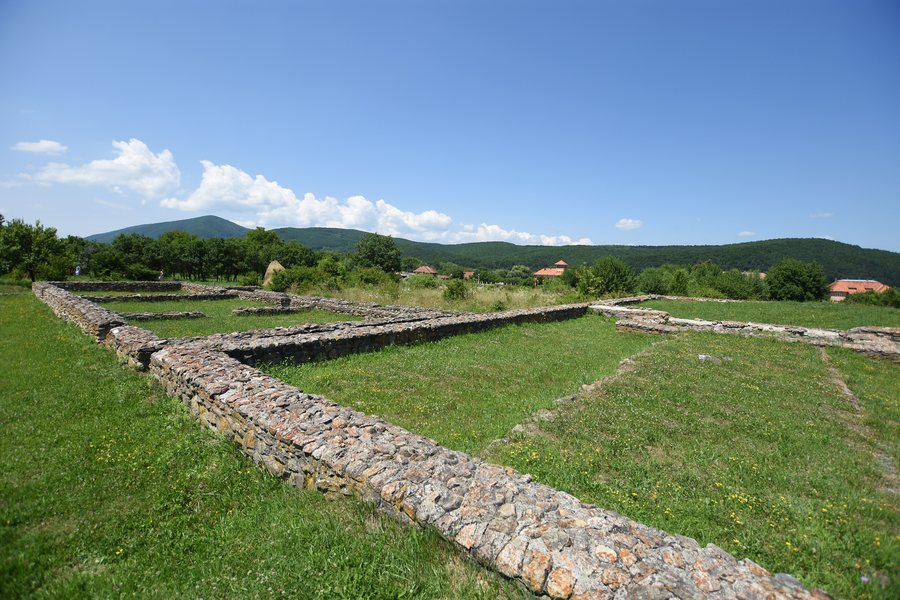 File:Ulpia Traiana Sarmizegetusa – România – 9 iulie 2021 (115).jpg
Photo: Dan Mihai Pitea via Wikimedia Commons, CC BY-SA 4.0
File:Ulpia Traiana Sarmizegetusa – România – 9 iulie 2021 (115).jpg
Photo: Dan Mihai Pitea via Wikimedia Commons, CC BY-SA 4.0
History
The amphitheater of Ulpia Traiana Sarmizegetusa was located outside the walls of the Roman city. The first excavations at the Temple of Nemesis took place between 1981 and 1983 in the area of the amphitheater of Ulpia Traiana Sarmizegetusa.
The temple of the Palmyrene gods was built under Septimius Severus and is of particular importance for understanding the Palmyrene religion.
The settlement’s necropolis includes the Mausoleum of the Aurelii and a tumulus with a stone base, a stele, a funerary altar, and a burial chamber built of brickwork. The Mausoleum of the Aurelii was built in the middle of the 3rd century.
Those who explore the site through its dates, structures, or finds can read about these areas of focus in whatever order they prefer. Religious buildings and funerary structures emphasize different aspects than the history of the city’s foundation.
Museum
The Sarmizegetusa Archaeological Museum houses Roman archaeological collections featuring epigraphic and sculptural monuments, mosaics, fragments of wall paintings, weapons, silverwork, bronze and bone objects, ceramics, glass, and coins.
The permanent exhibition comprises four rooms on the ground floor and five rooms on the upper floor; another room on the ground floor is dedicated to temporary exhibitions.
The division between the ground floor and upper floor provides a manageable framework for planning your time. If you have different interests, you can arrange the museum rooms and the other stops in separate sections.
Getting There
Sarmizegetusa can be reached via DN 68 between Hațeg and Caransebeș. By train, Sarmizegetusa can be reached via the Petroșani–Subcetate or Simeria–Subcetate lines.
For your planning, you can compare the road and rail connections as separate options. When comparing hotels in Sarmizegetusa, travel dates, room category, and cancellation policies can be considered as factual comparison points alongside one another. The focus remains on the period, the desired configuration, and the conditions, which may vary from one offer to another. The travel dates indicate the period under consideration, the room category indicates the desired configuration, and the cancellation policies indicate the applicable conditions. These details can be read separately without mixing historical information, transport routes, and accommodation details when planning your own trip.
Routes
During a walk through the village of Sarmizegetusa, traces of the walls that surrounded the ancient city can be discovered in residents’ courtyards. The village walk and the fort route operate on different scales; for your own planning, they can be considered as separate activities.
The Roman fort route leads from Ulpia Traiana Sarmizegetusa to the ruins of the Romano-Byzantine fortress of Sucidava over 1,500 kilometers.
More Destinations
Brad, Simeria, Cib, Zeicani, Mălăești, Topliţa, Teliucu Inferior and Lupeni
For the higher-level travel overview: Eisenmarkt.

.jpg)