
Homorâciu: Village Museum, Monuments and Iazul Dorului
Accommodation in Homorâciu
Homorâciu provides a concrete insight into architectural history and combines this focus with the village museum, archaeology, water and landscape. The Biserica „Adormirea Maicii Domnului“ is an architectural monument of national interest. It was built in 1743–1744; its side apses were added in 1877.
Culture and History
Casa Dumitru Ionescu dates from the first half of the 19th century and is now the village museum. Casa Anghel Ciocea dates from the late 19th century. Both houses represent different historical periods, without their functions necessarily being equated. The church, historic houses and archaeological site thus form distinct cultural focal points.
The cultural references therefore differ in terms of monument status, museum function, construction period and spatial extent. In this way, the archaeological perspective supplements architectural history with a site whose geographical reference is not limited to Homorâciu alone.
Homorâciu also has a clearly named archaeological connection: the Cetatea La Tène de la Homorâciu – La Cetăţuie archaeological site extends across both Homorâciu and Drajna de Sus. Its geographical relationship therefore encompasses two places.
The local architectural history also includes the Biserica Veche din Homorâciu, dedicated to „Adormirea Maicii Domnului“. Its massive walls consist of stone, bricks and roof tiles and range from 40 centimetres to 1 metre in thickness.
Water
Fresh fish can be purchased at Iazul Dorului. Iazul Dorului also offers fishing with the removal of fish as well as relaxation. The opportunity to buy, active use and peaceful stays are presented here as different connections with the water.
These three connections describe different forms of spending time at the same body of water: buying fresh fish, fishing with the removal of fish and relaxation. They can therefore be understood as separate aspects of the water-related offerings, without merging into a single use.
Geographical Setting
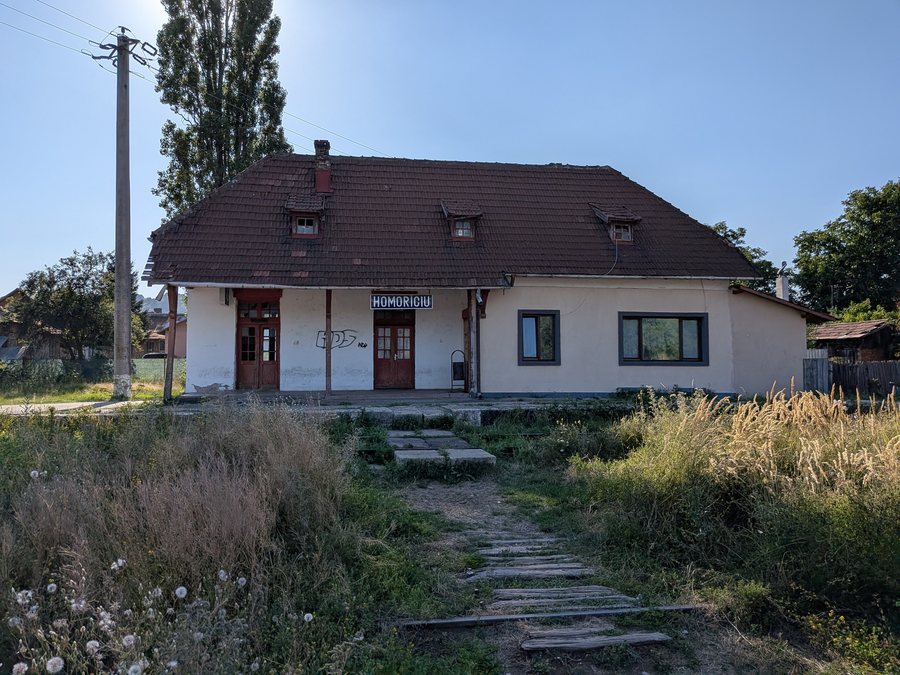
Homorâciu railway station is served by railway line 306 between Ploieşti and Măneciu. This railway connection adds a specific link between the two cities mentioned to the information about the locality.
Pietri is a peak in the surroundings of Homorâciu. Măgura Ceraşul is a mountain there, Plaiului Ursului is a peak and Vf. Mare is also a peak. The railway line and landscape features thus provide two different geographical perspectives on Homorâciu.
For the landscape features, the different designations are a distinct point of comparison: Pietri, Plaiului Ursului and Vf. Mare are peaks, while Măgura Ceraşul is classified as a mountain. All four features mentioned are located in the surroundings of Homorâciu.
The wider regional surroundings of Homorâciu contain three different religious buildings: Cheia Monastery as a monastery, Biserica Sfinţii Arhangheli as a church and Biserica Ortodoxă Bordenii Mici as an Orthodox church. The local and broader references thus distinguish between Homorâciu, its surroundings and the wider regional area.
Other Locality Pages
Other places for regional orientation: Bărcănești, Chițorani, Ceraşu, Blejoi, Boldești-Scăeni, Aluniş, Bucov and Sinaia.
If you combine your trip to Homorâciu with a hotel, travel dates, room category and cancellation conditions can make different aspects of the available options visible. This keeps the decision tied to your own travel period, the desired room type and the respective conditions, without equating these points with the cultural or geographical features of the locality.
For 14 October, Ziua Recoltei in Homorâciu was described as a traditional fair in honour of Saint Paraskeva, featuring folk celebrations.
For the overarching travel overview: Prahova.

