
Dragomirna Monastery – Churches, Museum and Surroundings
Accommodation in Dragomirna Monastery
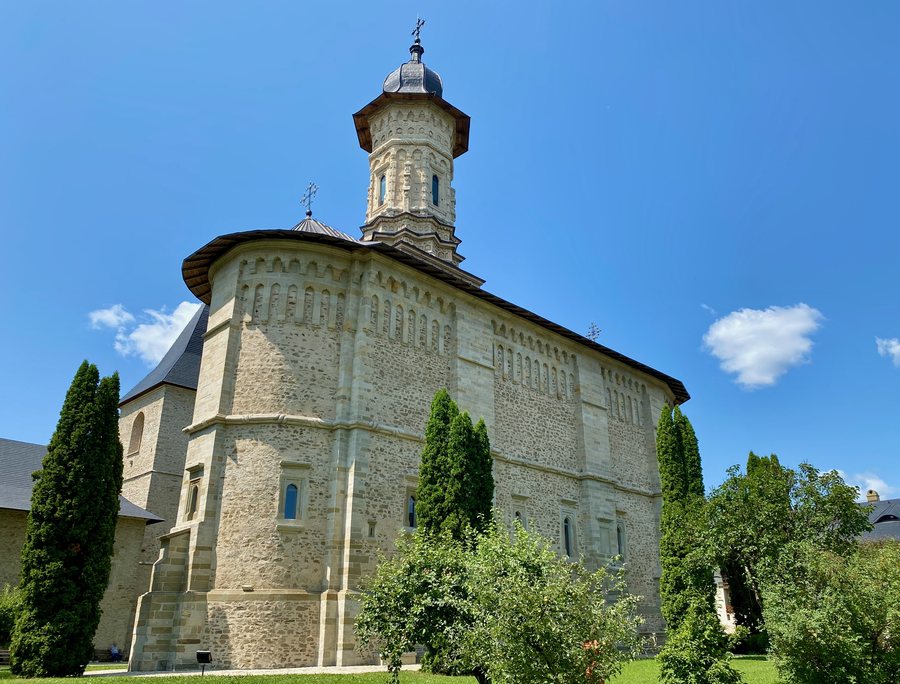
Dragomirna Monastery: The Great Church was completed in 1609 and consecrated on September 1, 1609. It is 9.60 meters wide, and its tower reaches a height of 42 meters.
 File:Monestir de Dragomirna - Església.jpg
Photo: Josep Renalias Lohen11 via Wikimedia Commons, CC BY 4.0
File:Monestir de Dragomirna - Església.jpg
Photo: Josep Renalias Lohen11 via Wikimedia Commons, CC BY 4.0
Culture
The Great Church uses traditional architectural elements of the Moldavian style with influences from neighboring countries. Its façades are made of unworked stone; decorative pilasters were fashioned from cut and polished stone blocks. Only the naos and the altar preserve original Byzantine frescoes.
The inscription above the entrance of the former hermit church, the Small Church of Dragomirna Monastery, dates the beginning of the monastery to 1602. The Small Church also has an open polygonal porch on columns.
The fortification walls of Dragomirna Monastery were built in 1627 by the ruler Miron Barnovschi. The fortified complex includes a bell tower and four defensive towers at the four corners of the enclosure. The walls are approximately 11 meters high.
The former Egumenia, or refectory building, now houses the monastery museum. The museum contains manuscripts from the years 1609, 1610, 1611 and 1616. Dragomirna had a school for calligraphers and miniaturists; manuscripts from this school are preserved in the monastery museum.
The Dragomirna Psalter manuscript from 1616 is written on parchment and consists of 25 quires. The monastery's painting school produced reproductions of the illustrations and texts based on it. The Anastasie Crimca Museum in the monastery includes a Gothic hall, the cell of Saint Paisius, a lapidarium, a room for facsimiles of miniatures and a room for parish seals.
Nature
Dragomirna Monastery lies within fortified walls and is reflected in a nearby lake. In the vicinity of Dragomirna, the beech reserve covers approximately 134.80 hectares and is about 97 percent natural in origin.
The beech reserve can be reached via the forest path known as “Trei meri” over a distance of 1.6 kilometers. Fântâna Doamnei is located in the immediate vicinity, about one kilometer north of the monastery, by the Dragomirna stream and next to the road leading from the village of Dragomirna into the forest.
Routes
The official route to Dragomirna Monastery leads through Mitocu Dragomirnei; the monastery is reached about 3 kilometers after the village.
A circular cycling route begins near the lake by Dragomirna Monastery. The Dragomirna–Călinești–Dragomirna cycling route is rated as moderate and is 45.8 kilometers long. It runs along forest and gravel roads and passes through the surrounding forests, hills and villages.
Different route lengths can be considered separately for your own planning.
This places a short forest connection, a longer moderate cycling loop and the monastery's historic rooms side by side at the same destination. For planning the day, nature, exercise and culture can be considered as separate focuses and clearly distinguished from one another.
Other destinations
Vama, Gura Humorului, Crucea, Podu Coșnei, Şaru Dornei, Rădăuţi, Pojorâta, Frasin
To the overarching travel overview: Suceava.

