
Murighiol: Nature, Waterways and Halmyris in the Danube Delta
Accommodation in Murighiol
Visitor Route 5 in the Danube Delta begins and ends in Murighiol and leads via the Dranov Canal, Gura Portiței and the Dunavăț Canal.
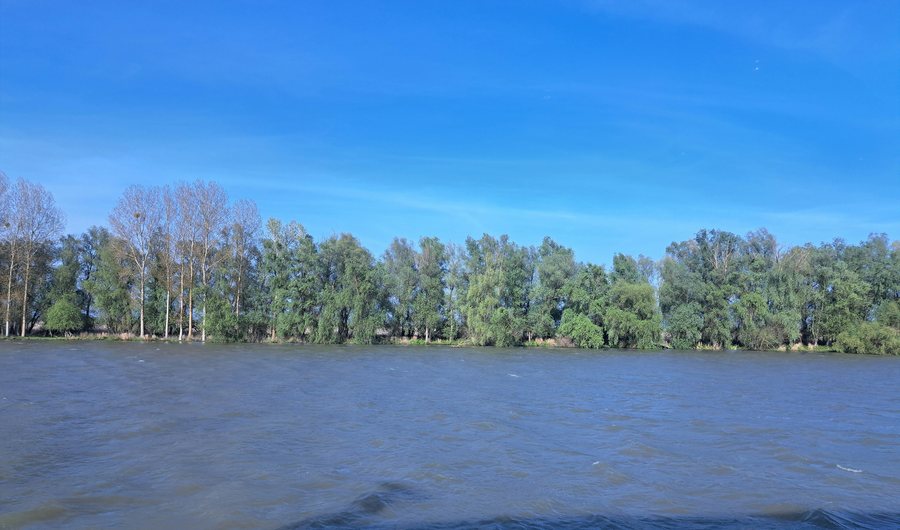 File:20230425.Sankt Georg Arm.Murighiol.-011.jpg
Photo: Bybbisch94, Christian Gebhardt via Wikimedia Commons, CC BY-SA 4.0
File:20230425.Sankt Georg Arm.Murighiol.-011.jpg
Photo: Bybbisch94, Christian Gebhardt via Wikimedia Commons, CC BY-SA 4.0
Nature and Water Landscape
Sărăturile Murighiol lies between Murighiol and Plopu and is designated as a strictly protected part of the Danube Delta Biosphere Reserve. Among the protected features is, among other things, a mixed bird colony on the lake’s islands. Sărăturile Murighiol is a chloride-sulphate lake without fish, rich in phytoplankton and zooplankton, and serves as an important breeding site for many bird species.
South of the village of Murighiol, Sărăturile Murighiol is a very shallow, saline wetland with dense vegetation; waterbirds use the area as a refuge. At Lacul Beibugeac, pelicans rest on their way to the colonies in the Danube Delta. Migratory birds also use the area as an important resting place and for feeding.
Routes in the Delta
Visitor Route 7 in the Danube Delta begins and ends in Murighiol and leads via Uzlina, Lake Uzlina, Lake Isac and the Gârla Perivolovca. Visitor Route D3 leads from Murighiol to Lake Sărături and back to Murighiol. From Murighiol, boat trips through the lake area of Lakes Isac, Isacel and Uzlina are possible.
The „Traseu 6 lacuri“ route leads via the Uzlina Canal to Lake Uzlina, past reed beds and white and yellow water lilies, where birds can be observed. The „Traseu 8 lacuri“ route offers opportunities for birdwatching. At the Litcov Canal, it leads to traditional fishing huts and provides insights into the way of life of traditional fishermen. For individual planning, the named canals, lakes, return routes and observation opportunities can be compared separately.
Culture, History and Cuisine
The „Casa Satului“ in the municipality of Murighiol contains traditionally furnished Ukrainian, Romanian and Turko-Tatar rooms. Authentic objects donated by residents of the municipality can be seen there.
The partially restored Halmyris complex includes an early Christian basilica with a crypt containing the martyrs Epictet and Astion. The Halmyris Monastery in Murighiol is associated with the discovery of the relics of the martyrs Epictet and Astion. The patronal feast of Halmyris Monastery is held annually on 8 July in Murighiol.
Cetatea Halmyris lies 2.5 km east of the village of Murighiol. It is a Roman fortress that went through several stages of development up to the first quarter of the 7th century.
Murighiol’s culinary tradition includes fish prepared by Romanians, Ukrainians and Muslims, including Turks and Tatars, by baking, frying, salting, marinating, and using it in soups and fish soups, stews, aspic or oven-baked dishes.
Getting There and Orientation
County road DJ 229M provides the road connection from Murighiol to the Murighiol pier. The road connection between the municipality of Murighiol and Tulcea is provided by DJ 222C; this road runs for 19.5 km through the municipality’s administrative area. The Murighiol area can also be reached on the Danube by waterway to and from Tulcea.
Other destinations:Mahmudia, Caraorman, Somova, Plopul, Chilia Veche, Sulina, Babadag, Băltenii De Sus
The Murighiol Tourist Information Centre is aimed at Romanian and foreign tourists and serves as a starting point for getting to know and exploring the area.
To the higher-level travel overview: Tulcea.

