
Bystré: Mineral Springs, Culture and Landscape
Accommodation in Bystré
Bystré lies in the Topľa Valley at the transition from the Podslanská and Pozdišovská uplands to the Low Beskids. In addition to the Topľa, the local network of waterways includes the Hermanovský potok and Šľachtinský potok streams. Below Mount Poloma, the Ščevica mineral spring rises on the left bank of the Topľa. There are two outlets of this mineral spring on the Topľa.
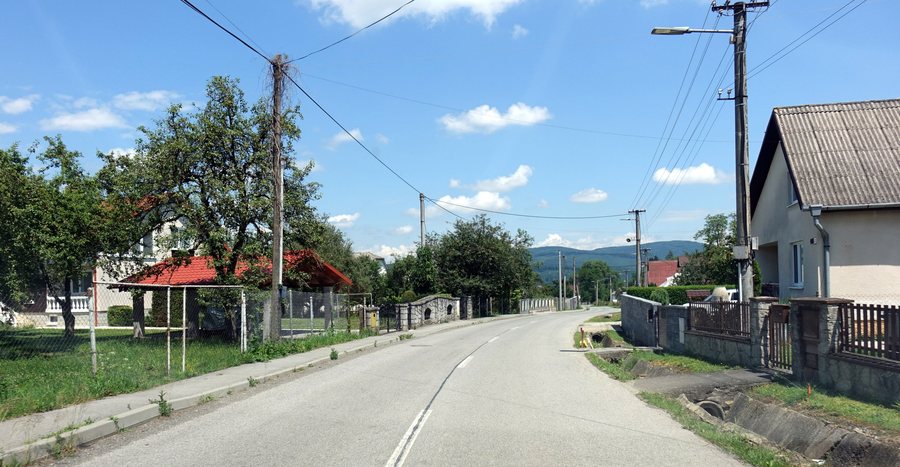
Landscape
Poloma is a mountain peak in the immediate vicinity of Bystré. Also nearby are Barvienky, a mountain, and Stredná hora and Lehotkov, both of which are classified as mountain peaks. The connection to the Ščevica mineral spring is also evident at the Dreveňák complex: the two Ščevica mineral springs with shelters can be reached via an iron suspension bridge over the Topľa. This bridge forms part of the cycling network of the Prešov Self-Governing Region.
Culture
The church in Bystré contains the main altar of the Coronation of the Virgin Mary, a polychrome and gilded late Gothic wood carving from the end of the 15th century. The church itself is said to have been built in the second half of the 14th century with the involvement of the Soósovcov landowning family from Solivar. The synagogue is also part of the town’s history: it was built at the beginning of the 19th century, is already mentioned in an 1833 schematism, is partly dilapidated, and no longer serves its original purpose.
Watermills are mentioned in Bystré in the second half of the 16th century; there were probably two mills. Of the five former watermills, the buildings of three have survived, none of which is in operation. The new cemetery in the upper part of Bystré, near the so-called Onufrovho mlyna, still exists today. The old cemetery in the lower part of the town has disappeared over time.
Experiences
For many years, the Bystrančan folklore ensemble has preserved and promoted the dance, singing, and musical traditions of the Šariš and Zemplín cultural regions in eastern Slovakia. Bystrančan’s approximately 90-minute programme includes folk songs, fast spun Csárdás dances, slow partner dances, recruit dances, girls’ circle dances, and polkas. It can be adapted to specific circumstances.
The sports- and tourism-oriented Dreveňák complex includes a motorest, paved courts, football pitches, tennis courts, the large Rodinka children’s playground, and two large pavilions. This means that a variety of facilities are located within the same complex alongside the mineral springs and the iron suspension bridge over the Topľa.
Regional Destinations
In the wider regional surroundings of Bystré are Kysacký hrad, Zřícenina Hradu Šariš, and Zřícenina Jasenov. All three are castle ruins.
For accommodation offers in Bystré, several points can be compared objectively on the respective offer page. The booking and cancellation conditions should also be clearly stated. The place name Bystré, with its accent, helps assign offers unambiguously.
More Destinations
More travel destinations: Holcíkovce, Vranov Nad Topľou, Nova Kelca, Slovenská Kajňa, Kvakovce.
Back to the higher-level travel overview: Okres Vranov Nad Topľou.

