
Hotel in Dobrnič – Culture, Karst and Trails
Accommodation in Dobrnič
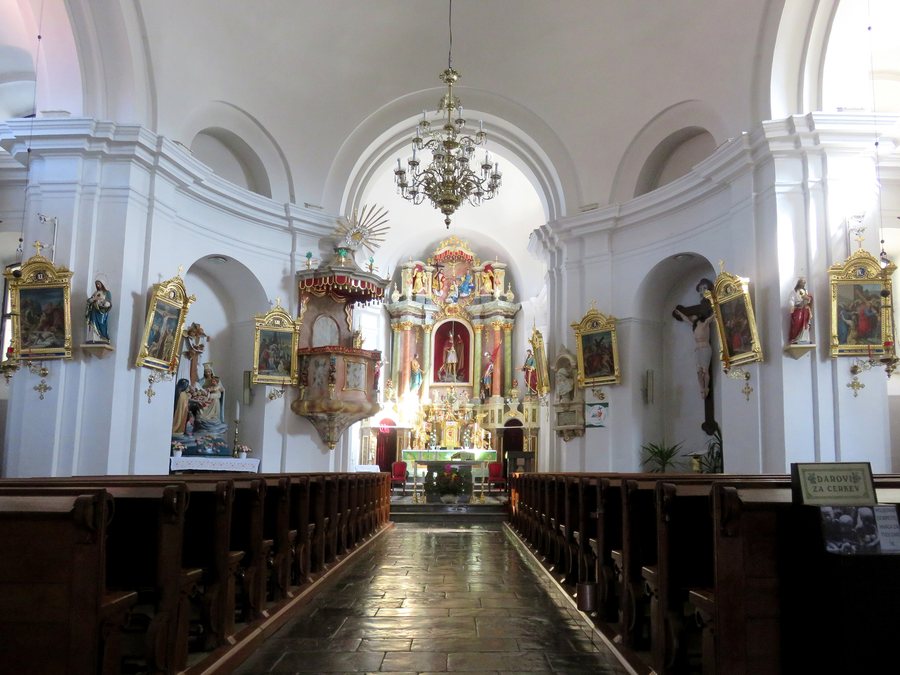
Dobrnič combines a historic town centre with important memorial sites, traces of the missionary Friderik Baraga and a distinctive karst landscape. The historic town centre of Dobrnič is a well-rounded square with St. George’s Church. Other aspects of Dobrnič include ecclesiastical architectural history, modern Slovenian history, trails through the surrounding area and distinctive natural formations.
Culture and History
Today’s St. George’s Church in Dobrnič is a Baroque church. Construction began in 1777, and it was opened for worship in 1785. The church also houses a baptismal font at which Friderik Baraga and Alojzij Šuštar were baptised.
An important chapter in Slovenian history is connected with Dobrnič: the founding congress of the Slovenian Antifascist Women’s Association took place in Dobrnič on 17 and 18 October 1943. The cultural centre houses a memorial room dedicated to the 1st Congress of the Slovenian Antifascist Women’s Association. It gives visitors context about the wartime period during which the congress took place. Dobrnič also hosted a traditional memorial ceremony for the 1st Congress of the Slovenian Antifascist Women’s Association, the SPŽZ.
The history of Friderik Baraga is also present at several sites. The Baragova domačija in Mali vasi is classified as protected architectural heritage and is also the birthplace of the missionary Friderik Irenej Baraga. The Baragova domačija contains memorial rooms with period furniture from Baraga’s life in Slovenia, as well as a museum presentation of his missionary life in Canada and the United States.
In the vicinity of Dobrnič, the settlement of Cvinger nad Koriti was established on a nearby hill in the 8th century BC. Several burial grounds in the surrounding area associated with Cvinger nad Koriti indicate continuous settlement into antiquity.
Nature
The Dobrnič area contains several karst caves, sinkholes, resurgence springs, karst depressions and shafts. An olm, a Dinaric endemic species, was found at the spring of the disappearing stream Žibrščica in the Dobrnič area.
Hiking
The Baraga Trail passes through Dobrnič and is an 18 km circular route. Dobrnič is one of Friderik Baraga’s three life stations along this trail.
The Pot Mare Rupene trail also connects Dobrnič with various starting points. The trail’s two branches meet in Dobrnič. From Dolenjske Toplice, one section leads via Globodolo and Šmavro to Dobrnič; this section is approximately 22 km long and takes around 7 hours at a moderate walking pace. From Žužemberk, another 12 km section leads via Lisec to Dobrnič and takes around 4 hours.
Cycling
The Mali Trebanjski Krog runs entirely on asphalt and mostly along local and village roads. The route leads through Knežja vas and Železno to Dobrnič.
More destinations
Other destinations in the same destination network include Trebnje, Drečji Vrh, Mokronog, Blato, Roženpelj, Šentrupert and Hom.
For the higher-level travel overview: Trebnje.

