
Počitelj Hotel: Historic Town and Fortress
Accommodation in Počitelj
The walled town of Počitelj developed from the 16th to the 18th century as a fortified complex with medieval and Ottoman construction phases. Its historic townscape forms a spatially and topographically self-contained ensemble. At the same time, Počitelj is one of the few urban ensembles in Bosnia and Herzegovina that have survived intact to the present day.
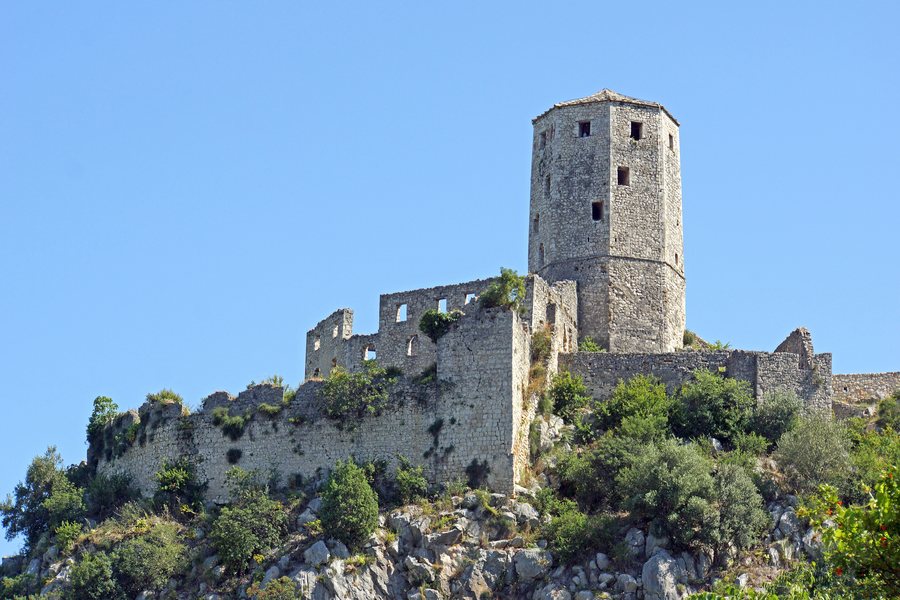 File:Bosnia and Herzegovina-02166 - Počitelj (10476710854).jpg
Photo: Dennis G. Jarvis via Wikimedia Commons, CC BY-SA 2.0
File:Bosnia and Herzegovina-02166 - Počitelj (10476710854).jpg
Photo: Dennis G. Jarvis via Wikimedia Commons, CC BY-SA 2.0
Culture
The fortress of Počitelj was built between the 15th and 18th centuries and incorporates a medieval core dating from the late 14th century. The fortress complex includes a square tower, two bastions, a granary, a mosque, a cistern, and four gates. The fortress stands on a rocky promontory that drops steeply toward the Neretva River; this hillside location determined the course of its fortifications.
The Šišman-Ibrahim-Paşa Mosque, also known as the Hadži-Alija Mosque, occupies a prominent position in Počitelj’s urban fabric and natural surroundings. It is a single-domed mosque in the classical Ottoman style, with a single prayer hall, and was built in 1562–63. The Šišman-Ibrahim-Paşa Mosque has been rehabilitated and returned to its original function.
The Gavrankapetanović House is the largest and most fully developed example of residential architecture in Počitelj. The Gavrankapetanović residential complex has been rehabilitated and restored to its function as an artists’ colony. The gallery of the International Artists’ Colony Počitelj houses a collection of artworks donated by participating artists; solo exhibitions are occasionally held there.
Townscape
The historic building stock also includes the Šišman-Ibrahim-Pašina Madrasa. It was built before 1664, has original copper domes, and belongs to the type of small religious schools. The hamam in Počitelj was likewise built before 1664 as a small public bathhouse by craftsmen sent from Istanbul. The Šišman-Ibrahim-Pašin Han was built around 1665 as a single-storey han and arranged around a central area with horse stables.
The Sahat-Kula was built after 1664. The building is a typical Herzegovinian clock tower that developed under the influence of Mediterranean-Dalmatian architecture. Together with the religious, military, and residential buildings, it is one of the various historic components standing side by side within the townscape.
The individual buildings therefore do not stand isolated from one another; instead, within the historic ensemble, they represent different aspects of its religious, military, and civic development. The madrasa reflects religious educational architecture, the hamam a public institution, and the han a historic form of accommodation with a central area for horse stables. Together with the clock tower and residential buildings, they make the different uses of the townscape visible.
Location
The historic town area of Počitelj lies on the left bank of the Neretva along the main road between Mostar and Metković.
For a transparent comparison of costs, occupancy, included services, and individual price components should also be considered together. The booking and cancellation conditions stated there can likewise be checked. Differences between offers arise from the specific fields shown. A straightforward comparison therefore takes into account the occupancy actually listed, the included services, the final price, and the conditions applicable in each case.
More destinations
Other places in the same higher-level area include Višići, Neum, Ravno, Polje Bijela, Međugorje, Blagaj, Stolac and Ježeprosina.
To the higher-level travel overview: Herzegovina-Neretva Canton.

.jpg)