
Hotels in Mrkonjić Grad – History, Nature and Balkana
Accommodation in Mrkonjić Grad
Mrkonjić Grad is a hilly mountain region where Roman history, regional craftsmanship and water-rich landscapes meet. The Roman long-distance road Salona–Servitium ran through the area, connecting the Adriatic with the Sava and Pannonia via western Bosnia. Leusaba was a settlement at a crossroads of Roman roads at the foot of Mount Grabež; it later developed into present-day Mrkonjić Grad.
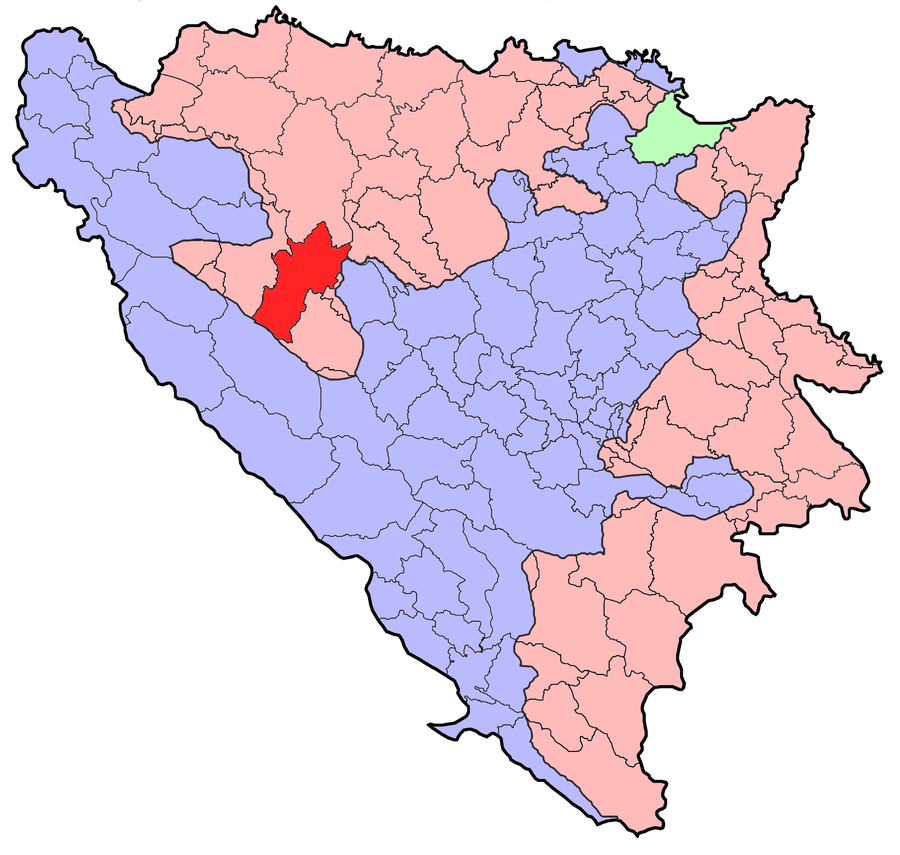 File:BH municipality location Mrkonjic Grad.png
Photo: User:Estavisti via Wikimedia Commons, CC BY-SA 3.0
File:BH municipality location Mrkonjic Grad.png
Photo: User:Estavisti via Wikimedia Commons, CC BY-SA 3.0
History and Culture
The town’s history is also connected with specific places and dates. In 1593, Krzlaraga, born Đukanović, established a foundation, a waqf, on the Kolobara, with a mosque, 24 shops, a water supply system, a bakery and a library. This foundation also included a fund to promote crafts and trade. The monument to King Peter I Karađorđević now stands on the Kolobara. On 25 November 1943, the first session of ZAVNOBiH was held in Mrkonjić Grad. The memorial museum dedicated to this first meeting in the town centre is designated as a national monument of Bosnia and Herzegovina.
The town museum in the “Petar Kočić” Cultural Centre also contributes to the cultural character of the town. It contains an ethnological collection of folk art as well as photographs. In the vicinity of Mrkonjić Grad, in the village of Baljvine, lies the medieval Stećak necropolis “Tešanovića krčevine”, which is designated as immovable cultural heritage.
Crafts and Regional Traditions
Mrkonjić Grad is considered a centre of blacksmithing in the north-western part of Republika Srpska. The products are sold mainly at markets in Mrkonjić Grad and Banja Luka, as well as in the workshops. Traditional home crafts are also preserved and practised in the Mrkonjić Grad area. These include wooden objects, barrels and flat flasks for rakija, as well as knitted socks and gloves, colourful carpets and blankets with traditional embroidery.
The connection between crafts and regional customs is also reflected in local events. A mowing competition is held in Balkana every year in honour of the best scythe mowers. The homemade rakija festival takes place in winter and brings together numerous producers.
Landscape and Water
There are around 1,000 springs in the area; approximately 360 smaller and larger springs are located on Mount Lisina alone. The “Vrela Sane” natural monument comprises three karst springs of the Sana, the lower course of the Korana and the Mračaj Cave. Another notable site is Lake Balkana, located 4 kilometres from Mrkonjić Grad. It consists of the Small Lake and the Large Lake and serves as a destination for excursions and swimming.
Activities and Excursion Destinations
Near Pecka there is a climbing area with more than 100 climbing routes, making it one of the largest climbing areas in Bosnia and Herzegovina. The Pecka Visitor Centre serves as a starting and return point for excursions, climbing, cycling tours, hikes and meetings with guides. In addition, the “Green tour” association mapped more than 300 kilometres of cycling routes in the Mrkonjić Grad area during a previous period.
Destinations in the wider area also add to the character of the region. In Zelenkovac, 15 kilometres from Mrkonjić Grad, the “Zašto nije Otišao Boro”!? art gallery is located in a forest landscape. Regional cuisine includes buckwheat ljevuša and grilled trout, which visitors to Mrkonjić Grad can sample.
Other destinations: Lukavica, Tjentište, Vučja Luka, Doboj, Prijedor, Derventa, Podrašnica, Dračevo.
For the broader travel overview: Republika Srpska.

