
Křenice – Village History and Historic Buildings
Accommodation in Křenice
Křenice combines traces of early settlement and a medieval fortress with historic buildings and a war memorial. Cycle Route No. 1 also passes through the village. Křenice can therefore be understood above all through its cultural history and its connection to cycling.
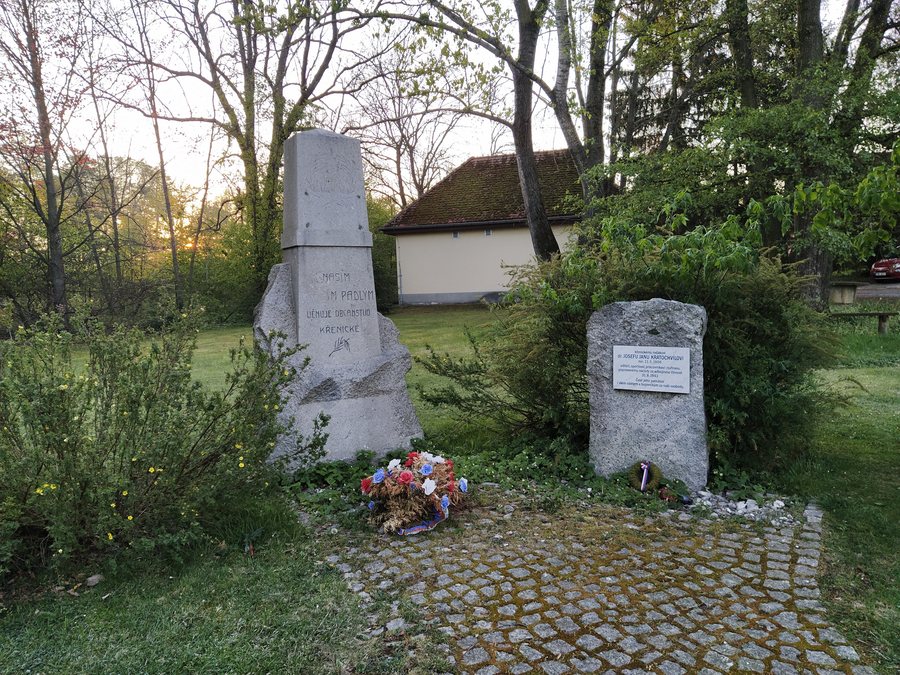
Key facts about Křenice
- The village was first mentioned in writing in 1331.
- The oldest surviving landmark is a bell by Jan Horálek dating from 1747.
- The war memorial was erected in the 1920s and commemorates eleven men born in Křenice who fell in the First World War.
- Cycle Route No. 1 passes through Křenice.
How far back does Křenice’s history go?
Archaeological traces reach further back than the written history of the village. People were living in Křenice and its immediate surroundings as early as around the 6th century BC. A La Tène bronze ring and a stone axe from the Stroked Pottery culture have also been found in the municipal area. This brings together evidence of settlement in the village and its surroundings with two specific prehistoric finds.
The village was first mentioned in writing in 1331. A fortress was probably built there as early as the 13th century. It stood on the site of the former manor farm until 1650; no further traces of the fortress survive. Only a remnant of the buildings of the former farm remains. The records thus trace a course from early settlement evidence through the village’s medieval history to a later chapter in its architectural history.
Which buildings reflect different periods?
The bell by Jan Horálek, dating from 1747, is Křenice’s oldest surviving landmark. The present stone bell tower, by contrast, dates from around the turn of the 20th century. The bell and tower thus mark clearly different periods. Beside the bell tower stands a wayside cross on a plinth dating from 1841. The cross depicts Jesus on the cross and Mary, came from a cemetery cross, and is considerably newer than its plinth. The bell tower and cross are a fine example of 19th-century folk stone carving.
Other buildings also reveal different states of preservation. Only the outer walls of the 1780 Baroque granary remain. The former cowshed dates from 1875 and is comparatively well preserved. Its rough, cyclopean granite masonry is made of large, irregularly laid stones. Křenice’s buildings thus preserve different parts and features of the village’s history.
What does the war memorial commemorate?
Erected in the 1920s, the war memorial commemorates eleven men born in Křenice who fell in the First World War. Its dedication is therefore specifically connected with the village and these eleven people. The memorial tells a different kind of story from the bell, granary or remains of walls: here, remembrance and local origins are central, while the other historic structures mainly reveal their period, architectural form and state of preservation.
What does the cycle route mean for planning your trip?
Cycle Route No. 1 passes through Křenice. If you are considering cycling alongside cultural and historical attractions on your trip, this connection to the village offers a specific point of reference when choosing a destination.
Discover more destinations: Záryby, Senohraby, Strancice, Louňovice, Zlatá, Žernovka, Panenské Břežany, Sibřina.
FAQ
What is the oldest surviving landmark in Křenice?
It is a bell dating from 1747, made by Jan Horálek.
When was Křenice first mentioned in writing?
The village was first mentioned in writing in 1331. A fortress was probably built there as early as the 13th century.
Which cycle route passes through Křenice?
Cycle Route No. 1 passes through the village.
To the regional travel overview: Okres Praha-Východ.

