
Ježená: Hotels and Accommodation
Accommodation in Ježená
A yellow-marked hiking trail runs through Ježená from Čeřínek to Větrný Jeníkov. Another hiking route led from Ježená via the medieval mining area of Rounek to Rantířov.
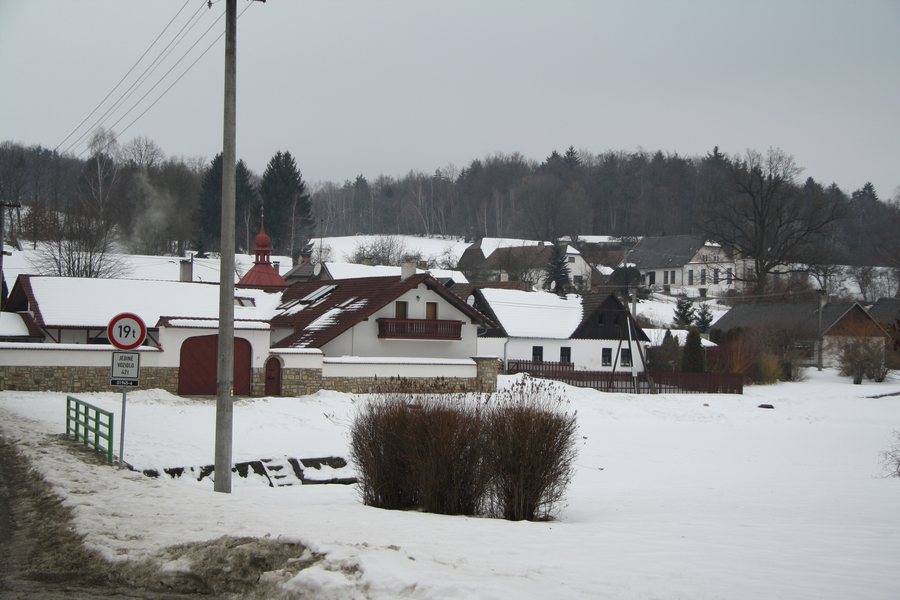 File:Center of Ježená, Jihlava District.jpg
Photo: Jiří Sedláček via Wikimedia Commons, CC BY-SA 4.0
File:Center of Ježená, Jihlava District.jpg
Photo: Jiří Sedláček via Wikimedia Commons, CC BY-SA 4.0
Landscape
The built-up settlement of Ježená lies in the valley of the Maršovský potok. The buildings extend along both banks, while the valley slopes form their natural setting. A protected linden tree stands in the northern part of Ježená. There is a retention basin on the village square.
History
Ježená originated around the end of the 12th century as a forest settlement with a village square on both sides of the Jezina stream. The first written mention dates from 1226; it confirms Ježená as one of the villages owned by Želiv Monastery. The originally Czech village was settled by German colonists in the 13th century during the silver rush.
Buildings
The Hukauf Mill in House No. 4 was the middle of the three former mills in Ježená and has been documented since the 16th century. The former Hukauf Mill has now been converted for residential use.
The Baroque Chapel of St. James has stood on the village square of Ježená since 1775. It is four-sided and has a small bell tower on a pyramidal roof; its present bell dates from 1922.
More local pages: Žatec Na Moravě, Zbinohy, Smrčná, Strachoňovice, Sedlatice, Panské Dubenky, Hrutov, Knínice.
To the higher-level travel overview: Jihlava District.

