
Hidegség: Papkert and Cultural Heritage
Accommodation in Hidegség
Hidegség brings together nature experiences in Papkert and distinctive traces of local history. Springs, small ponds, and a diverse amphibian population characterize the garden; on the hill above the village, the frescoes in St. Andrew’s Church make a striking impression. You can tailor your stay to your interests, choosing between the garden, pilgrimage route, and cultural heritage.
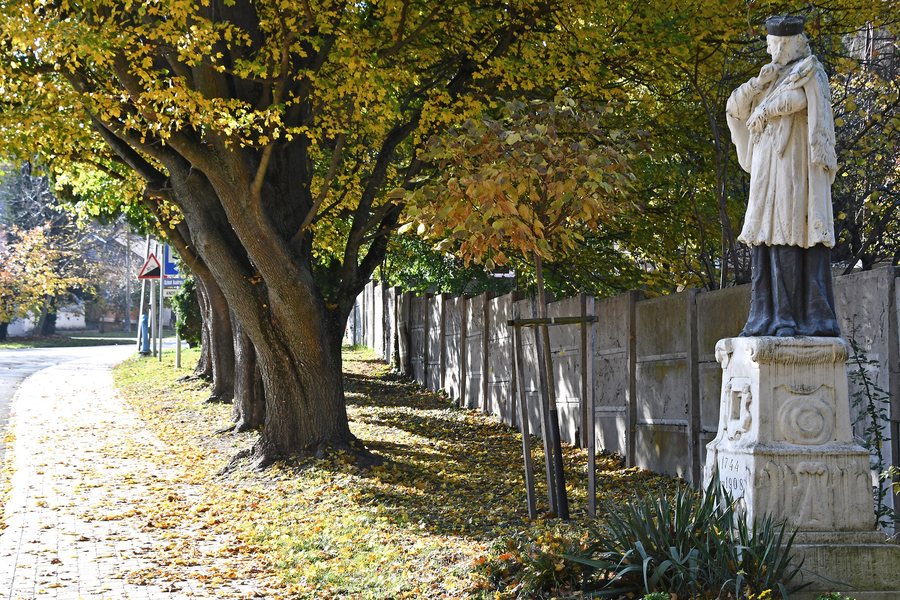 File:Hidegség, Nepomuki Szent János-szobor 2025 01.jpg
Photo: Pasztilla aka Attila Terbócs via Wikimedia Commons, CC BY-SA 4.0
File:Hidegség, Nepomuki Szent János-szobor 2025 01.jpg
Photo: Pasztilla aka Attila Terbócs via Wikimedia Commons, CC BY-SA 4.0
Hidegség at a glance
- Papkert belongs to the Catholic parish and offers paths with botanical information boards.
- The Mária-út is a pilgrimage route through the settlements along the shores of Lake Fertő and passes the Marian Grotto in Papkert.
- The Fertő Shore Cycling Route B10 runs near Papkert.
- The rotunda of St. Andrew’s Church has wall paintings dating from the mid-13th century.
What can you discover in Papkert?
The garden has numerous springs and small ponds, and is also home to a diverse amphibian population. Nature is more than just a backdrop in Papkert: visitors interested in plants and animals can find botanical information boards along the paths and take a walk through the garden. The combination of water features and diverse amphibian life gives your visit a tangible connection to nature.
Papkert also has a Kneipp foot-washing basin. It is fed by fresh spring water and lined with river pebbles. The Marian Grotto is also in the garden: the Mária-út, a pilgrimage route through settlements along the shores of Lake Fertő, passes by it. During a visit, you can combine a walk through Papkert with the cultural significance of the Mária-út.
What cultural traces shape the village?
St. Andrew’s Church stands on a church hill above Hidegség. Its rotunda preserves wall paintings from the mid-13th century, which are of particular significance in the context of 13th-century Hungarian painting. Visitors interested in medieval art will find a tangible connection to the village’s history here.
The bell tower near Hidegség also points to an earlier use of the landscape. It marks the site of a boat landing that stood there in the 18th century, before Lake Fertő was regulated. The tower thus brings a historic change to the lakeshore into view. Together with the church and Marian Grotto, it offers several cultural connections, each of which can be explored on its own.
Papkert is also near the Fertő Shore Cycling Route B10. Those exploring Hidegség by bike can take this proximity into account as a distinct feature of the village.
What else does the wider destination have to offer?
At the level of the wider destination of Győr-Moson-Sopron County, additional landscape features come into view that should not be confused with the characteristics of Hidegség. The Fertő/Neusiedler See Cultural Landscape includes Eurasia’s westernmost steppe lake, as well as wetlands, saline soils, reed beds, and shoreline areas. Lake Neusiedl forms the core of Fertő-Hanság National Park; the Hungarian part of the lake has been protected since 1977. The Fertő-táj Cultural Landscape received UNESCO World Heritage status on December 13, 2001.
Cultural sites and scenic viewpoints also shape the broader region. Pannonhalma Archabbey was founded in 996. The World Heritage property includes, among other things, the monastic complex, the basilica, educational buildings, the Chapel of Our Lady, the Millennium Chapel, and botanical and herb gardens. Fertőd is home to Esterházy Palace, an outstanding work of Hungarian Baroque-Rococo palace architecture.
For nature watching, the wider destination also recommends an electric boat trip on Lake Neusiedl: it explores reed channels and bays on the western shore, where visitors may spot, among others, reed warblers, great egrets, purple herons, and various ducks. Timetables and booking conditions may change, so check them before making plans. Another landscape feature is the Pannonhalmi Tájvédelmi Körzet Landscape Protection Area, covering 8,272 hectares. Its key areas include the Pannonhalma Hills and the calcareous sandy steppes of Kisalföld.
Discover more destinations: Pusztacsalád, Hegykő, Sarród, Sopron, Röjtökmuzsaj, Agyagosszergény, Fertőboz and Fertőszentmiklós.
FAQ
What makes Papkert special?
The garden belongs to the Catholic parish and has springs, small ponds, and a diverse amphibian population. Paths with botanical information boards, the Marian Grotto, and a Kneipp foot-washing basin fed by spring water add to the experience.
Which cycling route runs near Papkert?
The Fertő Shore Cycling Route B10 runs in the immediate vicinity of Papkert.
What does the bell tower near Hidegség commemorate?
It marks the site of a boat landing that stood there in the 18th century, before Lake Fertő was regulated.
Go to the wider travel overview: Sopron–Fertőd.

