
Egerszalók
Accommodation in Egerszalók
White limestone formations, easy walking trails and traces of local history define Egerszalók. The different trail lengths and sights offer practical guidance on which experiences you may want to focus on during your stay.
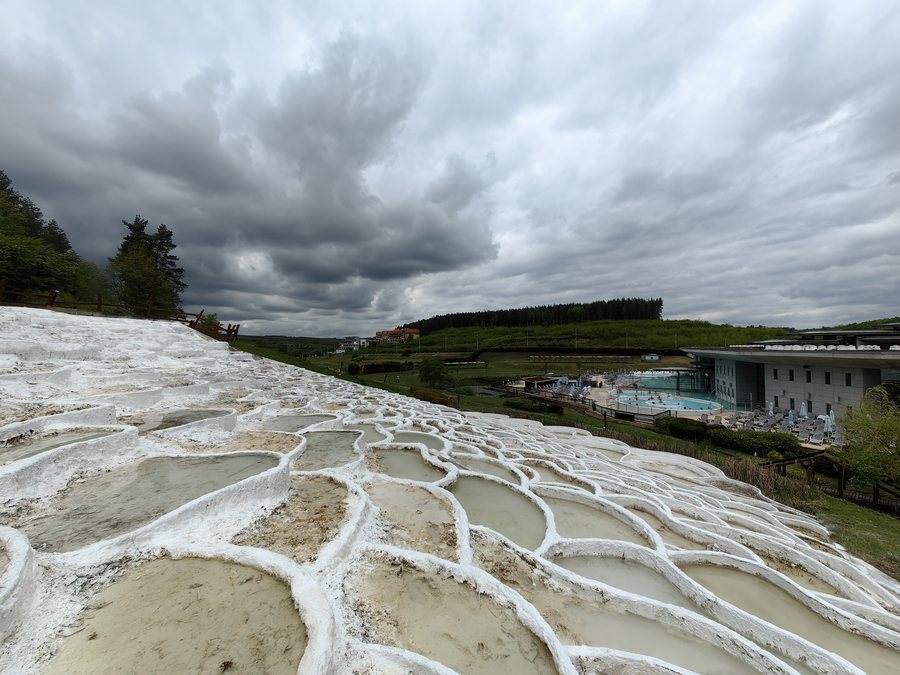
Egerszalók at a glance
- At Sódomb, in the south of the village, the thermal spring and flowing water continue to shape the limestone formations.
- The blue-marked Sódomb walk is about 5 kilometres long and can be done on foot or by bicycle.
- The red-marked Öreghegy walk is about 2.5 kilometres long and is described as a walking route.
- Historic sites include a local history collection in cave dwellings, a Baroque church and a stone bridge.
What makes the landscape at Sódomb special?
Locally protected Sódomb lies in the south of Egerszalók. Its white, jagged limestone formations are not simply a finished geological backdrop: the thermal spring and flowing water continue to shape them. Visitors can therefore see a landscape whose forms are changing through the movement of this water.
A designated walking path leads to Sódomb. It was established after the construction of the spa. The blue-marked walk is about 5 kilometres long, crosses easy terrain and can be completed on foot or by bicycle. These details make the route particularly interesting to travellers who want to plan a longer outing among their activities.
Which trails and natural attractions can you choose from?
The red-marked Öreghegy walk, at about 2.5 kilometres, is described as a shorter alternative. It also crosses easy terrain, but is listed as a walking route. Comparing the two marked walks can help with planning your day: the Sódomb route is longer and can also be done by bicycle, while Öreghegy is the shorter option on foot. Walking times are not provided for either route.
Another destination is the Betyárbújó beehive stone. From Ady E. út, it is about a 150-metre walk to reach it. Signs and trail markers from the recreation park at the Saliris Resort spa point to the Kőbojtár and Kőasszony beehive stones, as well as Menyecske-hegy. These are separate points of reference for excursions; they should not be understood as one shared hiking route.
Egerszalóki-tó is another local landscape attraction. The lake was created by damming the Laskó-patak. Together with Sódomb and the named beehive stones, it offers different nature-related themes to consider when planning your stay.
What local history can you encounter in Egerszalók?
The cave dwellings on Sáfrány utca house a local history collection. It offers a starting point for exploring the village’s history. The Baroque church, still visible today, is also one of its notable historic buildings: it was built in 1738 to designs by the Italian-born master Giovanni Battista Carlone.
Another architectural landmark is the single-arch stone bridge over the Laskó-patak, built in the 19th century. Egerszalók’s religious history also includes the beginnings of its pilgrimages: they started after news spread of the miraculous healing of a blind girl. In Egerszalók, natural formations, architectural history and traditional religious history therefore stand alongside one another as distinct themes.
If you would like to compare Egerszalók with other destinations, you can also explore Feldebrő, Egerszólát, Kerecsend, Szarvaskő, Novaj, Noszvaj, Verpelét and Egerbakta.
FAQ
How long are the described walks?
The blue-marked Sódomb walk is about 5 kilometres long. The red-marked Öreghegy walk covers about 2.5 kilometres.
Can the Sódomb walk be done by bicycle?
Yes. The approximately 5-kilometre blue-marked route is described as suitable for pedestrians and cyclists.
What is housed in the cave dwellings on Sáfrány utca?
They house a local history collection.
Which destinations are signposted from the recreation park at the Saliris Resort spa?
Signs and trail markers point to the Kőbojtár and Kőasszony beehive stones, as well as Menyecske-hegy.
For the broader travel overview: Egri.

