
Discover Schwiebus: History and Culture
Accommodation in Schwiebus
Schwiebus is a destination for anyone interested in urban history and culture. The center retains an almost medieval layout; the town hall, churches, and history of the fortifications offer different insights into the town’s development. A regional museum and the monumental figure of Christ the King add regional natural and religious history to these themes.
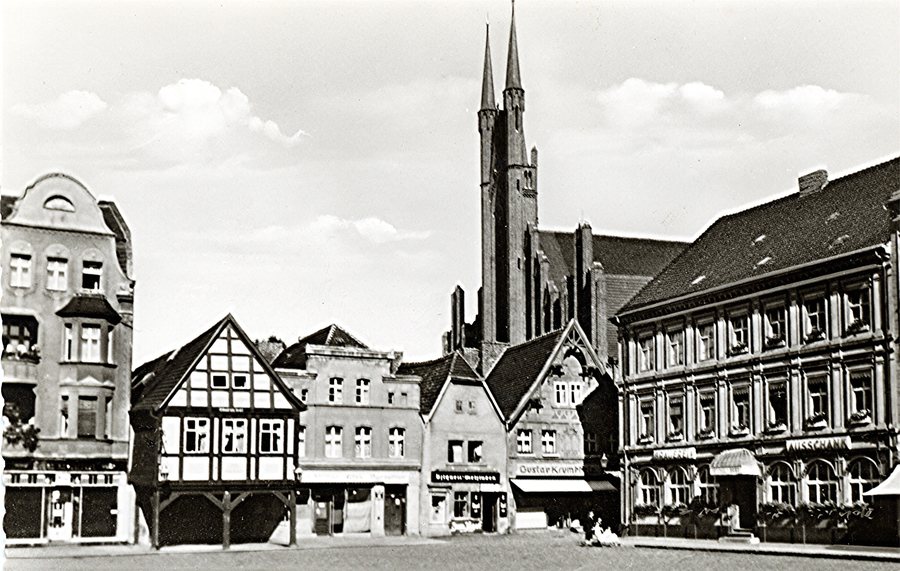 File:Schwiebus Markt und Michaelskirche.jpg
Photo: Werner Laudon via Wikimedia Commons, CC BY-SA 4.0
Schwiebus at a glance
- The historic center has an almost unchanged medieval layout with a rectangular market square.
- The town hall was probably built in the second half of the 14th century; stone barrel vaults from this period are preserved in its cellars.
- The regional museum features permanent exhibitions on town and regional history, as well as the natural environment of the Lubusz region.
What makes the historic town center interesting?
The central rectangular market square and the streets that run perpendicular to it define the town’s preserved layout. This clear arrangement offers a way to understand the town’s history in its physical setting: the market is at the center, while the town hall and churches each bring their own architectural and historical context.
The town hall was probably built in the second half of the 14th century. Stone barrel vaults from this period are preserved in its cellars. A barrel vault is an arched ceiling structure; here, it connects the town hall’s early building history to a specific architectural detail.
The Church of St. Michael the Archangel stands at the northeastern corner of the market square. It was built mostly in the second half of the 15th century as a three-aisled hall church with a pentagonal presbytery. The presbytery is the chancel area. The town hall and church thus represent different periods and forms of construction: the town hall with its vaults, and the church with its clearly described layout.
What traces of the fortifications have been recorded?
The town fortifications began to be built in the 14th century. In the 16th century, Schwiebus was surrounded by a defensive wall with twelve towers and three town gates, as well as a wide moat. This historical description conveys the scale of the fortifications at the time without equating their individual components with the townscape today.
The castle is also part of the history of the fortifications: it was built in the 16th century as part of the town’s defenses and altered through numerous renovations. Two ruined wings of the structure remain. The Church of NMP Królowej Polski tells another story of church construction. Built between 1698 and 1900 in the Neo-Gothic style, it stands on the site of two earlier Protestant churches.
What do the museum and the figure of Christ the King show?
The permanent exhibition “Historia miasta i regionu” at the regional museum explores the multicultural traditions of the Świebodzin area and the town’s connections to the history of the Silesian–Greater Poland borderland. The also-permanent exhibition “Przyroda Ziemi Lubuskiej” focuses on the landscape of the Lubusz region: its forests, lakes, meadows, and peat bogs; its many species of flora and fauna; and designated protected species and areas. Thus, the same museum covers town and borderland history on the one hand, and the natural environment of the wider region on the other.
Another point of interest is the monumental figure of Jesus Christ, King of the Universe. Construction work lasted from 2005 to 2010; the figure was blessed on November 21, 2010. It welcomes pilgrims arriving individually or in organized groups from Poland and various parts of the world. This offers a different emphasis for trip planning than the town hall, urban layout, and museum: Schwiebus combines urban history with a religious role as a place of pilgrimage.
What route offers a guide to the town walls?
The municipal route “Szlakiem murów miejskich” (Along the Town Walls) offers a thematic guide to the town fortifications. It runs via Plac Jana Pawła II, ul. Wałowa, ul. Okrężna, ul. Bramkowa, ul. Szpitalna, Chopin Park, and ul. Kilińskiego. The route connects the history of the fortifications to several named places in the town, offering another way to explore the subject.
In the wider Świebodziński destination area, the historic urban fabric of Świebodzin is considered one of the region’s most valuable urban ensembles. For your trip planning, you can consider this regional context alongside Schwiebus’s specific themes: architecture and urban history, exhibitions about the region, or the religious significance of the figure of Christ the King.
Discover more destinations: Zbąszynek, Rokitnica, Niedźwiedź, Łagów, Kłodnica, Lubrza, Zawisze, Szczaniec.
FAQ
How do the two permanent exhibitions differ?
“Historia miasta i regionu” covers the multicultural traditions of the Świebodzin area and its connections to the Silesian–Greater Poland borderland. “Przyroda Ziemi Lubuskiej” focuses on the nature and landscape of the Lubusz region.
What church architecture can you encounter in Schwiebus?
The Church of St. Michael the Archangel was built mostly in the second half of the 15th century as a three-aisled hall church with a pentagonal presbytery. The Church of NMP Królowej Polski was built between 1698 and 1900 in the Neo-Gothic style on the site of two earlier Protestant churches.
When was the figure of Christ the King built and blessed?
Construction work lasted from 2005 to 2010. The figure was blessed on November 21, 2010.
For the broader travel overview: Świebodziński.

